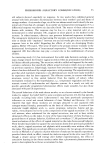
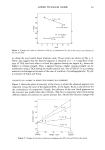
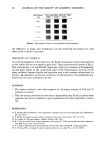
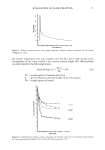
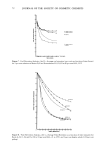
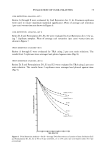
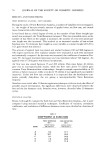
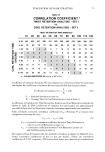
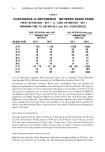
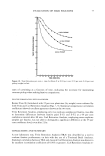
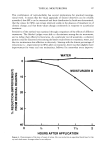
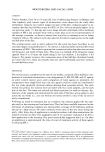
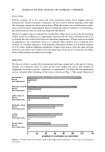
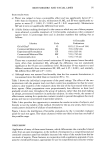
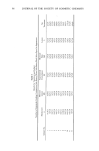
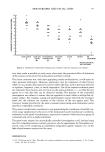
EVALUATION OF HAIR FIXATIVES 77 lOO 0.04% PICKUP 10 20 30 40 50 60 70 80 90 100 110 120 TIME (MINUTES) Figure 10. Twist Retention per cent vs. time for Resin E at 0.04 per cent, 0.19 per cent, 0.43 per cent pickup (weight) on hair rates of untwisting as a function of time, indicating the necessity for maintaining constant pickup when making fixative comparisons. FIXATIVE FORMULATION WITH PLASTICIZER Resins D and E, formulated with 15 per cent plasticizer (by weight) were evaluated by both Twist and Curl Retention Analysis (Figs. 7, 9). Statistical comparisons (correlation coefficient) showed excellent agreement between the two tests. Twist Retention Analysis, employing only two replicate samples per fixative, was able to determine differences between fixative pairs E-E1 and E-E2 at a 99 per cent confidence interval after 80 min. Curl Retention Analysis, employing seven replicate samples per fixative, was not able to distinguish a significant difference at the 95 per cent confidence level, even after 21 hr. CONCLUSIONS AND SUMMARY A new laboratory test, Twist Retention Analysis (TRA) was described as a tool to evaluate fixative performance on hair with the use of a Torsional Braid Analyzer. Statistical correlation between TRA and classical Curl Retention Analysis was shown to be excellent (correlation coefficients of 0.995 or greater). Curl Retention Analysis re-

78 JOURNAL OF THE SOCIETY OF COSMETIC CHEMISTS quired a large sample population (i.e., 7 to 15 replicates) while TRA sample population could be as small as two replicates. It is suggested that sources of error in Curl Retention Analysis are primarily a result of physical handling of curls during test preparation and the use of visual observations to record results. The technique of swatch preparation in the TRA procedure is felt to provide a sample with greater uniformity. Additionally, the TRA method maintains precise control of air flow and an automated output of sample response. Twist Retention method of analysis was shown to give statistical correlation (after 90 to 100 rain) to long-term (5 to 21 hr) Curl Retention testing. Use of this new test significantly decreases the testing time required to evaluate fixative performance on hair. Valid conclusions of fixative differences (to 95 per cent and 99 per cent confidence) were made much faster by Twist Retention Analysis. Twist Retention Analysis was able to distinguish statistical differences between fixa- tives (i.e., Formulations E1 and E2 compared to Resin E) where Curl Retention Analysis could not. It is felt that fixative differences that heretofore might have been overlooked can now be determined. This paper confirms Bogaty's (5) findings that torsional forces are important in the set- ting of hair on the head. The statistical correlation of the new test, which induces solely torsional.stresses to a hair swatch, to the performance of curled hair swatches seems to imply, in fact, that torsional stress is one of the most important factors determining the performance of set hair. Modern day life-styles have required curl holding performance of hair fixatives to func- tion over extended periods of time. More and more consumers are requiring a hair fixative to hold a set with one application or less per day. Until the development of the described test it could take up to 24 hr to evaluate hair fixative performance under humid conditions. With the TRA method, meaningful results can be obtained in less than 2 hr. REFERENCES (1) A. B. Reed,Jr. and I. Bronfein, Curl retention with hair sprays, Drug Cosrot. Ind., 94, 178 (1964). (2) A. L. Micchelli and F. T. Koehler, Polymer properties influencing curl retention at high humidity, J. Soc. Cosmet. Chem., 19, 863-80 (1968). (3) R. Ayer and J. Thompson, Scanning electron microscopy and other new approaches to hair spray evalua- tion, J. Soc. Cosmet. Chem., 23,617-36 (1972). (4) S. Takada, Possibilities of improving the qualities of hair spray, AerosoIRep., 11, 12-25 (1972). (5) H. Bogaty, Torsional properties of hair in relation to permanent waving and setting, J. Soc. Cosmet. Chem., 18, 575-89 (1967). (6) J. Gillham, Torsional braid analyzer. A semi-micro thermomechanical approach to polymer characteriza- tion, Crito Rev. Mac. Sci., 1 (1) 83-172 (1972).
Purchased for the exclusive use of nofirst nolast (unknown)
From: SCC Media Library & Resource Center (library.scconline.org)