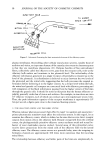
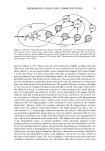
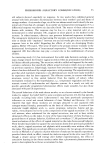
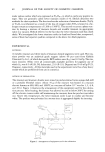
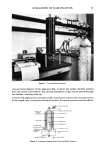
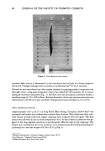
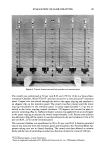
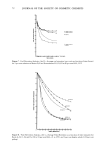
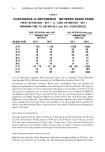
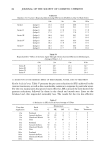
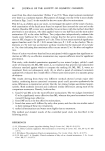
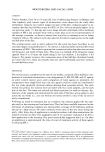
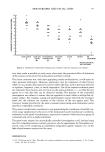
EVALUATION OF HAIR FIXATIVES 69 Figure 4. Twisted, fixative-saturated hair swatches on a retention panel The swatch was conditioned at 50 per cent R.H. and 22øC for 16 hr in a Tenny Envi- ronmental Chamber, Model TH-105, and then secured to a vertical Lucite ©6 retention panel. Copper wire was placed through the hole in the upper ring lug and attached to an alligator clip on the retention panel. The swatch was then rotated until th• lower ring lug was parallel to the retention panel. A clamp (approximately 12.5 g) was at- tached to the lower ring lug, twisted clockwise 720 degrees, and secured in place to prevent untwisfing (Fig. 4). Sufficient fixative solution was applied from an eyedropper at the upper ring lug to saturate the swatch (approximately 2 ml). Excess resin solution was allowed to drip off the swatch. It was then allowed to dry and condition (16 hr at 50 per cent R.H., 22øC) on the retention panel. The torsional chamber was equilibrated at 90 to 93 per cent R.H. A fixative-saturated swatch was removed from the retention panel and mounted in the Torsional Braid Ap- paratus taking care not to disturb bonding. The swatch was then allowed to untwist freely and the rate of untwisfing recorded as a function of time for a total of 120 min. 5Tenny Engineering Inc., Union, New Jersey. 6Lucite is a registered trademark of E.I. DuPont de Nemours & Co., Inc., Wilmington, Delaware.

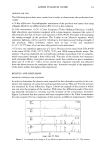
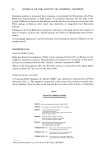
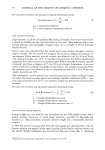
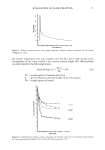
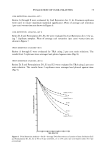
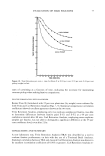
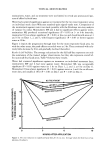
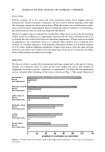
70 JOURNAL OF THE SOCIETY OF COSMETIC CHEMISTS Per cent twist retention was calculated using the following formula: Twist Retention (%) - x 100 (I) Do Do = initial twist (degrees) Dt = twist (degrees) remaining at time (t) CURL RETENTION TESTING Approximately 2 g of 30 cm long Remi Blue String, European, brown hair was tied into a swatch by binding the hair one inch from the root end. After washing with a com- mercial shampoo and thoroughly rinsing, it was cut to a length of 18 cm from the bound root end. Excess water was removed from the swatch and it was combed through to remove snarls or tangles. The wet swatch was wrapped into a helical configuration along a 1.25 cm diameter Teflon mandrel, secured in place, and allowed to dry for 16 hr at 50 per cent relative humidity and 22øC. It was then removed from the Teflon mandrel and suspended from the root end on a retention panel. With a manually activated Camar SS 10 pump 7, and from a distance of 25 cm, 0.6 g of a fixative formulation (2 per cent solids in anhydrous ethanol) was applied to the swatch. The sample was removed from the retention panel and allowed to dry in a horizontal position for 2 hr at 50 per cent relative humidity and 22øC. The conditioned curl was placed on a retention panel and an initial reading of length recorded. The panel was then placed into humidity chamber maintained at 90 -+ 2 per cent relative humidity and 22øC. Curl extention length was determined at various time intervals. Per cent curl retention was calculated using the following formula: L - Lt Curl Retention (%) - x 100 (II) L - L0 L = Length of hair fully extended L0 = Length of hair before exposure Lt = Length of hair after exposure time (t) FIXATIVE PICKUP MEASUREMENTS Pickup (weight per cent fixative) was determined for the TRA sample swatch with a nulled pressure transducer or strain gauge apparatus described by Micchelli and Koehler (2). (This instrument precisely converts weight into a measurable electrical output.) A TRA test swatch was suspended from the strain gauge and approximately 2 ml of a fixative solution was applied at the upper ring lug. Excess fixative solution drained off the swatch. Weight (milligrams) was recorded as a function of time (Fig. 5). Assuming ?Diamond International Corp., Calmar Div., City of Industry, CA 91749.
Purchased for the exclusive use of nofirst nolast (unknown)
From: SCC Media Library & Resource Center (library.scconline.org)