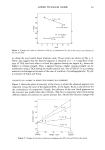
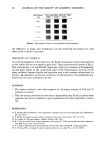
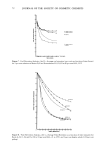
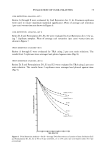
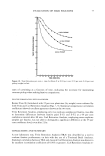
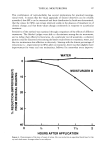
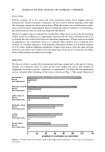
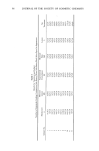
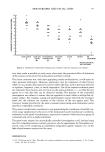
TOPICAL MOISTURIZERS 87 This confirmation of reproducibility has several implications for practical investiga- tional work. It means that the visual appraisals of trained observers can be reliably quantified that SFL's can be measured and their distribution by facial area determined that the values for SFL's can remain relatively stable in the absence of treatment or of climatic change and that these values change consistently in response to a particular treatment. Sensitivity of the method was examined through comparison of the effects of different treatments. The blinded judges were able to discriminate among the six treatments, and to define their effects by facial area. As a particular test of sensitivity, a coherent pattern could be discerned even among the lesser results from no treatment, water, and the two moisturizers less effective in this study. Starting with the lowest percentage of reductions (i.e., improvement) in SFL's after no treatment, there was then slightly more improvement fbr water and one moisturizer, followed by somewhat more improve- 0 •, z 20 z• •o ,"•o = u. 30 WATER 40 I I I I 0 1/2 I 11/2 2 HOURS AFTER APPLICATION Figure 4. Determination of the time of onset of action. Per cent reduction in superficial facial lines for the eye and cheek areas. Average values for ten subjects

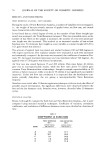
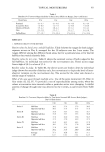
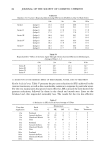
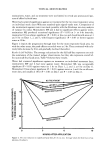
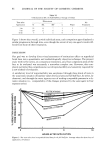
88 JOURNAL OF THE SOCIETY OF COSMETIC CHEMISTS ment from the other moisturizer (Tables V and VI). These improvements moderated over time in a consistent manner. The pattern of change over the 10 hr is most clearly evident in Figs. 2 and 3 in the results for the two more effective moisturizers. This led us, as a follow-up to our study, to investigate the pattern of the onset of action, with examination of the facial areas found to respond best (around the eyes and on the cheeks). Baseline SFL scores were quantified in accordance with the method described previously in ten subjects, who then applied water to one half-face and the most active moisturizer (O) to the other half-face. Two judges than independently evaluated the results every half-hour for 2 hr. Figure 4 shows that for the active treatment, reduc- tions in SFL's began to be apparent at 1 V2 hr. They did not attain statistical significance against baseline until 2 hr (P 0.01 around the eyes, P 0.05 on the cheeks). The re- ductions at 2 hr were not as extensive as those recorded in the main part of our study at 3 hr, thus indicating that maximum effect occurs around 2 to 3 hr after each applica- tion. Onset of action was slower than had been anticipated which suggests that significant re- duction in SFL's by an effective moisturizer may require sufficient time for significant penetration. This study, with detailed quantitative appraisal by two trained judges, yielded a rank order of treatments (O, ML, MF, water, L, no treatment) that provided an independent reference standard against which to compare the ranking (O, ML, MF, L, water, no treatment) from our subsequent study (8), in which a panel of untrained consumers qualitatively evaluated the overall effect of these same moisturizers in a separate group of subjects. The results deriving from these two different methods showed certain major simi- larities, confirming that an untrained consumer panel could perceive qualitatively the same differences in moisturizer activity that the two trained judges ascertained quanti- tatively. Both methods detected and confirmed similar differences among most of the comparison treatments. Namely, both studies: 1. found O and ML to be the more effective moisturizers. The two judges determined O to be significantly more effective than ML, whereas the panel ascertained a trend toward O being more effective 2. found MF and L to be less effective moisturizers 3. found that water and L differed by only a few points, and thus the two studies varied in their ranking of these two treatments 4. ranked all moisturizers and water more highly than no treatment. The method and detailed results of the controlled panel study are described in the following article. REFERENCES (1) H.J. Eiermann, Cosmetic ingredient labeling, Drug & Cosmet. Ind., 118, 42-45 (1976). (2) D. A. Davis, Cosmetic regulation. The honeymoon is over! Drug & Cosmet. Ind., 117, 38-41, 96-100 (1975). (3) I. M. Gibson, The evaluation of hand-care preparations, J. Soc. Cosmet. Chem., 24, 31-41 (1973). (4) E. R. Jolly and C. A. Sloughfy, Clinical evaluation of baby oil as a derreal moisturizer, J. Soc. Cosmet. Chem., 26, 277-34 (1975).
Purchased for the exclusive use of nofirst nolast (unknown)
From: SCC Media Library & Resource Center (library.scconline.org)