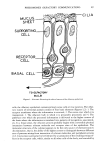
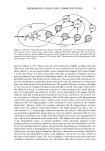
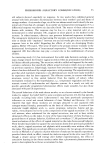
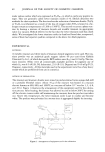
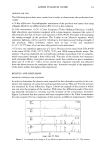
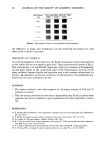
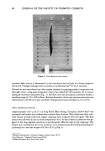
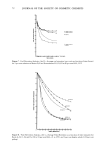
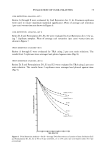
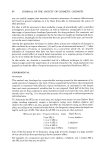
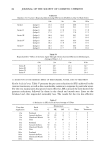
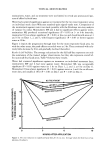
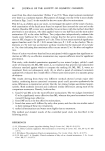
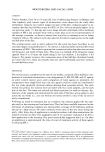
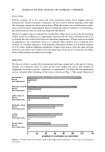
PHEROMONES (OLFACTORY COMMUNICATION) 49 MUCUS SHEET SUPPORTING. CELL CILIA RECEPTOR CELL BASAL CELL TO OLFACTORY BULB Figure 1. Schematic illustrating the salient features of the olfactory epithelium cells, the olfactory epithelium contains primary sense cells or true neurons. The olfa& tory system of terrestrial animals consists of four basic elements (Figures 1,2): 1. The receptor membrane where the information is received 2. The nerve over which it is transported 3. The olfactory bulb in which it is presumbly processed and 4. The pathways over which the processed information is delivered to the higher centers of the brain where the information is translated into patterns of recognition, association •, etc. In a broad sense, the olfactory process probably begins with a reversible physical interaction between odorant molecule and receptor sites of the epithelium. The molecular structure of the odorant appears to be the only source of chemoreceptory discrimination, that is, the ability of the higher centers to distinguish between different sets of patterns arising from interaction of odorant molecules and peripheral systems (22). Interaction is presumed to be followed by a summation of the resulting energy ef- fects in the receptor cells, which, similar to all other cells of the body, are bounded by

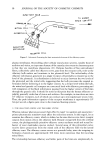
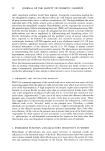
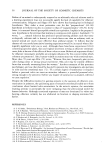
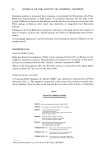
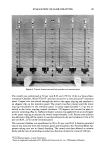
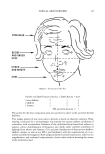
50 JOURNAL OF THE SOCIETY OF COSMETIC CHEMISTS OLFACTORY BULB ---.-------- GRANULAR CEL ! OLFAc TORY TRACT MITRAL CELL GLOMERULU5 OLFACTORY EPITHELIUM TO HIGHER BRAIN CENTERS RECEPTOR CELL Figure 2. Schematic illustrating the basic anatomical elements of the olfactory system plasma membranes. Resembling other cellular transduction systems, notably those of audition and vision, an important feature of the transduction events in chemoreceptors is that they are membrane phenomena (23). Delicate bundles of fine unmyelinated fibers, collectively called the olfactory nerve, pass from the receptor cells, enter at the olfactory bulb surface and terminate in the glomeruli level. The individuality of the olfactory information generated in a single receptor cell probably is retained up to the level of the glomeruli. A redistribution is believed to occur between the two levels of the glomeruli and the mitral cells, suggesting that the bulb processes the original in- formation before delivering it to the higher centers. At a deeper level within the bulb, the mitral and granule cell synapses are concerned both with olfactory processing and with integration of feedback information passing from the higher centers of the brain through the granule cells. It should be noted at this point that the human olfactory ca- pability generally rivals that of vision and audition. For example, in man there are circa 107 olfactory receptors, each of which can conduct up to ten impulses per second (24). Thus, the peak information capacity of the receptor membrane is approximately 108 bits per second, a figure quite close to the visual and hearing systems. 2.2 THE OLFACTORY CORTEX AND THE LIMBIC SYSTEM Whereas releaser pheromones exert their effect by rapid "recognition and association," primer pheromones somehow must affect the endocrine system. In this regard, let us examine the olfactory cortex, which is defined as the sites that receive direct synaptic outputs from mitral cells in the olfactory bulb. Despite overgrowth from the cerebral cortex, the phylogenetically primitive olfactory cortex mediates social and sexual be- havior of most mammalian species studied. Several areas of this primordial cortex receive direct projections from the mitral cells of the olfactory bulb via the lateral olfactory tract. The olfactory cortex serves as a powerful relay, since the outgoing in- formation channels are approximately 100 times more numerous than the incoming mitral fibers. The relationship between olfactory and limbic parts of the brain are simplistically di-
Purchased for the exclusive use of nofirst nolast (unknown)
From: SCC Media Library & Resource Center (library.scconline.org)