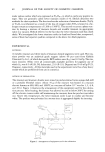
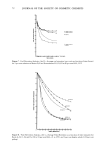
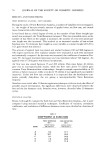
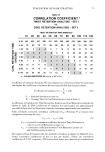
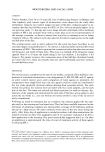
48 JOURNAL OF THE SOCIETY OF COSMETIC CHEMISTS substances releaser pheromones. Because this designation is too restrictive for the considerably more complex mammalian systems, the concept of primer pheromones was introduced. These substances produce endocrine changes, e.g., the release of re- productive hormones into the bloodstream, causing physiological changes in the recipient animal. Striking examples of behavioral effects brought about by this mode of chemical communication may be seen in female mice: 1. Pregnancy block frequently occurs when a recently impregnated mouse is exposed to the odor of a male of a strain different from that of the stud male, while exposure to males of the same strain as the stud male does not prevent implantation [Bruce Effect (5)] 2. A decrease of reproduc- tive capacity of the animal occurs when the odor of other mice increases its corti- costerold production [Ropartz Effect (6)] 3. Estrus is suppressed and pseudo- pregnancies develop when four or more female mice are grouped together in the absence of a male [Lee-Boot Effect (7)] and 4. The estrous cycle is induced and ac- celerated in grouped females by exposure to an odorant present in the urine of male mice [Whitten Effect(8)]. Although pheromones may be classified as olfactory or oral according to their site of reception, the overwhelming majority found in the world of insects and mammals are volatile and airborne compounds that are olfactorily sensed. More than two hundred chemicals have been characterized from insects that mediate overt sexual behavior and modify mating behavior (9). In contrast, relatively few mammalian pheromones have been isolated and identified, although many are known to exist. Pheromones have been identified in those species with specialized scent glands, e.g., Marmoset monkey, Mon- golian gerbil, European rabbit, blacktail deer, and pronghorn antelope (10). A sex at- tractant was reported to be present in the female rhesus monkey (11-16), but a recent study (17,18) did not support this claim. Pheromones in fish may play a role in terri- torial defense, attraction and recognition of the other sex, parents or off-spring, and guidance of fish migrating upstream to their spawning sites. However, the only phero- mones known with certainty are the alarm substance which elicits a fright reaction (19), and substances which induce exploratory feeding behavior (20). The following discussion basically will pursue two approaches in the multifaceted aspects of olfactory communication in primates. First, it will be shown in Section 2 that anatomical and clinical evidence suggests that pheromones could be involved in the mediation of behavior. Second, in Section 3 a brief will be presented for the role of learning and/or prior experience as an alternative to the pheromone concept. 2. OLFACTORY PATHWAYS 2.1 OLFACTORY EPITHELIUM AND OLFACTORY BULB Lucretius wrote (21), "You may readily infer that such substances as agreeably titillate the sense (of smell) are composed of smooth round atoms. Those that seem bitter and harsh are more tightly compacted of hooked particles and accordingly tear their way into our senses and rend our bodies by their inroads." Many and diverse odor theories have since been proposed, crossing a spectrum from reasoned conjecture to implausi- ble speculation. Actually, we have no more than a limited understanding of the mechanism underlying olfaction. It is generally accepted that the olfactory and taste systems in all vertebrates, including man, conform to the same basic plan. In contrast with the cells of the taste mucosa, which are highly specialized cells related to skin

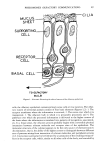
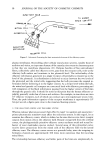
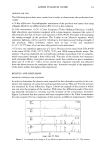
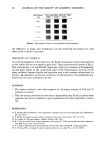
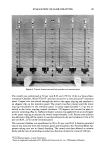
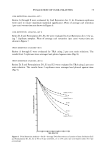
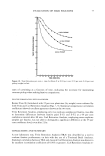
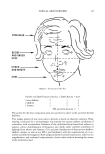
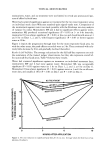
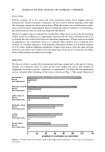
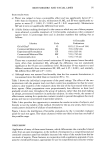
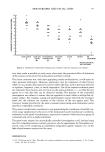
PHEROMONES (OLFACTORY COMMUNICATION) 49 MUCUS SHEET SUPPORTING. CELL CILIA RECEPTOR CELL BASAL CELL TO OLFACTORY BULB Figure 1. Schematic illustrating the salient features of the olfactory epithelium cells, the olfactory epithelium contains primary sense cells or true neurons. The olfa& tory system of terrestrial animals consists of four basic elements (Figures 1,2): 1. The receptor membrane where the information is received 2. The nerve over which it is transported 3. The olfactory bulb in which it is presumbly processed and 4. The pathways over which the processed information is delivered to the higher centers of the brain where the information is translated into patterns of recognition, association •, etc. In a broad sense, the olfactory process probably begins with a reversible physical interaction between odorant molecule and receptor sites of the epithelium. The molecular structure of the odorant appears to be the only source of chemoreceptory discrimination, that is, the ability of the higher centers to distinguish between different sets of patterns arising from interaction of odorant molecules and peripheral systems (22). Interaction is presumed to be followed by a summation of the resulting energy ef- fects in the receptor cells, which, similar to all other cells of the body, are bounded by
Purchased for the exclusive use of nofirst nolast (unknown)
From: SCC Media Library & Resource Center (library.scconline.org)