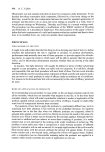
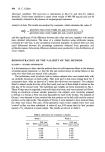
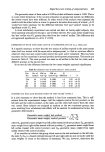
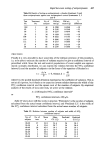
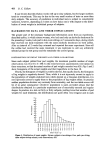
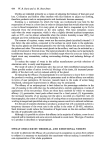
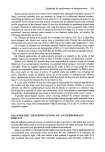
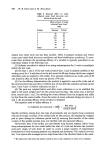
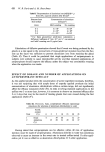
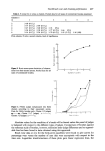
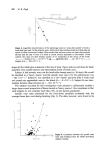
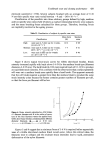
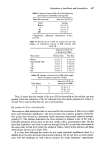
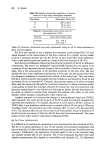
420 W. B. Davis and A. M. Rees-Jones Table II. The penetration of aluminium ions (AI[H•O] 3 + s) from 20•o aqueous solution after 20 min* Distance from skin surface Concentration of aluminium (ions/gm a) (mm) Mild sweating No sweating 0.2 4x 10⁷ 8x 10⁸ 0'6 4x 10 a 4x 10⁸ 2'0 1 x 10 -3 4 x 10⁴ * For these geometrical subdivision calculations a Diffusion Coefficient of 7.66 x 10 -7 cm • s -• was assumed and 'mild' sweating was 15 I.tg/cmymin. Calculations of diffusive penetration showed that if sweat was being produced by the glands at a rate equal to the normal rate of trans-epidermal moisture loss then the flow rate up the ducts was sufficient to prevent aluminium ions from reaching the gland (Table II). Thus it could be predicted that single applications of antiperspirants to subjects were unlikely to cause reproducible activity and that repeated applications of antiperspirant should improve the efficacy unless the subject was consistently sweating when the application was made. EFFECT OF DOSAGE AND NUMBER OF APPLICATIONS ON ANTIPERSPIRANT EFFICACY As the applied product dries the concentration of active ingredient increases, therefore, it was not surprising that with ample doses of expertly applied products the initial concentrations of aluminium chlorhydrate within a certain range, did not significantly affect the efficacy measured (Table III). In tests involving repeated applications to the axillae over 3 or more days, however, it is common to observe an increased efficacy after 2 or 3 days that may be the result of treating glands that were missed during the first application (Table IV). Table Ill. Hot-room, back, antiperspirant efficacies (percentage reductions) for solutions of aluminium chlorhydrate in water A1.Chl. content Trial (%) 0 2 5 10 15 20 25 1 Sweat 4 39 44 32 27 2 reductions 25 29 24 29 30 37 (%) Having stated that antiperspirants can be effective within 40 min of application mention must be made of properspirancy. Aluminium chloride in water was sometimes observed to cause an increase in the sweat rate in treated axillae tested 1 h after appli- cation yet it was as effective as aluminium chlorhydrate 22 h after application.

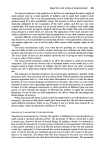
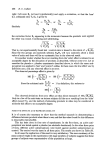
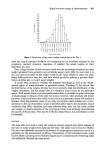
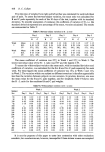
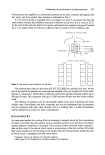
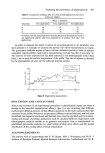
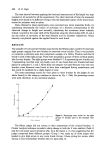
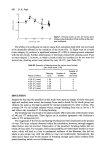
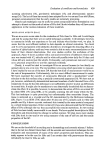
Evaluating the performance of antiperspirants Table IV. Comparison of efficacy after two, four and six applications, hot-room axilla, ten subjects 421 Mean % reduction Treatment Two applications Four applications Six applications X 26 27 35 Y 25 34 37 Z 24 36 39 A student t-test for paired data shows that the efficacies of formulations Y and Z are significantly greater after four applications of product than after two applications. In order to measure the speed of action of an antiperspirant or its durability over short periods it is necessary to decrease the period over which measurements are made. The gravimetric methods require at least a 20 min collection period in order to achieve acceptable reproducibility hygrometry measurements can take less than 2 min (Fig. 9). The extreme of short response time has been achieved in our thermography work which takes 1 sec to map the surface temperature of the axilla. The rate of repeats is dictated by the photographic process not the infra-red detector system. 60 2O 40øC 52% RH flow rate 150 ml/min Test 0 20 50 60 Time (rain) Figure 9. Hygrometric measurements. DISCUSSION AND CONCLUSIONS Almost any variation in an experimental procedure or physiological aspect can cause a change in the recorded antiperspirant efficacy, thus it is not surprising that different methods give different answers, or that efficacy measured on the back is greater than that measured in the axillae. Whenever antiperspirant efficacy is quoted the basic method must be defined, the degree of emotional and thermal stress must be specified and the number, timing and dosage of product application must be specified. Both the hygrometric and thermographic methods enable us to generate information that is unobtainable by established gravimetric methods, i.e. observations of short term effects and the spatial distribution of the cooling effect of sweat evaporation. ACKNOWLEDGMENTS The authors wish to acknowledge Mrs P.M. Baxter, Miss J. Winchester and Dr R. J. Jackson of Beecham Products Applied Research Laboratories, Leatherhead and Dr R.
Purchased for the exclusive use of nofirst nolast (unknown)
From: SCC Media Library & Resource Center (library.scconline.org)