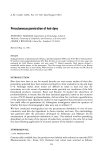
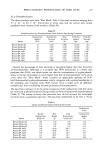
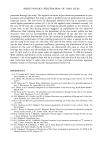
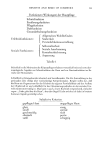
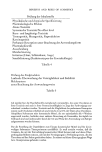
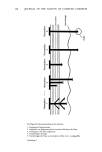
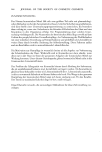
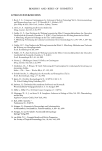
PERCUTANEOUS PENETRATION OF HAIR DYES 227 B. p- Phenylenediamine The three monkeys dyed with "Blue Black" Nice'n Easy had excretions ranging from 3.5 X 10 -2 tO 8.6 X 10 -2 microcuries in seven days and the human data closely paralleled those obtained with monkeys (Table IV). Table IV Scalp Penetration of p-Phenylenediamine Under Practical Hair Dyeing Conditions. Species Radioactivity Radioactivity Dose Total Dye Total Dye Applied Excreted Excretion Applied Excreted (•Ci) (•Ci) (%) (•g) (•g) Rhesus Monkey #3 42 0.035 0.083 67,950 56.4 Rhesus Monkey if4 42 0.059 0.140 67,950 95.1 Rhesus Monkey #5 42 0.081 0.190 67,950 129.1 Human (#4, male) 701 0.87 0.124 1,564,520 1,940 Human (#5, male) 787 1.55 0.196 1,584,690 3,106 Human (3{6, male) 564 1.17 0.207 1,565,700 3,241 Human (if7, male) 559 0.402 0.072 1,558,330 1,122 Human (#8, male) 577 0.690 0.119 1,563,020 1,860 Overall, the percentage of dose excretion is somewhat higher than that found for 2,4-diaminoanisole. Although it is possible that PPD intrinsically is a better skin penetrant than DAA, one should point out that the concentration of p-phenylenedi- amine in the dye formulation is much higher than that of diaminoanisole (2.7% versus 1.7%). Also, the "Blue Black" shade contains an appreciable quantity of N,N- bis(2-hydroxyethyl)-p-phenylenediamine which competes with p-phenylenediamine in the oxidizing and coupling steps. Both factors favor a larger pool of diffusion- available dye, thus contributing to more pronounced skin penetration. The dyed hair continues to be the prime receptacle of the radioactivity with the values for recovered p-phenylenediamine being similar to those obtained with diaminoanisole (Table V). The urinary recovery data presented here do not account for incomplete excretion from a parenteral injection. This has been determined to be 72% + 7% for Table V Uptake of p-Phenylenediamine-Derived Dye by Hair. Species Radioactivity in hair Specific Hair Total Radioactivity Radioactivity Weight Radioactivity applied /xCi/g hair (g) in hair (•Ci) (%) Rhesus Monkey #3 2.86 1.90 5.45 12.9 Rhesus Monkey #4 2.92 1.99 5.80 13.8 Rhesus Monkey #5 3.20 1.91 6.12 14.5 Human (#4, male) 2.50 42.20 105.5 15.2 Human (#5, male) 2.74 60.98 167.1 21.2 Human (3{6, male) 2.82 53.01 149.5 26.5 Human (#7, male) 2.21 36.97 81.7 14.1 Human (#8, male) 1.61 89.0 143.3 24.8

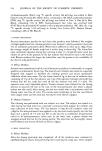
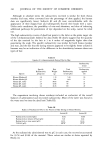
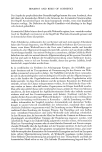
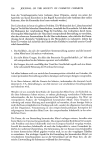
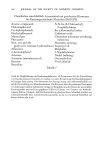
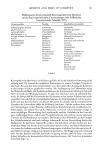
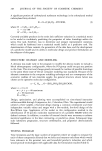
228 JOURNAL OF THE SOCIETY OF COSMETIC CHEMISTS PPD in man (10) and 61% for DAAin guinea pigs (11). These corrections would raise, somewhat, the excretional values reported. 2. SEMI-PERMANENT COLOR--HC BLUE //1 The radioactivity excretion data listed in Table VI indicate that the absorbtion values are of the same order of magnitude as those observed with p-phenylenediamine. This is in spite of substantial differences in the nature of the dye base, in the chemical structure of the dyes, and in the reaction pathways responsible for the color formation. Table VI Scalp Penetration of HC Blue #1 Under Practical Hair Dyeing Conditions. Species Radioactivity Radioactivity Dose Total Dye Total Dye Applied Excreted Excretion Applied Excreted (tzCi) (tzCi) (%) (tzg) (tzg) Rhesus Monkey if6 24 0.036 0.150 74,000 111.0 Rhesus Monkey #7 24 0.022 0.092 74,000 68.1 Rhesus Monkey #8 24 0.029 0.120 74,000 88.8 Human (frO, Male) 336 0.137 0.041 1,268,000 520 Human (#10, Male) 366 0.578 0.166 1,217,470 2,021 Human (#11, Male) 356 0.201 0.056 1,278,570 716 Similarity in the skin absorption pattern between permanent and semi-permanent dyes does not extend, however, to the deposition of these dyes in hair. With HC Blue #1, at least, the color yield in hair is much less than that obtained with either diaminoanisole or p-phenylenediamine (Table VII). Table VII Uptake of HC Blue #1 by Hair. Species Radioactivity in hair Specific Hair Total Radioactivity Radioactivity Weight Radioactivity applied /•Ci/g hair (g) in hair (vCi) (%) Human (frO, male) 0.56 32.02 17.92 5.3 Human (#10, male) 0.62 34.54 21.42 5.8 Human (#11, male) 0.63 37.40 23.56 6.6 DISCUSSION Two major points emerge from the results of our investigation. First, there is a striking equivalence in cutaneous absorption between Rhesus monkey and man. This parallels earlier findings by Wester, et al. (9) who noted a similar pattern with absorbtion of benzoic acid, testosterone and hydrocortisone. Secondly, less than 0.2% of applied dyes
Purchased for the exclusive use of nofirst nolast (unknown)
From: SCC Media Library & Resource Center (library.scconline.org)