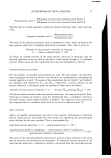
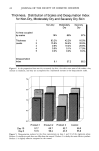
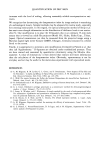
ANTIPERSPIRANT DATA ANALYSIS 15 Posttreatment ratio = Milligrams of sweat after treatment from Axilla Y Milligrams of sweat after treatment from Axilla X The data that is actually analyzed is called the adjusted treatment ratio, and is calculat- ed by Adjusted treatment ratio = Posttreatment ratio Pretreatment ratio The mean of the adjusted treatment ratios is employed to find a point estimate of the mean percent reduction in sweating achieved by consumers. This value is given by Estimate of mean percent reduction in sweating = (1 - mean of adjusted ratio) x 100. To obtain an interval estimate of the mean percent reduction in sweating, first the adjusted treatment ratios are used to calculate a small sample (Student's t) confidence interval. These values are then subtracted from one and multiplied by 100 (4). WOODING-FINKELSTEIN METHOD For this analysis, no baseline measurements are used. For each subject, the posttreat- ment milligrams of sweat for Axilla Y and Axilla X are transformed by calculating the natural logarithm of each. The means of the transformed data for Axilla Y and Axilla X are calculated and denoted by Ylog and X•og, respectively. A point estimate of the percent reduction is calculated using the antilogs of these values as follows' -- -- Estimate of mean percent reduction = [1 - Antilog (Y•og)/Antilog (X•og)] x 100. To find an interval estimate of the mean percent reduction, two steps are required. First, following an analysis of variance using the transformed data, a confidence interval is calculated using a small sample (Student's t) method. The endpoints of this interval are then exponentiated to transform them back to the percent reduction scale (5). DIRECT METHOD Again, no baseline measurements are used in this analysis. Posttreatment individual percent reductions are determined for each subject by employing the posttreatment ratios (defined for the ratio method). This is accomplished by Individual percent reductions = (1 - posttreatment ratio) x 100 = (posttreatment Axilla X milligrams) - (posttreatment Axilla Y milligrams) x 100. (posttreatment Axilla X milligrams) The mean of the individual percent reductions is used as a point estimate of the mean percent reduction in sweating for all consumers. To obtain an interval estimate of the mean percent reduction, a confidence interval is calculated from the individual percent

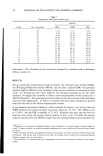
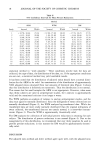
16 JOURNAL OF THE SOCIETY OF COSMETIC CHEMISTS Table I Estimates of Mean Percent Reductions Method Study No. of panelists ARM WFM DM 1 29 - 1.16 3.21 -3.67 2 30 9.65 14.59 8.81 3 30 19.49 20.60 18.04 4 30 19.98 19.54 15.95 5 10 22.72 21.72 19.16 6 30 22.77 21.77 18.34 7 52 27.68 29.65 26.64 8 29 32.96 35.51 32.24 9 30 41.96 48.70 44.30 10 30 42.05 42.93 38.92 11 30 43.56 45.72 42.65 12 33 45.28 47.13 43.99 13 32 50.30 55.42 53.31 14 15 56.55 58.10 54.17 15 15 59.92 65.96 62.49 ß 1 reducuons . The calculation of this interval is obtained by a method used in deodorant efficacy studies (6). RESULTS For any particular antiperspirant study of interest, the adjusted ratio method (ARM), the Wooding-Finkelstein method (WFM), and the direct method (DM) will generally produce slightly different point estimates of the percent reduction in sweating for that study. To demonstrate how much different the estimates typically are for the three methods, we applied the methods to fifteen recent antiperspirant studies conducted at Hill Top Research 2. The posttreatment data analyzed were the one-hour collection taken after the third application 3. In Table I we present the three point estimates of percent reduction for each of the fifteen antiperspirant studies. If you examine the results of Study 8, which included 29 subjects, you will see that the WFM produced the largest estimate of percent reduction, 35.51%. The ARM is next at 32.96%, and the DM is smallest at 32.24%. Although this exact pattern does not exist for every study, the overall trend is similar. In fact, in all 15 studies the percent reduction produced by the WFM is larger than the corresponding estimate produced by t Depending on the number of subjects sampled, either a Student's t or a large sample Z interval might be found. To assure validity, we would recommend sampling over thirty subjects and using the large sample procedure. 2 When selecting the fifteen antiperspirant studies to be analyzed, we made sure they covered a wide range of efficacies. This was the only criterion used to select the studies, and no studies were eliminated because of lack of support for our conclusions. 3 This collection is accepted as one that is appropriate to use when estimating the efficacy of an antiper- spirant.
Purchased for the exclusive use of nofirst nolast (unknown)
From: SCC Media Library & Resource Center (library.scconline.org)