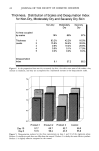
ANTIPERSPIRANT DATA ANALYSIS method tending to have slightly higher estimates than the direct method. The Wood- ing-Finkelstein method always produces higher estimates of percent reduction than the direct method and almost always produces higher estimates than the adjusted ratio method. These statements are supported by empirical results as well as theoretical considerations. Since the direct method produces statistically unbiased estimates, while the other two methods do not, the direct method is preferred. Also, there is little in the way of increased precision (width of confidence intervals) to recommend one of the three methods over the other two. Other methods of analysis such as analysis of covariance, analysis of log-transformed adjusted ratios, and non-parametric methods have also been used by experimenters to analyze antiperspirant data. Since the first two of these methods use transformed data, they will provide biased estimators, as the Wooding-Finkelstein method does. Although a non-parametric technique might be valid, it is well known that non-parametric methods are less powerful than parametric methods. Thus the direct method would be preferred. Finally, we want to emphasize that the results of this paper are in reference to experi- ments in which the objective is to estimate the percent reduction of an antiperspirant. For studies with other objectives, such as testing which of two or more antiperspirants has the greater (or greatest) efficacy, it is as yet to be determined what, if any, statistical analysis is most appropriate. ACKNOWLEDGMENTS The authors gratefully acknowledge Cindy Yablok and Sally Burkhard for their assis- tance in the preparation of this manuscript. REFERENCES (1) W. G. Fredall and R. R. Read, Antiperspirant-axillary method of determining effectiveness, Proc, Sci. Sect., Toilet Goo& Assoc., 15, 23-27 (1951). (2) W. M. Wooding et al., Statistical evaluation of quantitative anriperspiranr data. I., J. Soc. Cosmet. Chem., 15, 579-592 (1964). (3) F. B. Carabello, Guidelines for the clinical study of antiperspirant and deodorant efficacy, Cosmet. Toilerr., 95, 33 (1980). (4) P. A. Majors and John E. Wild, The evaluation of anriperspirant efficacy--Influence of certain variables, J. Soc. Cosmet. Chem., 25, 139-152 (1974). (5) W. M. Wooding and P. Finklestein, A critical comparison of two procedures for antiperspirant evaluation, J. Soc. Cosmet. Chem., 26, 255-275 (1974). (6) ASTM Committee E-18, "Standard Practice for the Sensory Evaluation of Axillary Deodorancy," in Annual Book of ASTM Standards, Vol. 15.07 (1988).

j. Soc. Cosmet. Chem., 44, 23-34 (January/February 1993) Evaporation from a complex emulsion system BRUNO R. C. LANGLOIS and STIG E. FRIBERG, Center for Advanced Materials Processing, Department of Chemistry, Clarkson University, Potsdam, NY 1699-5814. Received September 30, 1992. Synopsis The phase equilibria were analyzed in a typical skin lotion system of water, decane, triethanolamine, and isostearic acid, and the evaporation rate was determined. The system showed two isotropic solutions, one of decane/isostearic acid, and a water/triethanolamine combination. In addition, a large region of lamellar liquid crystal phase was found plus a small region of liquid crystal that consisted of close-packed cylinders. Evaporation of water and decane initially led to a transfer of triethanolamine from the aqueous solution to the decane/isostearic acid solution. With sufficient depletion of water and decane, a three-phase region was entered with the third phase, the lameIlar liquid crystal. INTRODUCTION Cosmetic emulsions (1) are of significant interest because of their stringent stability requirements, combined with a pleasing appearance as well as appealing feel upon application. The phase changes that occur during evaporation of volatile components are important because they influence the evaporation rate per se (2-4). In addition, the structure remaining on the skin after evaporation has ceased is of equal importance. This structure may be an oil phase, in which case excellent occlusivity may be found (5), or a liquid crystal with its interesting structural interactions with the stratum comeurn lipids (3,6). We have earlier (7) analyzed the conditions when an emulsion is applied to a surface with a hydrophobicity similar to that of human skin. That analysis was concerned with phase changes and inversion of the emulsion as well as with its flocculation and coalescence. In the current article we present an analysis of the phase equilibria related to the evaporation of water and decane from the system. The changes in the equilibria show a more complex behavior than expected. EXPERIMENTAL CHEMICALS The decane 99.7% (Fisher Scientific), the triethanolamine 99.9%, (Fisher Scientific), 23
Purchased for the exclusive use of nofirst nolast (unknown)
From: SCC Media Library & Resource Center (library.scconline.org)