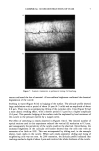
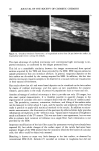
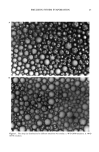
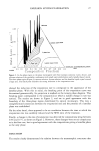
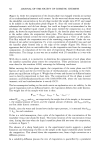
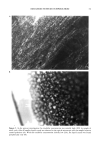
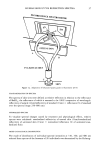
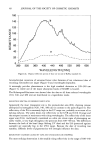
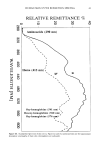
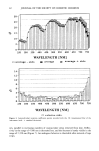
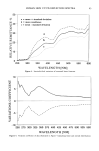
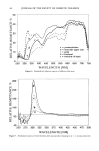
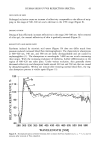
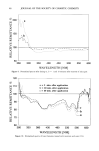
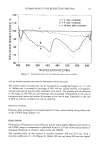
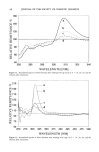
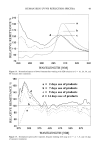
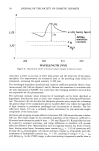
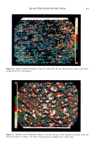
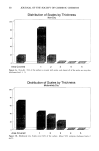
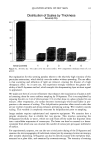
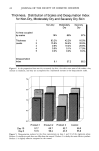
36 JOURNAL OF THE SOCIETY OF COSMETIC CHEMISTS Traditionally the reflection of monochromatic light is recorded using an integrating sphere connected to a photometer (4-6). Such an instrumental array does not allow discrimination of reflection from fluorescence: when using a UV-photometer the re- flected light after interaction with skin is no longer limited to a controlled wavelength. Fluorescence contributes considerably to the recorded signal when skin is irradiated with UV (1) because the epidermis contains a series of UV-absorbing fluorescent molecules: aromatic aminoacids, NADH, flavines, porphyrines, possibly Maillard products, and lipofuscin (7). To record only reflection and eliminate fluorescence of different wave- lengths, a commercial fluorimeter with monochromators in the excitation as well as in the emission pathway has been used and operated in the so-called synchronous mode, i.e., both monochromators are moved synchronously through the whole spectrum with a wavelength difference of zero. To measure optical data at arbitrarily chosen skin sites, light guides transporting light from the instrument to the skin, and after interaction with the skin back to the instrument for further analysis, are preferentially chosen. The moisture content of the excised horny layer is steadily related to the relative humidity of the environment (8). A frequently used technique uses electrical capacitance to measure relative water content of the skin (9). We found that application of dry silica gel under occlusive dressing decreases electrical capacitance measured with an appro- priate instrument (Corneometer, Courage-Khasake, Cologne, Germany) and therefore probably skin moisture content (t0). This technique to reduce skin moisture content was used to get optical data on dry skin. Contact of skin with water elutes amino acids, urocanic acid, lactic acid, etc., from the horny layer (11). UV-spectrometric measurements of such aqueous extracts show ab- sorption maxima around 260-280nm. Quantification and identification of the main components as urocanic acid and tyrosine can be achieved by HPLC (t0). EXPERIMENTAL DETAILS INSTRUMENTS To measure reflection spectra a fluorimeter (LS 50, Perkin-Elmer) was operated in synchronous mode with a wavelength (h.) difference between excitation and emission monochromator (Ah. = 0 nm). To avoid overloading of the photomultiplier, filters were introduced into the excitation pathway: attenuator t %. Both arms of a bifurcated quartz guide (UV-type, Schott, Mainz, Germany) were installed into the fiber-optic holder (Figure ta). The end, C, of the fiber-optic should contain the individual fibers coming from branches A and B in a statistical or optimally evenly distributed manner to avoid as far as possible specular reflection (Figure lb). C is surrounded by a transparent and stiff disc of plastic (radius: 3 cm). Transparency is necessary to precisely select skin areas a disc should minimize changes of dermal blood volume caused by pressure. REFLECTION STANDARDS Commercially available standards of BaSO 4 and Teflon were used.

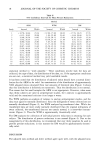
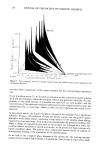
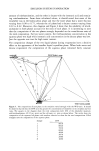
HUMAN SKIN UV/VIS REFLECTION SPECTRA 37 FLUORESCENCE SPECTROMETER A FITTING BOX UV-LIGHT-GUIDES SKIN Figure la. Adaptation of bifurcated quartz guide to fluorimeter LS 50. STANDARDIZATION OF SPECTRA The spectra of skin sites were defined as relative reflection in relation to the reflectance of BaSO4, the reflectance of which is assumed to be 100% irrespective of wavelength: reflectivity of sample (1/nm)/reflectivity of standard (1/nm) = reflectance (% of standard over the spectral range 250-800 nm). NORMALIZED SPECTRA To visualize spectral changes caused by treatment and physiological effects, relative spectra were calculated: standardized reflectivity of treated skin (1/nm)/standardized reflectivity of untreated skin (1/nm) = normalized reflectance (% of untreated stan- dardized skin). MODE OF STATISTICAL DISTRIBUTION The mode of distribution of individual spectral intensities at 310, 340, and 480 nm selected from spectra of the forearms of 20 individuals was determined by the Kolmog-
Purchased for the exclusive use of nofirst nolast (unknown)
From: SCC Media Library & Resource Center (library.scconline.org)