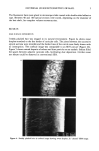
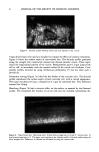
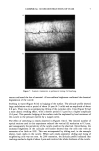
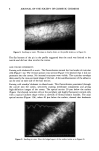
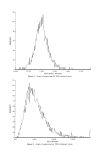
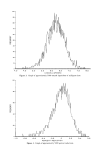
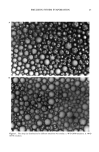
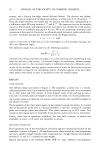
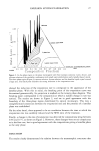
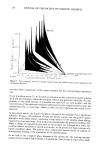
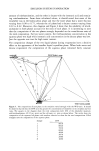
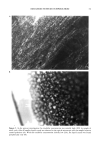
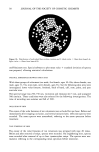
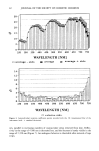
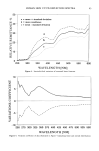
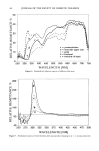
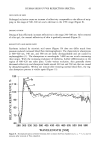
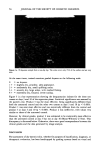
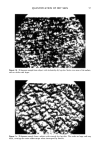
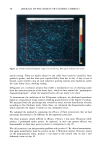
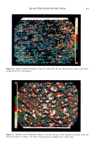
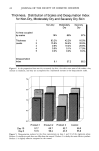
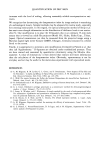
24 JOURNAL OF THE SOCIETY OF COSMETIC CHEMISTS the isostearic acid (Sigma), and a mixture of approximately 30% normal and methyl branched isomers and their homologs were used as obtained without further purifica- tion. The water was doubly distilled. EMULSION PREPARATION FOR EVAPORATION A mixture of isostearic acid/triethanolamine (65/35 weight ratio) was used as an emul- sifier. The emulsions were prepared by a method previously described (7), with different W/O ratios and 10% emulsifier counted on total weight. After emulsification on a vortex mixer, the droplet size distribution was checked by microscopy and found similar for the different W/O ratios (Figure 1). EVAPORATION STUDIES Previously we have noted (7) that the essential factor for the evaporation is the area exposed to the atmosphere. The monitoring of the area was made possible by use of a watch glass to avoid interruption of the film during evaporation, and the atmosphere was controlled by a constant air flow to ensure identical convection. The relative humidity was ambient and varied between 24.0% and 27.0%. This small variation had no influence on our results. The exposed area of the emulsion was slowly decreased by evaporation. To obtain the rate of evaporation per unit area, the slope of the weight loss as a function of time is divided by the exposed area. The areas measured during evaporation were divided by the largest initial area obtained for the emulsion system of different W/O ratios, giving an evaporation rate per arbitrary unit area. All the initial areas were nearly identical, since we started with similar quantities of material. Since water and decane, which are the only volatile components of our systems at room temperature, have similar vapor pressure, it is possible to follow the evaporation rate versus the composition of each emulsion with different W/O ratios. Finally, for some experiments, the evaporation was followed gravimetrically, while changes in phase structure that occurred during evaporation were observed under a microscope with the sample between crossed polarizers. PHASE DIAGRAM DETERMINATION The phases in the ternary phase diagram for the decane/water/(isostearic acid/ triethanolamine, wt. ratio 65/35) were determined. The liquid crystalline phase, the isotropic phase, and the three-phase area boundaries were identified by optical micros- copy. The boundaries of the lameliar phase were also obtained by small-angle X-ray diffrac- tion. The mixture was drawn into fine glass capillaries of 0.7-mm diameter, sealed at both ends, and placed into a brass sample holder with a 2-mm diameter opening. The X-ray radiation was K= copper filtered by a nickel foil to give a wavelength of 0. 1542 nm at 40,000 V and 18.10 -3 A. The X-Ray equipment (Siemens Crystalloflex 4) consisted of a sensitive detector system (Tennelec PSD 100), a flow proportional

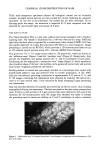
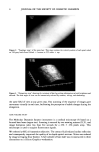
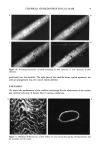
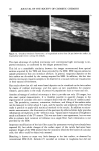
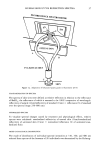
EMULSION SYSTEM EVAPORATION 25 Figure 1. The drop size distribution for different emulsions was similar. a. W/O 20/80 emulsion. b. W/O 60/40 emulsion.
Purchased for the exclusive use of nofirst nolast (unknown)
From: SCC Media Library & Resource Center (library.scconline.org)