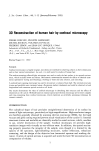
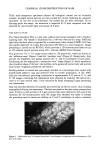
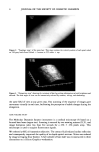
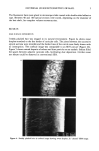
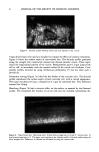
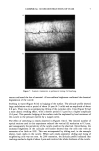
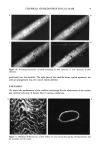
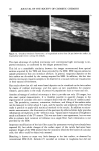
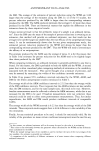
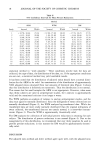
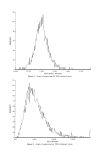
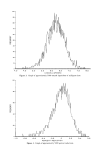
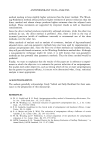
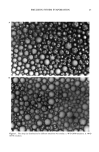
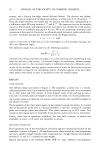
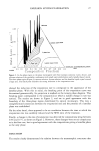
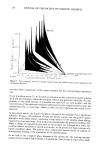
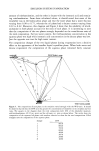
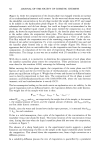
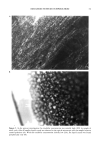
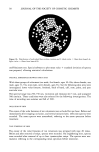
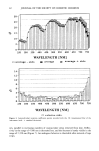
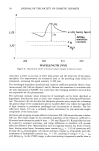
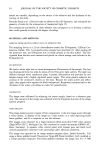
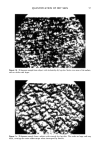
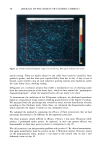
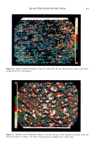
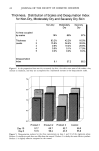
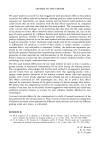
EMULSION SYSTEM EVAPORATION 25 Figure 1. The drop size distribution for different emulsions was similar. a. W/O 20/80 emulsion. b. W/O 60/40 emulsion.

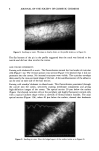
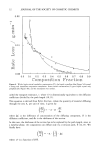
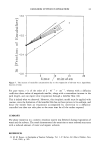
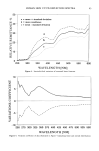
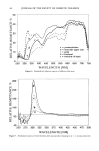
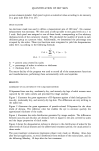
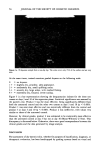
26 JOURNAL OF THE SOCIETY OF COSMETIC CHEMISTS counter, and a Kiessig low-angle camera (Richard Seifert). The detector was flushed with a mixture of oxygen-free nitrogen and methane, at a flow rate of 15-20 ml/min- • The path length between the sample and the detector was 500 mm, corresponding to a diffraction angle 20 lying between 5.7 ø and 0.7 ø. The exposure time for the samples was set to 600 seconds, and alignment of the instrument was checked by a lead stearate standard with an interlayer spacing of 4.82 nm. With our measuring instrument and conversion of the signal to the plotter, we obtained paired symmetric peaks on both sides of center. Interlayer spacing was determined using the Bragg equation: n' ?• = 2 ß d' sin0 where n is the order of diffraction, ?• is the wavelength, d is the interlayer spacing, and 20 is the diffraction angle. The diffraction angle was calculated by the following equation: D.S tan(20) - 2(/ + x) where D is the distance between the peaks, S is a correction factor for transferring X-rays from the detector to the plotter, 1 is the path length, in millimeters, between sample and detector, and x is the calculated length in millimeters from the calibration curve. A plot of the interlayer spacing against volume ratio of water for fixed ratios of decane and emulsifier is linear for the monophasic system. A plateau appears in the plot where other phases were found to exist in equilibrium with the lamellar phase. RESULTS PHASE DIAGRAM The different phases are shown in Figure 2. The emulsifier, a molar ratio 1:1 trietha- nolamine/isostearic acid, has a lameliar liquid crystalline structure and can accommodate up to 45% water and 22% decane. A more detailed study of the packing in such a structure is currently under investigation and will be the subject of a future publication. An isotropic phase was observed, for decane content between 42% and 80% (weight) in the absence of water. The boundaries of the three-phase region in the complete system are shown. It is noted that for the specific molar ratio 2:1 decane/emulsifier, a "gel-like" mixture of a lameliar phase and isotropic phase was observed. This phase contains up to 65% water. The sample in this region gave no detectable X-ray pattern and its structure is not known. Finally, there was no significant solubility, less than half a percent, of decane and emulsifier in water, or of water and emulsifier in decane. EMULSION EVAPORATION The evaporation rate of the water/decane emulsions against composition fraction of the emulsifier is shown in Figure 3. All emulsions can be characterized by a fast evaporation rate and a sudden change towards a slow evaporation for a weight fraction of emulsifier between 0.11 and 0.15 counted on total weight. Optical microscopy of the emulsion 60/40, O/W wt. ratio, between cross-polarizers
Purchased for the exclusive use of nofirst nolast (unknown)
From: SCC Media Library & Resource Center (library.scconline.org)