290 JOURNAL OF THE SOCIETY OF COSMETIC CHEMISTS (3) (4) (5) (6) (7) (8) (9) (10) (11) (12) (13) (14) (15) (16) (17) 4319879 (1982) Improvement of wool fibers by removing exocuticle in the presence of metallic ions, Proc. 7th Inter. Wool Text. Res. Conf. Tokyo, 4, 322-331 (1985). F. Taki, M. Kurokawa, Y. Nakamura, and T. Kondo, Descaling of wool fibers by the treatments with various alcoholic solutions of potassium hydroxide, Sen'i Gakkaishi, 31, T448-T451 (1975). F. Taki, Structure and sorption behavior of water vapor and dye of descaled wool fibers. Sen'i Gakkaishi, 33, T336-T341 (1977). H. Ando, Y. Nakamura, and H. Inagaki, Separation and characterization of keratine components of merino wool. III: Removal of the cuticle by ultrasinic irradiation, Sen'i Gakkaishi, 31, T81-T85 (1975). F. J. Wortmann, R. Greven, and H. Zahn, A method for isolating the cortex of keratin fibers, Textile Res. J., 52, 479 (1982). L. Wolfram, and M. Lindemann, Some observations on the hair cuticle, J. Soc. Cosmet. Chem., 22, 839-850 (1971). J. A. Swift, Chemistry of Natural Protein Fibers, R. S. Asquith, Ed. (Plenum Press, New York, 1977), p. 81. J. A. Swift, and B. Bews, The chemistry of human hair cuticle I: A new method for the physical isolation of cuticle, J. Soc. Cosmet. Chem., 25, 13-22 (1974). A. W. Holmes, Degradation of human hair by papain: The pattern of degradation, Textile Res. J., 34, 706-712 (1964). J. A. Swift and B. Bews, The isolation of membranes from keratin fibers with papain and dithio- threitol, J. Text. Inst., 64, 222-224 (1973). J. A. Swift, Chemical composition of various morphological components isolated from human hair cuticle, Cosmet. Toilerr., 91, 46-48 (1976). C. R. Robbins, and R. J. Crawford, Cuticle damage and the tensile properties of human hair, J. Soc. Cosmet. Chem., 42, 59-67 (1991). P. Alexander and R. F. Hudson, Woo/, Its Chemistry and Physic• (Chapman & Hall Ltd., 1954), p. 257. C. M. Carr and D. M. Lewis, An FT-IR spectroscopic study of the photodegradation and thermal degradation of wool, J. Soc. Dyers Co/our., 109, 21-24 (1993). J. Strassburger and M. M. Breuer, Quantitative fourier transform infrared spectroscopy of oxidized hair, J. Soc. Cosmet. Chem., 36, 61-74 (1985). E. Bramanti, F. Ronca, L. Teodori, M. L. Trinca, F. Papineschi, E. Benedetti, G. Spremolla, P. Vergamini, and E. Benedetti, A new approach to the study of human hair by means of FT-IR microspectroscopy, J. Soc. Cosmet. Chem., 43, 285-296 (1992).

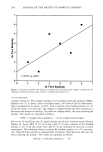
j. Soc. Cosmet. Chem., 46, 291-299 (November/December 1995) A comparison of three in vitro screening tests with an in vivo clinical test to evaluate the irritation potential of antibacterial liquid soaps BOYCE M. MORRISON, JR., and MARC PAYE, Colgate-Palmolive Company, 909 River Road, Piscataway, NJ 08855 (B. M. M. ), and Colgate-Palmolive Research & Development, Liege, Belgium (M.P.). Received July I, I994. Presented at the 18th IFSCC Congress, Venice, Italy, October I994. Synopsis A series of in vitro screening studies has been performed to determine the irritation potential of antibacterial liquid soaps. The results from these in vitro studies were compared to the results from an in vivo clinical study in an effort to determine their utility. Three in vitro techniques were employed to evaluate antibacterial liquid soaps: the collagen swelling test, the pH rise test, and the zein test. In order to compare the data from these three tests, a solution of 1% SLS was included as a positive control. This enabled the data for the antibacterial liquid soaps to be expressed as a percentage of the SLS score. The in vivo clinical test was the modified soap chamber test. The skin was evaluated for irritation using clinical parameters (such as erythema) and biophysical techniques (evaporimetry and chromametry), and the data from the test products were normalized to the data of a mild control product. The overall ranking of the antibacterial liquid soaps from the soap chamber test had a good correlation with the ranking from the collagen swelling test (r = 0.71) and the pH rise test (r = 0.81). The correlation with the zein test was not as good (r = -0.26). However, if the data from the three tests were averaged, the best correlation was achieved with the in vivo results (r = 0.94). In conclusion, each of these tests was used to predict product-induced irritation to the skin. These tests were used individually and collectively. The best correlation occurred when the antibacterial liquid soaps were ranked according to their total in vitro score and compared with the in vivo ranking. INTRODUCTION In vitro assays have been developed to predict the skin's response to surfactant-induced irritation (1-7). These assays are quite useful when a large number of surfactants need to be screened for their irritation potential. Three of these tests, collagen swelling, pH rise, and the zein test, had previously been evaluated by our group to determine their ability to predict surfactant-induced erythema from single-surfactant systems (8). The results showed that each of the methods was based on a similar principle of protein 291
Purchased for the exclusive use of nofirst nolast (unknown)
From: SCC Media Library & Resource Center (library.scconline.org)