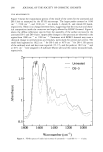
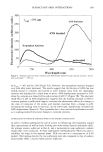
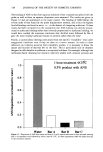
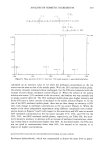
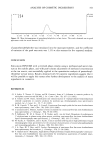
ISOLATION OF CUTICLE 289 0.25 0.2 0.15 0.1 Untreated DS-3 -- DS-4 0.05 :,,\ I v I ''\ t t ,' '\t: •, i • , ', , , \ 0 I 1800 1600 1400 1200 1000 Wavenumber (cm -1) Figure 6. Diffuse reflectance FT-IR spectra of the surface of untreated (--), DS-3 ( ...... ), and DS-4 (---) hairs. Arrows indicate the position of 1022 cm- • and 1076 cm- • peaks appearing in DS-3 and DS-4 hairs, respectively. Since the reaction mechanism in KOH/1-butanol is not completely understood as yet, the small peaks detected in DS-3 and DS-4 are not definitely characterized in the present work. We can conclude at least qualitatively that KOH/1-butanol solution penetrates only through the outer surface of the cortex and that the disulfide and SH groups are partly modified. They may be converted to cystein derivatives. The present work demonstrates that hair without cuticle cells can be obtained, provided that the treatment time in 5% KOH/1-butanol at 50øC is properly controlled. REFERENCES (1) P. H. Springell, Proteolysis of wool and its S-carboxymethyl derivatives by pronase and other pro- teases, A•st. J. Bid. $ci., 16, 727-755 (1965). (2) H. Hojo, Method for modifying wool fiber materials to advance quality grade thereof, U.S. Patent

290 JOURNAL OF THE SOCIETY OF COSMETIC CHEMISTS (3) (4) (5) (6) (7) (8) (9) (10) (11) (12) (13) (14) (15) (16) (17) 4319879 (1982) Improvement of wool fibers by removing exocuticle in the presence of metallic ions, Proc. 7th Inter. Wool Text. Res. Conf. Tokyo, 4, 322-331 (1985). F. Taki, M. Kurokawa, Y. Nakamura, and T. Kondo, Descaling of wool fibers by the treatments with various alcoholic solutions of potassium hydroxide, Sen'i Gakkaishi, 31, T448-T451 (1975). F. Taki, Structure and sorption behavior of water vapor and dye of descaled wool fibers. Sen'i Gakkaishi, 33, T336-T341 (1977). H. Ando, Y. Nakamura, and H. Inagaki, Separation and characterization of keratine components of merino wool. III: Removal of the cuticle by ultrasinic irradiation, Sen'i Gakkaishi, 31, T81-T85 (1975). F. J. Wortmann, R. Greven, and H. Zahn, A method for isolating the cortex of keratin fibers, Textile Res. J., 52, 479 (1982). L. Wolfram, and M. Lindemann, Some observations on the hair cuticle, J. Soc. Cosmet. Chem., 22, 839-850 (1971). J. A. Swift, Chemistry of Natural Protein Fibers, R. S. Asquith, Ed. (Plenum Press, New York, 1977), p. 81. J. A. Swift, and B. Bews, The chemistry of human hair cuticle I: A new method for the physical isolation of cuticle, J. Soc. Cosmet. Chem., 25, 13-22 (1974). A. W. Holmes, Degradation of human hair by papain: The pattern of degradation, Textile Res. J., 34, 706-712 (1964). J. A. Swift and B. Bews, The isolation of membranes from keratin fibers with papain and dithio- threitol, J. Text. Inst., 64, 222-224 (1973). J. A. Swift, Chemical composition of various morphological components isolated from human hair cuticle, Cosmet. Toilerr., 91, 46-48 (1976). C. R. Robbins, and R. J. Crawford, Cuticle damage and the tensile properties of human hair, J. Soc. Cosmet. Chem., 42, 59-67 (1991). P. Alexander and R. F. Hudson, Woo/, Its Chemistry and Physic• (Chapman & Hall Ltd., 1954), p. 257. C. M. Carr and D. M. Lewis, An FT-IR spectroscopic study of the photodegradation and thermal degradation of wool, J. Soc. Dyers Co/our., 109, 21-24 (1993). J. Strassburger and M. M. Breuer, Quantitative fourier transform infrared spectroscopy of oxidized hair, J. Soc. Cosmet. Chem., 36, 61-74 (1985). E. Bramanti, F. Ronca, L. Teodori, M. L. Trinca, F. Papineschi, E. Benedetti, G. Spremolla, P. Vergamini, and E. Benedetti, A new approach to the study of human hair by means of FT-IR microspectroscopy, J. Soc. Cosmet. Chem., 43, 285-296 (1992).
Purchased for the exclusive use of nofirst nolast (unknown)
From: SCC Media Library & Resource Center (library.scconline.org)