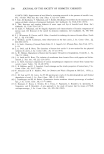
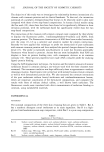
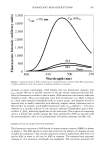
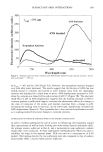
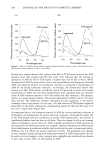
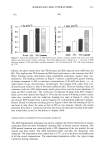
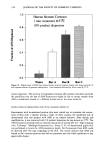
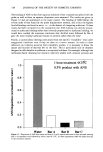
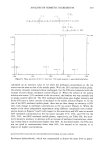
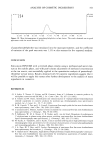
314 JOURNAL OF THE SOCIETY OF COSMETIC CHEMISTS 1.0 0.8 0.6 0.4 Human Stratum Comeurn 1 min. treatment @37qZ 10% product dispersion -r -- :- _ _ __ 0.2 0.0 Water Bar A Bar B Bar C Figure 10. Displacement of ANS from isolated human stratum comeurn treated with water and with 10 wt% aqueous slurries of personal washing bars: l-rain treatment followed by 30-sec rinse • 37øC. comes important. The recovery of tryptophan emission after product treatment excludes the possibility that the loss of ANS fluorescence might be due to energy transfer from ANS to surfactants bound to a different distant site at the same molecule. INTERACTIONS OF DERMATOMED SKIN WITH CLEANSING PRODUCTS Experiments with dermatomed porcine skin were carried out to stimulate the interac- tions of skin with a cleanser during a wash. In these studies, the epidermal side of dermatomed skin was sprayed with ANS in an ethanol solution. After drying and equilibration, it was contacted with 1% product dispersion for one minute at 37øC. The ANS fluoresced intensely with an emission maximum of around 465 nm. Tape stripping with "Cellotape" (Hadleigh Enterprises Ltd., Essex, U.K.) of dermatomed piglet skin was performed to locate the ANS penetration depth. No fluorescence from ANS could be detected after five tape strippings of the skin. The results indicate that ANS was bound to the corneum proteins and did not penetrate into the viable epidermis to any appreciable degree.

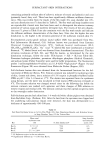
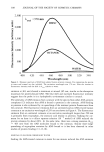
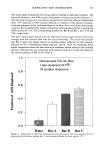
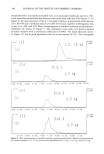
SURFACTANT-SKIN INTERACTIONS 315 The results again demonstrate the strong corneum binding of soap-based cleansers. The fractional decreases in the ANS emission after product treatment are shown in Figure 11. The data were averages of at least sixteen measurements with four different dermatomed skins. The reduction of ANS emission intensity is a measure of the amount of anionic surfactant adsorbed on the epidermal layers of the skin. As in our studies with human corneum, Bar A exhibited the weakest interactions with corneum proteins, lowering the ANS emission by 31%. The corresponding numbers for Bar B and Bar C were 47% and 54%, respectively. The above results again indicate that the soap-based compositions interact much more strongly with skin proteins than does the cocoyl isethionate. The results also indicate that Bar C leaves the largest amount of residual anionic surfactant on the corneum, followed by the triethanolamine-based soap bar, Bar B, while the isethionate-based syndet composition leaves the least amount of surfactant residue bound to the corneum proteins. The relatively low interaction with corneum proteins is in part the reason for the clinical mildness of Bar A (see Table I). 1.0 0.8 -- 0.6 -- 0.4 -- 0.2 -- 0.0 Dermatomed Porcine Skin I min. u-eatment @37øC 1% product dispersion Water Bar A Bar B Bar C Figure 11. Displacement of ANS from dermatomed porcine skin treated with water and with 10 wt% aqueous slurries of personal washing bars: 1-min treatment followed by 30-sec rinse @ 37øC.
Purchased for the exclusive use of nofirst nolast (unknown)
From: SCC Media Library & Resource Center (library.scconline.org)