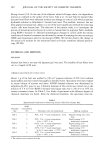
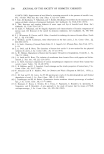
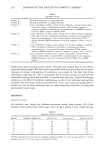
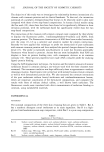
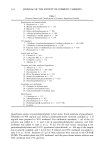
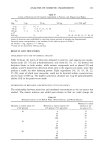
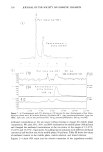
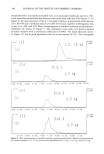
332 JOURNAL OF THE SOCIETY OF COSMETIC CHEMISTS Table I Chemical Names and Classifications of Cosmetic Ingredients Studied Preservatives and antimicrobials 6: Resorcinol m = 110 8: Methyl p-hydroxybenzoate m = 152 9: Phenol m = 94 10: Ethyl p-hydroxybenzoate m = 166 11: n-Propyl p-hydroxybenzoate m = 180 12: 4-Isopropyl 3-methyl phenol m = 150 13: n-Butyl p-hydroxybenzoate m = 194 UV absorbers 7: 2-Hydroxy-4-methoxybenzophenone-5-sodium sulfonate m = 330 (308) 15: 2-Hydroxy-4-methoxybenzophenone m = 228 16: Glyceryl mono-2-ethylhexanoate di-p-methoxycinnamate m = 538 17: Homosalate m = 262 Amino acid and base 23: L-Serine m = 105 24:L-Arginine-HC1 m = 210 (174) 25: L-Aspartic acid m = 133 4: Adenine m = 135 Vitamins and other medicinal ingredients 2: Arbutin m = 272 3:Pyridoxine-HC1 m = 205 (169) 5: Nicotinamide m = 122 18: DL-tx-Tocopheryl acetate m = 472 19: Stearyl glycyrrhetinate m = 722 26: Monoammonium glycyrrhizinate m = 822 30: Pantothenylethylether m = 233 Ceramides and cerebroside 22: Ceramide (o•-hydroxy-type) 28: Ceramide (non-hydroxy-type) 29: Galactocerebroside (o•-hydroxy type) Miscellaneous 1: Creatinine m = 113 14: Valerophenone m = 162 20: [3-Cyclodextrin m = 1134 21: Hydroxypropyl-lB-cyclodextrin m = 1134 + 58n 27: Lecithin Quantitative analysis of pantothenylethylether in hair lotion. Stock solutions of pantothenyl- ethylether (0. 100 mg/ml) and methyl p-hydroxybenzoate (internal standard ca. 1.0 mg/ml) were prepared in 50% methanol. For calibration standards, 1 ml of the I.S solution was added to 1, 2, and 4 ml of pantothenylethylether solution, and 50% methanol was added to raise it to ca. 10 ml. For the hair lotion containing 0.2% pantothenylethylether and 0.05% pyridoxine hydrochloride, ca. 100 mg of the sample was accurately weighed, and 1 ml of the I.S solution and 50% methanol was added to raise it to ca. 10 ml. Aliquots of 2 !xl of these solutions were injected to the CF-FAB LC/MS. The mobile phase was 50% methanol, and the post-column matrix solution was 50% methanol with 15% glycerin.

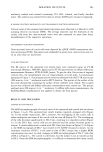
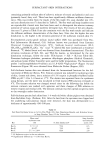
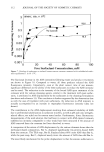
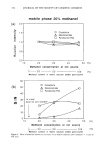
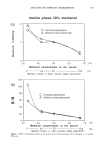
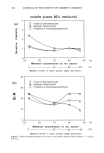
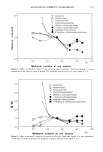
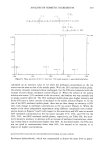
ANALYSIS OF COSMETIC INGREDIENTS 333 Table II Limits of Detection for 30 Cosmetic Ingredients in Positive- and Negative-Ion Modes Pos Neg 5 ng 50 ng 500 ng n.d. (500 ng)* 5 ng 50 ng 500 ng (500 ng) 13 10, 11 12 3, 8, 17, 21, 23, 26 7 1, 4 5, 24, 25 2, 6, 9 15 14 16, 18, 19, 20, 22, 27, 28, 29 Limits of detection were established by injecting various amounts of samples (see Experimental). Chemical names corresponding to the numbers in this table are given in Table I. 30, Positive: 5 ng negative ( ):500 ng. * Could not be detected by 500-ng injection. RESULTS AND DISCUSSION APPLICABILITY OF CF-FAB TO COSMETIC ANALYSIS Table II shows the limits of detection obtained in positive- and negative-ion modes. Amino acids [23-25] and p-hydroxybenzoic acid esters [8, 10, 11, 13] showed low detection limits in both modes, while anionic compounds such as phenol [9] and sulfonic acid [7] showed low detection limits only in the negative-ion mode, since they produce a stable ion after releasing proton. Eight ingredients [16, 18, 19, 20, 22, 27-29], most of which were non-polar, could not be detected within a practical sen- sitivity limit of 500 ng. The highest sensitivity obtained was 5 pg for pantothenyleth- ylether [30] in the positive-ion mode. OPTIMIZATION OF METHANOL CONCENTRATION AT THE ION SOURCE The relationship between sensitivity and methanol concentration at the ion source was studied. The matrix solution was added post-column so that we could change the Table III Methanol Content in the Mobile Phase, Matrix Solution, and Mixed Solution Methanol in mobile phase (%) [100 Ixl/min] Methanol in matrix solution (%) [50 Ixl/min (15% glycerin)] Methanol in mixed solution at the ion source (%) 20 50 80 0 20 50 100 0 25 50 100 0 50 80 100 13 20 3O 47 33 42 5O 67 53 7O 8O 87
Purchased for the exclusive use of nofirst nolast (unknown)
From: SCC Media Library & Resource Center (library.scconline.org)