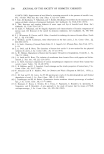
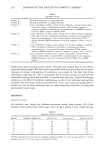
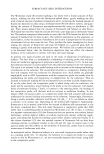
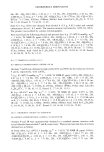
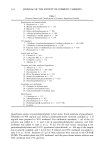
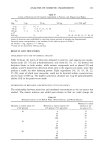
324 JOURNAL OF THE SOCIETY OF COSMETIC CHEMISTS Table I Odor Descriptions of Compounds Synthesized* -CO2C2H 5 -CH2OH -CH2OAc -CHO -CH(OCH3) 2 -CH(OC2H5) 2 -CH (CH2) 2 \o / -CH (CH2) • \o / Medium-intensive, agreeable, fruity with rum and desiccated-apricot note Medium-intensive, floral with rose note, citronellol-like Weak, vegetable, reminds one of carrot leaves odor Intensive, penetrating, floral with calamus note Weak, agreeable, soft, fruity-floral with apricot note Intensive, floral with lily flower note (lilium candidum) Medium intensive, agreeable, fruity-floral with woody note Weak, fruity-floral Less intensive than C-analogue, fruity, rum note less marked Weak, floral with rose note Vegetable with well-marked parsley root note Intensive but less than odor of C~analogue, floral with calamus and citrus note Weak, fruity-floral, similar to odor of C-analogue Intensive but less than odor of C-analogue, floral Medium-intensive agreeable, fruity-floral Weak, floral with apple note * The odor was evaluated for samples that were above 97% (gc) purity. bromide, formed from neopentyl bromide (15.1 g, 0.1 mole) and magnesium (2.4 g, 0L ø, 1 mole), was carried out in tetrahydrofuran by the standard method. The reaction mixture was quenched with distilled water. The crude product was distilled in vacuo to afford alcohol 3 (10.0 g, 70%), b.p. 41øC/2.5 mmHg, nD 20 = 1.4576. 1H NMR (8, ppm): 0.96 (s, 9H, (CHOC-), 1.68 (d, J = 5.0 Hz, 3H, -CH=CH-CH3), 4.2 (m, 1H,-CH(OH)-), 5.28-5.95 (m, 2H,-CH=CH-). IR (cm-1): 3352(s,b), 1016(s), __ -- __ 968(s). Anal. Calcd for C9H180: C, 75.99 H, 12.75. Found: C, 76.05 H, 12.80. Alcohol 4 (2.8 g, 72%) b.p. 94øC/25 mmHg and nD 20 = 1.4458 was obtained from crotonaldeyde (1.8 g, 0.025 mole) and trimethylsilylmethylmagnesium chloride (3.1 g, 0.025 mole of 2 + 0.6 g of Mg). The reaction was carried out in a similar way for the synthesis of alcohol 3. The spectral data are the same as reported earlier (11). ETHYL (E)-3,7,7-TRIMETHYL-4-OCTENOATE (5) ETHYL (E)-3-METHYL-6-TRIMETHYLSILYL-4-HEXENOATE (6) A mixture of alcohol 3 (2.8 g, 0.02 mole), triethyl orthoacetate (23 cm 3, 0.14 mole), and 0.1 cm 3 ofpropionic acid was heated for 1 h at 138øC with a simultaneous removal of ethanol. Then unreacted orthoester was distilled, and the residue was purified by column chromatography. Thus pure ester 5 (3.0 g, 72%), b.p. 94-95øC/6 mmHg, nD 20 •- 1,4311 was obtained. •H NMR (8, ppm): 0.87 (s, 9H, -C(CH3)3), 1.05(d, J = 7.0 Hz, 3H,-CH(CH0-), 1.26(t,J = 7.0 Hz, 3H, ~OCH2CH3), 1.86 (t,J = 5.5

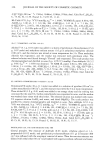
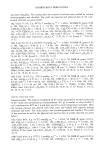
ODORIFEROUS DERIVATIVES 325 Hz, 2H, -CH2-CH=CH-), 2.29 (d, J = 7.0 Hz, 2H, -CH2C(O)-), 2.45 (m, 1H, -CH(CH3)-), 4.14 (q, J = 7.0 Hz, 2H, -OCH2CH3), 5.30-5.70 (m, 2H, -CH = CH-). IR•m-1): 1724(s), 1652(m), 1048(m), 984(m). Anal. Calcd for C•H2402: C, 73.53 H, 11.39. Found: C, 73.42 H, 11.45. Ester 6 (1.8 g, 66%) was obtained from alcohol 4 (1.9 g, 0.012 mole) and triethyl orthoacetate (16 cm -•, 0.1 mole). The reaction mixture was heated at 138øC for 168 h. The product was purified by column chromatography. 20 Pure ester 6 had the following physical and spectral data: b.p. 97-98øC/6 mmHg, nr) = 1.4439, •H NMR (8, ppm): 0.00 (s, 9H, -Si(CH•) 0, 1.00 (d, J = 6.0 Hz, 3H, -CH(CH•)-), 1.26 (t, J = 7.0 Hz, 3H,-OCH2CH3), 1.32 (d, J = 6.5 Hz, 2H, -Si-CH2-CH =), 2.24 (d, J = 7.0 Hz, 2H, -CH2C(O)-), 2.65 (m, 1H, -CH(CH•)-), 4.14 (q, J = 7.0 Hz, 2H, -OCH2CH3), 5.22 (d, J = 16 Hz, split on d, J = 7.0 Hz, 1H, H-4), 5.48 (d, J = 16 Hz, split on t, J = 6.5 Hz, 1H, H-5). IR (cm- 1): 1756(s), 972(s), 844(m). Anal. Calcd for C12H128iO 2' C, 63.10 H, 10.59 Si, 12.30. Found: C, 63.04 H, 10.53 Si, 12.41. (E)-3,7,7-TRIMETHYL-4-OCTEN- 1-OL (7) (E)-3-METHYL-6-TRIMETHYLSILYL-4-HEXEN- 1-OL (8) Alcohols 7 and 8 were obtained in high yields (92% and 90%) by the reduction of esters 5 and 6, respectively, with LiA1H 4. 7: b.p. 87-88øC/5 mmHg nx) 2ø = 1.4420 1H NMR (8, ppm): 0.80 (s, 9H, (CH3)3C-), 0.97 (d, J = 7.0 Hz, 3H, -CH(CH3)-), 1.37 (s, 1H, -OH), 1.43-1.73 (m, 2H, -CH(CH3)CH2-CH2-), 1.83 (d, J = 6.0 Hz, 2H, -CH2CH=CH-), 2.00-2.50 (m, 1H, -CH(CH3)-), 3.63 (t, J = 7.0 Hz, 2H, -CH2CH2OH) , 5.20-5.78 (m, 2H, -CH = CH-) IR (cm- •): 3336(s, b), 2952(s), 1660(w), 1048(s), 972(s) Anal. Calcd for __ -- CllH220: C, 77.58 H, 13.12. Found: C, 77.41 H, 13.13. 8: b.p. 80-81/7 mm Hg nD 20 = 1.4453 1H NMR (8, ppm): 0.037 (s, 9H, -Si(CH3)3) , 1.04 (d, J = 6.8 Hz, 3H,-CH(CH0-), 1.45 (d, J = 6.8 Hz, 2H, Si-CH2-CH=), 3.70 (t, J = 6.6 Hz, 2H, -CH2OH), 5.20 (d, J = 15.8 Hz split on d, J = 6.8 Hz, 1H, H-4), 5.50 (d, J = 15.8 Hz split on t, J = 6.5 Hz, 1H, H-5) IR (cm-1): 3336(s, b), 1248(s), 1056(s), 968(s), 860(m) Anal. Calcd for CloH22SiO: C, 64.44 H, 11.90 Si, 15.07. Found: C, 64.14 H, 11.93 Si, 15.00. (E)-3,7,7-TRIMETHYL-4-OCTEN- 1-YL ACETATE (9) (E)-3-METHYL-6-TRIMETHYLSILYL-4-HEXEN-1-YL ACETATE (10) Acetates 9 and 10 were quantitatively obtained in a standard manner (reaction with acetyl chloride) from alcohols 7 and 8, respectively. Physical and spectral data of acetates obtained are as follows: 9: Yield: 86% b.p. 68øC/3.5 mmHg nr) •ø = 1.4325 1H NMR (8, ppm): 0.84 (s, 9H, (CH03C), 0.99 (d, J = 6.5 Hz, 3H, -CH(CH3)-), 1.48-1.75 (m, 2H, -CH(CH3)CH2CH2-), 1.84 (d, J = 6.5 Hz, 2H, -CH__2CH=CH-), 2.01 (s, 3H, -C(O)CH3), 4.06 (t, J = 7.0 Hz, 2H, -CH2CH20-), 5.03-5.71 (m, 2H,
Purchased for the exclusive use of nofirst nolast (unknown)
From: SCC Media Library & Resource Center (library.scconline.org)