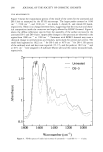
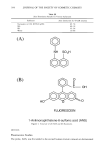
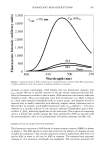
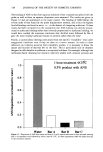
306 JOURNAL OF THE SOCIETY OF COSMETIC CHEMISTS internal reflection of the light at the dermal side, water was used as the optical medium on the dermal side of the skin. Surfactant Adsorption The procedure will be described in more detail in a separate communication (17). Briefly, three 8-mm discs of human stratum corneum were placed between two 1-inch- square teflon screens. These screens were then placed in treatment solutions containing a combination of •4C (specific activity 1 IxCurie/ml) labeled and nonlabeled surfactants. The concentrations of labeled surfactants in the treatment solutions were 3.47 X 10 -4 moles/l, 3.03 x 10 -4 moles/l, and 1.59 x 10 -4 moles/l, respectively, for SLS, SLI, and TEA-Na laurate. The concentrations of unlabeled fraction were varied to obtain total initial surfactant concentrations in the range of 2 x 10⁻³ moles/l to 1 x 10⁻¹ moles/1. The TEA concentration in Na-laurate solution was maintained at 4 x 10⁻² moles/l to maintain the pH and to avoid the precipitation of the Na-laurate. Before the addition of the stratum corneum sample to the treatment solution, 5 Ixl of the treatment solution was removed to provide the initial concentration. After one hour, the screens were rinsed by moving them back and forth in a dish of distilled water five times. Excess water was removed by blotting with a paper towel, and the screens were then allowed to dry overnight in a desiccator. The weight of each individual corneum sample was recorded using a Perkin-Elmer AD4 autobalance, and the sample was placed into scintillation vials containing 0.5 ml distilled water. Scintiverse BD (Fisher Scientific) was added to each vial, and the radioactivity of the treatment solution before and after inclusion of the corneum was determined using liquid scintillation (Beckman). The amount of surfactant bound was calculated and normalized to the final dry weight of the corneum. This procedure corrects for extraction of soluble materials by the surfactant solution, which can be significant for damaging surfactants (17). RESULTS ANS FLUORESCENCE IN SOLUTION The probe ANS has very weak fluorescence (quantum yield 0.004) in water, with a broad emission maximum at about 520 nm. In a less polar solvent, e.g., in octanol, ANS fluoresces much more intensely (quantum yield 0.646), with an emission maxi- mum of 464 nm. The fluorescence intensity also increases significantly when ANS is bound to certain proteins such as apomyoglobin or apohemoglobin (11) or tubulin (18), with the emission maxima shifting to shorter (450-490 nm) wavelengths. The absorp- tion maximum for protein-bound ANS is around 360 nm (11). The fluorescence en- hancement is believed to be due to binding of ANS to specific binding sites in proteins. The spectra of ANS equilibrated in 1% solutions of several pure surfactants, along with the corresponding one in water, are shown in Figure 2. These surfactant concentrations are well above their cmc values (SLS 0.23%, SLI 0.13%, Ci2EO 6 0.003%). The concentration of ANS in these tests was only 1.47 X 10 -4 M (0.004%). Since the ANS concentration is two to three orders of magnitude lower than the miceliar concentration, the solubilization or the lack of it of ANS in these miceliar solutions is dependent only on the affinity of ANS for the micelies. As expected, ANS exhibits low fluorescence

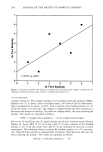
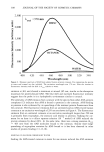
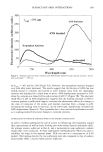
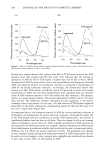
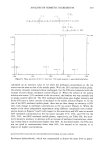
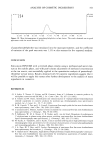
SURFACTANT-SKIN INTERACTIONS 307 3,500 ext = 3,000 2,500 2,000 1,500 ,ooo 0 400 450 500 550 Wavelength (rim) Figure 2. Emission spectra of ANS in water and in miceliar solutions of anionic (SLI, SLS) and nonionic (C12EO6) surfactants. Note the positions of maxima and relative intensities. intensity in water. Interestingly, ANS exhibits only low fluorescence intensity with X.m• x around 500 nm in micellar solutions of the two artionic surfactants SLI and SLS. Since its fluorescence is similar to that in water, ANS interaction with anionic surfactant micelles is small. This is not surprising, since from its structure, it is likely to behave as a short-chain branched hydrophobe with an anionic group, and therefore would be expected only to weakly comicellize with relatively compact artionic surfactants such as SLS and SLI. In contrast, much higher fluorescence with a Xm•x shifted to --470 nm is observed in a micellar solution of the nonionic surfactant hexaethylene glycol dode- cylether, C •2EO6, indicating significant micelle association. This is again not surprising since it is known that aromatic groups like those possessed by ANS can associate with the polyoxyethylene chain in the palisade layer of nonionic surfactant micelies (19). BINDING OF ANS TO HUMAN STRATUM CORNEUM The fluorescence spectrum of ANS bound to human stratum corneum (HMSC) is shown in Figure 3. The ANS spectra in water and octanol (in the absence of corneum) are also included for comparison. The emission maximum showed a marked blue shift from 515 nm for ANS in water to 463 nm for ANS in corneum. The emission from untreated comeurn at this excitation wavelength was negligible. The excitation spectrum (for
Purchased for the exclusive use of nofirst nolast (unknown)
From: SCC Media Library & Resource Center (library.scconline.org)