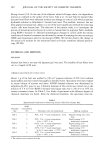
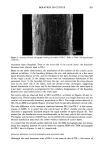
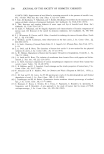
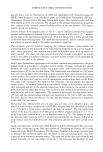
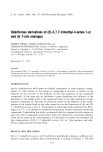
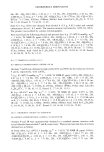
322 JOURNAL OF THE SOCIETY OF COSMETIC CHEMISTS /XvMgY 1 Y=Br 2 Y=CI O OH 3,4 CH3C(OC2H5)3 C2H5CO2H 138 'C 2X•oH 7,8 C r'O3, Py 11,12 CH3C(OR) 3 LiAIH 4 C OC I, Py HO(CH2)nOH •X-••,•-C O2C2H5 5, 6 9, 10 13a, 14a n=2 13b, 14b n-3 •X•oR 15a, 16a, R=-CH 3 15b, 16b, R=-CH2CH 3 1, 3, 5, 7, 9,11, 13 and 15 X=C 2, 4, 6, 8, 10, 12, 14 and 16 X=Si Scheme 1. step, the Grignard reaction of crotonaldehyde with neopentylmagnesium bromide (1) or trimethylsilylmethylmagnesium chloride (2), was carried out without any copper(I) halide catalyst and afforded the corresponding alcohols 3 and 4 in satisfactory yields of 59% and 72%, respectively. Such yields were achieved when the reaction mixture was quenched with water. In the case of using ammonium chloride or other acidic agent for hydrolysis, the yield dropped because of an extremely easy dehydration process.

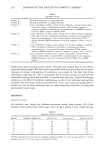
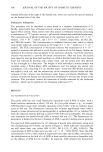
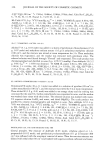
ODORIFEROUS DERIVATIVES 323 Allyl alcohols 3 and 4 were subjected to the orthoacetate modification of the Claisen rearrangement (8). The reaction of sila alcohol 4 was carried out without an acidic catalyst. Such a mode of carrying out the reaction required heating (138øC) of the reaction mixture for 168 h. When propionic acid or 2,4-dinitrophenol were used as catalyst, the product of protodesilylation, ethyl 3-methyl-5-hexanoate, was obtained as a main one in the complex product mixture. Esters 5 and 6 were then reduced with lithium aluminium hydride to alcohols 7 and 8, respectively. These alcohols were transformed into the corresponding acetates 9 and 10 by reaction with acetyl chloride. Aidehyde 11 was obtained by the oxidation of alcohol 7 with pyridinum chlorochromate (9). The application of the same reagent for the oxidation of alcohol 8 did not afford aidehyde 12 a satisfactory yield. The best yield (76%) was achieved when the chromium trioxide-pyridine complex (10) was used as an oxidizing agent. We have also found that the use of carbon tetrachloride instead of methylene chloride, commonly employed in this method, results in an increase in yield and purity of the aidehyde isolated. Aldehydes 11 and 12 were the starting materials in the synthesis of two groups of their derivatives: acyclic and cyclic acetals. Acyclic methyl (15a, 16a) and ethyl (15b and 16b) acetals were obtained by the reaction of corresponding aidehyde with trimethyl or triethyl orthoacetate in the presence of pyridinum p-toluenesulfonate as an acidic cat- alyst. Dioxolanes (13a and 14a) and dioxanes (13b and 14b) were synthesized in a standard manner by the reaction of aidehyde 11 or 12 with ethylene glycol or 1,3- propanediol, respectively. The odor characteristics of compounds synthesized by us are given in Table I. The direct comparison of the odors of C compounds and their Si analogues indicates that odors of Si compounds were less intensive than C ones. In general, with the exception of acetates and cyclic acetals, the character of corresponding compounds in the pairs are similar. It can also be noted that both acetates tested are characterized by vegetable odors, whereas acetates synthesized earlier by us and others usually possessed fruity or fruity-floral ordors. EXPERIMENTAL 1H NMR spectra were recorded for solutions (CDCI•) on a 80-MHz Tesla BS 587A spectrometer. Infrared spectra were determied with a Specord M80 infrared spectropho- tometer. Gas chromatographic analyses were performed on a Hewlett Packard instru- ment, using an HP-5 capillary column (30-m) 0.3 lm). Analytical TLC was carried out on silica gel G (Merck) with different developing systems. Compounds were de- tected by spraying the plates with 7% H2SO 4 in ethanol containing ca 0.1% of p-an- isaldehyde, followed by heating to 120øC. In some cases compounds were detected by 12 in the iodine chamber. Column chromatography was performed on silica gel (Kie- selgel 60, 230-400 mesh, Merck) with hexane-ethyl acetate 7:1 (for alcohols) or 40:1 (for other compounds) system as eluents. 6,6-DIMETHYL-2-HEPTEN-4-OL (3) 1-TRIMETHYLSILYL- 3-PENTEN-2-OL (4) The Grignard reaction of crotonaldehyde (7.0 g, 0.1 mole) with neopentylmagnesium
Purchased for the exclusive use of nofirst nolast (unknown)
From: SCC Media Library & Resource Center (library.scconline.org)