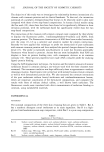
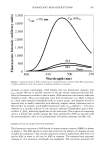
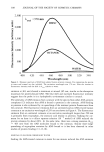
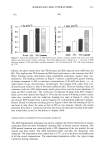
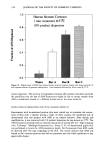
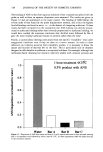
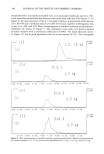
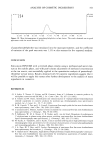
318 JOURNAL OF THE SOCIETY OF COSMETIC CHEMISTS The binding of ANS to skin from aqueous solutions of bar compositions spiked with the probe as well as from an aqueous dispersion were measured. The results are given in Figure 12 and are normalized to the water control. The binding of ANS follows the reverse order of that found by the probe displacement method, and in fact the highest level of binding was found in water, i.e., in the absence of competing surfactant. If these results had been interpreted on the assumption that ANS binding was directly propor- tional to surfactant binding rather than inversely proportional to surfactant binding, we would have reached the erroneous conclusion that distilled water followed by Bar A gave the most residual surfactant bound to proteins rather than the least! Finally, a caution about drawing conclusions from non-specific "rinsability" tests under exaggerated conditions even if they are done in a correct manner. In order to draw inferences on irritation potential from rinsability studies, it is necessary to know the nature and location of material left on the skin. This is particularly true of cleansers designed to offer benefits in addition to exceptional mildness. For example, although the isethionate-based cleansing bar interacts relatively weakly with corneum proteins and 0.8 -- 0.6 -- 0.4 -- 0.2 -- 0.0 I hour treatment @25øC 0.5% product with ANS 1 m , Water Bar A Bar B Bar C Figure 12. Deposition of ANS from water and from 0.5 wt% aqueous solutions of three personal washing bars: 1-hr treatment time followed by 30-sec rinse (•' 25øC. In these experiments ANS was added directly to the treatment solution.

SURFACTANT-SKIN INTERACTIONS 319 leaves few residues there, it does leave materials on skin after a wash that are similar to some of the natural components found in the skin barrier lipids, i.e., fatty acids. We have carried out a detailed electron-spin resonance probe study coupled with direct- binding measurement to quantify the nature and location of such deposits, and this will be reported shortly. Such deposits are quite different from protein-bound anionic sur- factants that induce protein unfolding and stratum corneum damage. Thus, it is quite misleading to conclude that any materiMs left on the skin by a cleansing composition contribute to irritation. Depending on their nature and location, some material may be beneficial, for example, in preserving the composition of the barrier lipids. CONCLUSIONS The ANS displacement from corneum proteins is a sensitive method to study cleanser interactions with superficial corneal layers under realistic washing conditions. Our results show that pure anionic surfactants as well as formulated products containing them vary considerably in their corneum protein binding ability. An isethionate-based cleansing bar leaves consistently less residual anionic surfactants bound to corneum proteins than either a pure soap or a glycerin soap-based bar composition. The results correlate well with their known clinical mildness as measured by the flex wash. The lower protein interactions of the isethionate-based synthetic detergent bar is in part due to the significantly lower protein binding of sodium acyl isethionate, the primary active, relative to soaps. A reinterpretation of the experimental results of an earlier published study was proposed to take account of the competitive nature of anionic dyes and anionic surfactants in binding to substrates like skin. REFERENCES (1) G. Imokawa and T. Takeuchi, Surfactants and skin roughness, Cosmet. Toiletr., 91, 32-46 (1976). (2) G. Imokawa and Y. Mishima, Cumulative effects of surfactants on cutaneous horny layers: Adsorption onto human keratin layers in vivo, Contact Dermatitis, 5, 357-366 (1979). (3) M. Kawai and G. Imokawa, The induction of skin tightness by surfactants. J. Soc. Cosmet. Chem., 35, 147-156 (1984). (4) J. C. Blake-Haskins, D. Scala, and L. D. Rhein, Predicting surfactant irritation from the swelling response of a collagen film, J. Soc. Cosmet. Chem., 37, 199-210 (1986). (5) L. D. Rhein and F. A. Sireion, "Surfactant Interactions With Skin," in Surfactant Science Series, M. Bender, Ed. (Marcel Dekker, New York, 1991), Vol. 39, pp. 33-49. (6) M. Rieger, Human epidermal responses to sodium lauryl sulfate exposure, Cosmet. Toiletr., 109, 6 (1994). (7) E. Gotte, Skin compatibility of tensides measured by their capacity for dissolving zein, Proc. of the 4th lnt. Cong. Surface Active Subs. (Brussels), 3, 83-90 (1964). (8) M. S. Wortzman, R. A. Scott, P.S. Wong, N.J. Lowe, and J. Breeding, Soap and detergent bar rinsability, J. Soc. Cosmet. Chem., 37, 89-97 (1986). (9) M. Paye, F. A. Simion, and G. Pierard, Dansyl chloride labelling of stratum corneum: Its rapid extraction from skin can predict skin irritation due to surfactants and cleansing products, Contact Dermatitis, 30, 91-96 (1994). (10) D. D. Strube, S. W. Koontz, R. I. Murahata, and R. F. Theiler, The flex wash test: A test method for evaluating the mildness of personal washing products,J. Soc. Cosmet. Chem., 40, 297-306 (1989). (11) L. Styrer, The interaction of a naphthalene dye with apomyoglobin: A fluorescent probe of non-polar binding sites, J. Mol. Biol., 13, 482-495 (1965).
Purchased for the exclusive use of nofirst nolast (unknown)
From: SCC Media Library & Resource Center (library.scconline.org)