j. Soc. Cosmet. Chem., 46, 321-328 (November/December 1995) Odoriferous derivatives of (E)-3,7,7-trimethyl-4-octen-1-ol and its 7-sila analogue ROBERT OBARA, TERESA OLEJNICZAK, and CZESLAW WAWRZEI'•CZYK, Institute of Chemistry, Pedagogical University, Chffigska 5, 25-020-Kielce, Poland (R.O.), and Institute of Fundamental Chemistry, Agricultural University, Norwida 25, 50-375 Wroctaw, Poland (T.O., C.W.). Received July 21, 1995. Synopsis The synthesis of (E)-3,7,7-trimethyl-4-octen-1-ol and its 7-sila analogue is described. Odor characteristics of both alcohols as well as their derivatives are also presented. No, essential differences between odors of the corresponding carbon and sila compounds were observed. INTRODUCTION Acyclic terpenoids are well known as valuable components of many fragrance compo- sitions (1). Our interest in this group of compounds is directed to studies on the influence of the structure of the molecule on the odor properties of the isoprenoid compounds. A few years ago we published a paper describing the influence of the placement of the double bond in the isoprenoid chain on the odor properties of some isomeric compounds (2). Recently we presented studies on the influence of the config- uration of the double bond on the odor carried out on the derivatives of (E) and (Z) 3,7-dimethyl-4-octen-l-ols (3). Encouraged by interesting results presented by Wan- nagat eta/. (4-7), we decided to synthesize sila analogues of some isoprenoid odoriferous compounds. Undertaking this work, we expected that the comparative odor analysis of pairs of C and Si compounds would deliver some new information concerning influence of the silicon atom on the odor properties. In this paper we present the syntheses and odor characteristics of (E)-3,7,7-trimethyl-4-octen-l-ol, its 7-sila analogue, and odor- iferous compounds derived from them. RESULTS AND DISCUSSION (E)-3,7,7-trimethyl-4-octen-l-ol (7) and (E)-6-trimethylsilyl-4-hexen-l-ol (8) were ob- tained in three-step syntheses from crotonaldehyde, according to Scheme 1. The first 321

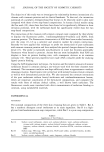
322 JOURNAL OF THE SOCIETY OF COSMETIC CHEMISTS /XvMgY 1 Y=Br 2 Y=CI O OH 3,4 CH3C(OC2H5)3 C2H5CO2H 138 'C 2X•oH 7,8 C r'O3, Py 11,12 CH3C(OR) 3 LiAIH 4 C OC I, Py HO(CH2)nOH •X-••,•-C O2C2H5 5, 6 9, 10 13a, 14a n=2 13b, 14b n-3 •X•oR 15a, 16a, R=-CH 3 15b, 16b, R=-CH2CH 3 1, 3, 5, 7, 9,11, 13 and 15 X=C 2, 4, 6, 8, 10, 12, 14 and 16 X=Si Scheme 1. step, the Grignard reaction of crotonaldehyde with neopentylmagnesium bromide (1) or trimethylsilylmethylmagnesium chloride (2), was carried out without any copper(I) halide catalyst and afforded the corresponding alcohols 3 and 4 in satisfactory yields of 59% and 72%, respectively. Such yields were achieved when the reaction mixture was quenched with water. In the case of using ammonium chloride or other acidic agent for hydrolysis, the yield dropped because of an extremely easy dehydration process.
Purchased for the exclusive use of nofirst nolast (unknown)
From: SCC Media Library & Resource Center (library.scconline.org)