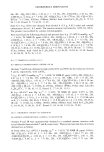
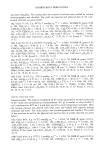
ODORIFEROUS DERIVATIVES 327 and dried (Na2SO4). The residue after the removal of solvents was purified by column chromatography and distilled. The yield and spectral and physical data of the com- pounds obtained are given below: 13a: Yield: 75.5% b.p. 84øC/3.5 mmHg nD 2ø = 1.4456 •H NMR (8, ppm)' 0.86 (s, 9H, (CH3)3C-), 1.03 (d, J = 7.0 Hz, 3H, -CH(CH3)-), 1.48-1.75 (m, 2H, -CH(CH3)-CHI-CH), 1.86 (d, J = 7.0 Hz, 2H, -CH2-CH=CH-), 2.10-2.68 (m, 1H, =CH -CH(CH3)-), 3.63-4.20 (m, 4H, -O-CHi-CH2-O-), 4.88 (t, J = 5.0 Hz, 1H, -CH•-CH), 5.12-5.70 (m, 2H, -CH=CHW) IR (cm-•): 1660(w), 1136(s), 1032(s), 972(s) Anal. Calcd for Cl382402: C, 73.53 H, 11.39. Found: C, 73.03 H, 11.52. 13b: Yield' 83.5% b.p. 84-85øC/3 mmHg nD •ø = 1.4486 •H NMR (8, ppm): 0.93 (s, 9H, (CH3)3C-), 0.99 (d, J = 7.0 Hz, 3H, -CH(CH3)-), 1.43-1.68 (m, 2H, -CH(CH3)-CH2-CH), 1.86 (d, J = 7.0 Hz, 2H, -CH•-CH = CH-), 3.50-4.38 (2m, 4H, -O-CHI-CH•-CH•-O-)4.60 (t, J = 5.5 Hz, 1H, -CH•-CH), 5.10-5.62 (m, 2H, -CH = CH-) IR (cm-•): 1144(s), 1096(s), 972(s) Anal. Calcd for C1482602: C, 74.28 •, 11.•8. Found: C, 74.02 H, 11.64. 14a: Yield: 83.8% b.p. 73øC/2 mm Hg nD lø = 1.4511 •H NMR (8, ppm): -0.019 (s, 9H,-Si(CH3)3), 1.01 (d,J = 6.8 Hz, 3H,-CH(CH3)-), 1.39 (d,J = 7.1Hz, 2H, Si-CH•-CH =), 3.79-3.99 (m, 4H, -CH(OCH2)•), 4.84 (t, J = 5.1 Hz, 1H, -CHI- CH(OCH•)2), 4.96-5.52 (m, 2H, -CH = CHO W, IR (cm- •): 1248(s), 1140(s), 1040(s), 96-•(s), 844(s) Anal. Calcd for C•2H24SiO2: C, 63.10 H, 10.59 Si, 12.30. Found: C, 63.12 H, 10.62 Si, 12.41. 14b: Yield: 79.4% b.p. 79øC/2 mmHg nD lø = 1.4518 •H NMR (8, ppm): -0.003 (s, 9H, -Si(CHs)3), 0.97 (d, J = 6.6 Hz, 3H, -CH(CH3)-), 1.40 (d, J = 7.1 Hz, 2H, Si-CHI-CH=), 3.58-4.20 (m, 4H, -CH(OCH•-)I), 4.52 (t, J = 5.4 Hz, 1H, -CH2- CH(O-)I), 5.13-5.40 (m, 2H, -CH=CH-) IR (cm-•): 1248(s), 1144(s), 968(s), 84-•(s) Anal. Calcd for C13H•6SiO2:-•, 64.04 H, 10.81 Si, 11.59. Found: C, 64.24 H, 10.75 Si, 11.64. ACETALS 15A,B AND 16A, B Generalprocedure. The mixture of aldehyde (0.015 mole) trimethyl or triethyl ottoacetate (0.017 mole) and pyridinium p-toluenesulfonate (0.1 g) in methyl or ethyl alcohol (5 cm 3) was heated at 40øC for 2 h and then was left at room temperature overnight. Then the reaction mixture was diluted with ethyl ether and washed with aqueous sodium carbonate and water. The crude product was chromatographed and distilled. The yields of the reactions as well as the physical and spectral data of acetals obtained are given below: 15a: Yield: 84% b.p. 61øC/3 mmHg nD 20 = 1.4294 1H NMR ($, ppm): 0.83 (s, 9H, (CH3)3C-), 0.94 (d, J = 6.0 Hz, 3H, -CH(CH3)-), 1.81 (d, J = 6.0 Hz, 2H, -CH2-CH=CH-), 3.26 3.28 (2s, 6H, -CH(OCH3)2), 4.39 (t, J = 6.0 Hz, 1H, -C•2-CH(OCH3)2), 5.00-5.73 (m, 2H,-CH=CH-) IR (cm-•): 1648(w), 1128(s), -- 1052(s),•72(s) Anal. Calcd for C•382602: C, 72.84 H, 12.23. Found: C, 72.57 H, 12.32. 15b: Yield: 84% b.p. 87øC/3.5 mmHg nD 20 = 1.4292 1H NMR ($, ppm): 0.83 (s, 9H, (CH03C-), 0.96 (d, J = 6.5 Hz, 3H, -CH(CH3)-), 1.18 (t, J = 7.1 Hz, 6H,

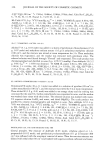
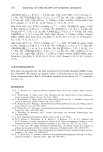
328 JOURNAL OF THE SOCIETY OF COSMETIC CHEMISTS -CH(OCH2CH3)2), 1.85 (d, J = 6.0 Hz, 2H, -CH2 -CH=CH), 3.54 3.65 (2q, J = 7.1 Hz, 4H, -CH(OCH2CH3)2) , 4.53 (t, J = 6.5 Hz, 1H, -CH 2 -CH(O-)2), 5.00- 5.75 (m, 2H, -CH=CH-) IR (cm-•): 1660(w), 1128(s), 1064(s), 976(s) Anal. Calcd -- -- for C•5H3oO2: C, 74.32 H, 12.48. Found: C, 74.25 H, 12.35. 16a: Yield: 82% b.p. 65øC/3.5 mmHg ni •ø -- 1.4382 •H NMR (8, ppm): -0.003 (s, 9H, -Si(CH3)3), 0.99 (d, J = 6.6 Hz, 3H, -CH(CH•)-), 1.41 (d, J = 6.8 Hz, 2H, Si-CH•-CH=), 3.30 3.32 (2s, 6H, -CH(OCH•)•), 4.41 (t, J = 5.9 Hz, 1H, -CH• -CH(OCH3)2), 5.13-5.5 1 (m, 2H, -CH = CH-) IR (cm- •): 1248(s), 1128(s), 1056(s), -- 968(s), 848(s) Anal. Calcd for C•2H26SiO2: C, 62.55 H, 11.37 Si, 12.19. Found: C, 62.73 H, 11.31 Si, 12.31. 16b: Yield: 85% b.p. 76øC/3.5 mmHg nil o = 1.4381 •H NMR (8, ppm): 0.003 (s, 9H, -Si(CH3)3), 0.99 (d, J = 6.6 Hz, 3H, -CH(CH3)-), 1.22 (t, J = 7.1 Hz, 6H, -CH(OCH2CH3)2), 1.41 (d, J = 6.8 Hz, 2H, Si-CH2-CH=) , 3.55 3.59 (2q, J = 7.1 Hz, 4H, -CH(OCH2CH3)2), 4.54 (t, J = 5.9 Hz, 1H, -CH• -CH(O-)2), 5.14- 5.42 (m, 2H, -CH = CH-) IR (cm- 1): 1248 (s), 1128(s), 1064(s), 968(s•, 848(s) Anal. __ -- Calcd for C•4H3oSiO2: C, 65.05 H, 11.70 Si, 10.87. Found: C, 65.12, H, 11.64 Si, 11.03. ACKNOWLEDGMENTS This work was supported by the State Committee for Scientific Research (KBN), Grant No. S3020806. We express our thanks to Prof. J. G6ra for help in the odor evaluation of our compounds and to Mrs A. Puchata for synthesis of derivatives of 3,7,7-trimethyl- 4-octen- 1-ol. REFERENCES (1) E. T. Theimer, Ed., Fragrance Chemistry (Academic Press, New York, London, Tokyo, Toronto, 1982). (2) C. Wawrzeficzyk, A. Zab•a, and J. G6ra, Syntheses and odor characteristics of some homologs of acyclic terpenoids, Perfum. Flavor,st, 8, 39-47 (1988). (3) C. Wawrzeficzyk, R. Obara, and J. G6ra, Odor analysis of (E)- and (Z)- 3,7-dimethyl-4-octen- 1-ols and their derivatives, Perilira. Flavorist, 18, 29-32 (1993). (4) R. Munstedt and U. Wannagat, Sila-Riechstoffe und Riechstoffe-Isostere, Ein neuer Weg zu Sila-b- Jonon, Monatsh. 116, 693-700 (1985). (5) R. Munstedt and U. Wannagat, a-Formylpropenylsilane als Modellsubstanzen fur Sila-b-cyclocitral, Liebigs Ann. Chem., 944-949 (1985). (6) U. Wannagat, R. Munstedt, and U. Horder, Sila-b-Jonon und verwandte Verbindungen, ibid, 950-958 (1985). (7) J. G6ra, Organosilicon Fragrances, Perfum. Flavorist, 10, 21-25 (1985). (8) W. S. Johnson, L. Wertemann, W. R. Bartlett, T. J. Brockson, T. T. Li, D.J. Faulkner, and M. R. Peterson, A simple stereoselective version of the Claisen rearrangement leading to trans- trisubstituted olefinic bonds: Synthesis of squalene, J. Am. Chem. Soc., 92, 741-743 (1970). (9) F.J. Corey and J. W. Suggs, Pyridinium chlorochromate: An efficient reagent for oxidation of primary and secondary alcohols to carbonyl compounds, Tetrahedron Letters, 2647-2650 (1975). (10) R. Ratcliff and R. Rodehorst, Improved procedure for oxidation with the chromium trioxide-pyridine complex, J. Org. Chem., 35, 4000 (1970). (11) R. T. Taylor and J. G. Galloway, Addition of trimethylsilylmethylmagnesium chloride to or, [3-un- saturated carbonyls, J. Organomet. Chem., 220, 295-300 (1981).
Purchased for the exclusive use of nofirst nolast (unknown)
From: SCC Media Library & Resource Center (library.scconline.org)