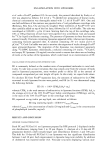
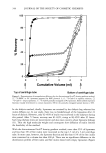
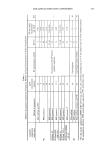
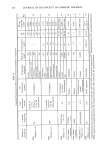
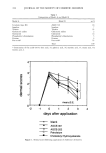
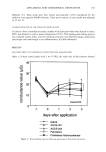
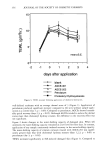
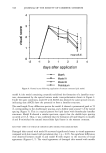
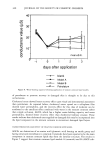
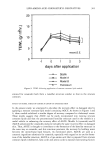
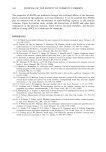
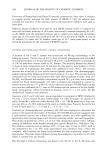
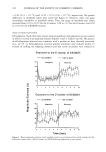
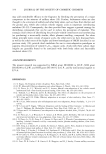
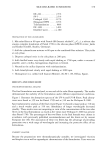
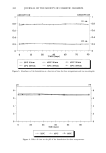
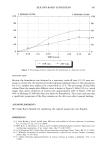
356 JOURNAL OF THE SOCIETY OF COSMETIC CHEMISTS E LM 15 mean_S.E. 0 ' I ' I ' I ' I ' I ' -2 -1 0 1 2 3 4 days after application = blank •' AGCE-301 ß *' AGCE-202 []-- Petrolatum - Cholesteryl Hydroxystearate Figure 3. TEWL recovery following application of cholesteryl derivatives. well-defined erythema with an average dermal score of 3 (Figure 1). Application of petrolatum produced significant recovery compared to the sites without sample appli- cation as a control (day 3 p 0.05). Compared to petrolatum, AGCEs showed remark- ably quick recovery (days 2,3 p 0.05). Although AGCEs tended to reduce the dermal scores more than cholesteryl hydroxy stearate, the difference in the recovery effect was not significant. Figure 2 shows changes in the water-holding capacity of damaged skin. When left untreated, the water-holding capacity remained at a low level for three days. In contrast, application of any sample consistently induced recovery in the water-holding capacity. The water-holding capacity of stratum corneum treated with AGCE-202 was signifi- cantly greater than that with cholesteryl hydroxy stearate (days 1,2,3 p 0.05) or petrolatum (day 3 p 0.02). TEWL increased significantly in SLS-induced damaged skin (Figure 3). Compared to

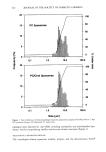
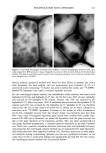
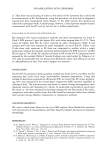
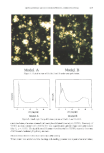
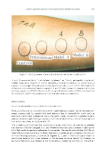
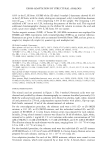
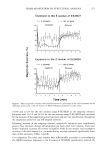
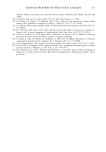
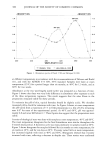
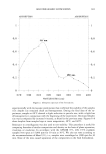
LIPO-AMINO ACID CHOLESTERYL DERIVATIVES 357 Model A Model B Figure 4. Optical texture of Models A and B under cross polarization. e 115 i I 0 20 25 0 5 10 20 25 20 (degree) 20 (degree) Model A Model B Figure 5. Small-angle X-ray diffraction patterns of Model A and Model B. untreated sites, the sites treated with sample exhibited recovery in TEWL. Recovery of TEWL in skin treated with AGCE-301 was significantly greater than with petrolatum (day 1 p 0.05). No significant difference was observed in TEWL recovery between AGCEs and cholesteryl hydroxy stearate. CHARACTERIZATION OF STRATUM CORNEUM LIPID MODEL When water was added and the heating and cooling process was repeated several times,
Purchased for the exclusive use of nofirst nolast (unknown)
From: SCC Media Library & Resource Center (library.scconline.org)