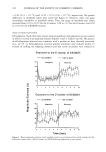
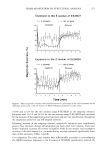
368 JOURNAL OF THE SOCIETY OF COSMETIC CHEMISTS procedure was used at the beginning of each session to equate intensities of the test stimuli. Each trial consisted of a step-10 concentration of the odorant to be used for adaptation and an alternating concentration of the other test odorant (starting at step 8). Subjects were instructed to identify the more intense of the two bottles. Each pair of stimuli was presented twice, with trials separated by one minute. If the subject selected the soon-to-be-adapting odorant as being stronger in each of the two trials, the subse- quent trial used the next stronger concentration of the other test odorant. Similarly, if the subject selected the other test odorant as stronger in each of the two trials, a weaker concentration of that odorant was used for the subsequent pairing. The concentration at which subjects failed to identify the same stimulus as stronger in two consecutive trials was selected as the concentration most similar in intensity to step 10 of the odorant to be used as the adapting stimulus. Thus, the test odorants were step 10 of the odorant for adaptation and the concentration of the other odorant judged to be most similar in intensity by the individual subject the stimulus used for adaptation was a fourfold higher concentration (i.e., step 12) than the test stimulus. A two-minute rest was imposed following perceptual matching. Subjects then rated, using magnitude estimation, the intensities of step 10 of the adapting stimulus and the intensity-matched concentration of the other test odorant. Subjects assigned numerical ratings to each of these two stimuli twice. If the means of the magnitude estimates for each odor were dissimilar (greater than 20% discrepancy), the matching procedure was repeated. In this manner, initial magnitude estimates ensured that the two stimuli were perceptually equivalent for that subject. After making the initial magnitude estimates, subjects began to sniff repeatedly the adapting stimulus. Every 15 seconds during this adaptation period, subjects sniffed and rated a test stimulus between sniffs of the adapting stimulus. The test stimulus, either 3M2H or one of the individual ethyl esters, alternated in sequential trials so that subjects made a total of 20 ratings (10 3M2H, 10 ethyl ester) during the 5-rain adaptation period. Following these ratings, the adapting stimulus was removed and subjects con- tinued to rate test stimuli every 15 seconds during a 5-rain postadaptation period. Subjects thus made a total of 20 ratings during this recovery period. In the second session, the adapting odorant, either 3M2H or one of the ethyl esters, was reversed and the entire procedure was repeated. The adapting odorant used in a par- ticular session was counterbalanced across sessions for all subjects. Each magnitude estimate was converted to a percentage of the initial magnitude esti- mate for that odorant and analyzed by a series of repeated measures, single-factor ANOVAs a separate analysis was performed for each comparison. The ANOVAs were calculated after each estimate was first subtracted from 100, allowing an assessment of whether estimates were significantly different from the initial estimates (100%). Sig- nificance levels were set atp .01 because four F-tests were performed on the data from each session. Threshold procedure. A forced-choice, modified, single-staircase procedure through five reversals was used to establish olfactory thresholds for the individual isomers of EE3M2H. A trial consisted of the presentation of two polypropylene bottles in rapid succession and in counterbalanced order. One bottle contained 10 ml of a given con- centration of the test odorant dissolved in light, white, mineral oil, and the other

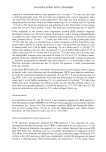
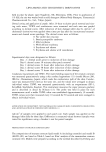
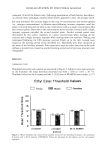
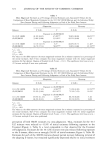
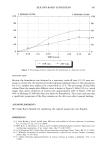
CROSS-ADAPTATION BY STRUCTURAL ANALOGS 369 contained 10 ml of the diluent only. Following presentation of both bottles, the subject, in a forced-choice paradigm, reported which bottle appeared to have the stronger smell. For each threshold, the staircase began at the step-10 concentration and moved upward (i.e., stronger concentrations), in dilution steps following incorrect responses, until the subject correctly detected the odor in two consecutive trials at a single concentration (the first reversal point). Direction in the concentration series was then reversed until a single incorrect response provided the second reversal point. Further reversal points were determined by two correct responses at a given concentration when moving up the staircase and a single incorrect response when moving down the staircase. Testing was terminated following the fifth staircase reversal. Trials up to the first reversal were treated as the learning period of the threshold test. Thresholds were thus calculated as the mean of the last four reversals. Five consecutive steps in either direction on the scale without a reversal were treated as another learning period and all previous reversals were disregarded. RESULTS THRESHOLD TESTS Threshold values for each odorant are presented in Figure 2. Subjects were most sensitive to the Z-isomer the mean detection threshold was 9.00 _+ 0.60 or 3.051 x Threshold values for the E-isomer and the 3:1 E:Z ratio of EE3M2H were similar, 12.75 Ethyl Ester Threshold Values [-----I Group '•-• Males • Females 24 16 e 12 8 m 4 0 E-EE3M2H Z-EE3M2H 3E:IZ EE3M2H Stimulus Figure 2. Mean threshold step values (with standard errors) for the individual E-isomer, the individual Z-isomer, and a 3E:iZ mixture of EE3M2H. Values are presented for all subjects and for each gender separately.
Purchased for the exclusive use of nofirst nolast (unknown)
From: SCC Media Library & Resource Center (library.scconline.org)