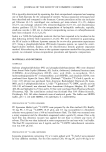
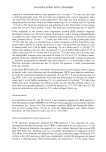
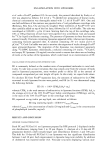
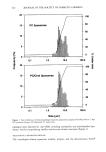
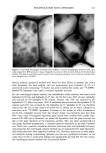
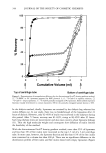
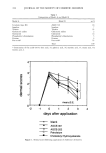
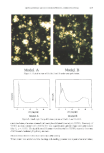
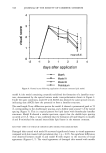
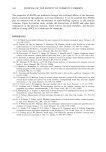
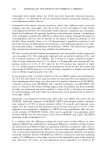
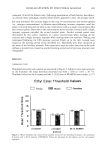
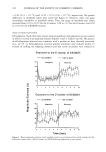
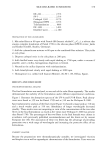
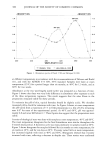
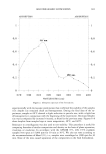
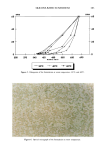
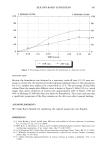
358 JOURNAL OF THE SOCIETY OF COSMETIC CHEMISTS 4 1 • mean_+S.E. o -2 -1 o 1 2 3 4 days after application = blank -- Model A o Model B [] Petrolatum Figure 6. Dermal scores following application of stratum corneum lipid model. model A (the model containing ceramide) exhibited the formation of a lameliar struc- ture, demonstrated by the optical texture under cross-polarization shown in Figure 4. Under the same conditions, model B with AGCE also showed the same optical texture, indicating that AGCEs have the potential to form a lameliar structure. The small-angle X-ray diffraction spectra for model A showed a pronounced peak at 59 fl., corresponding to the double-layer spacing, and a hollow peak around 5 fi- for lateral spacing (Figure 5). This is a typical pattern for lipid layers with bimolecular lameliar structures. Model B showed a similar spectrum, expect that the double-layer spacing occurred at 63 fi-. Thus, it was confirmed that the formation of lipid bilayers in models A and B mimicked the natural intercellular lipid layers in the stratum corneum. RECOVERY EFFECT OF STRATUM CORNEUM LIPID MODEL FOR DAMAGED SKIN Damaged skin treated with model B recovered significantly better in visual appearance compared with skin treated with petrolatum (day 3 p 0.05). No significant differences were observed between model A and model B with respect to the recovery of visual appearance (Figures 6, 7). The visual appearance of damaged skin treated with models

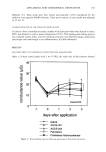
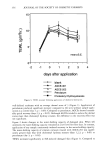
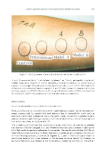
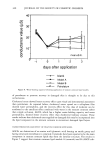
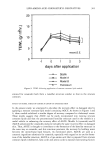
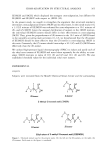
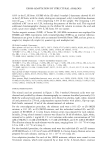
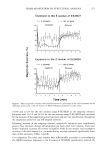
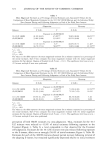
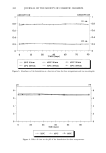
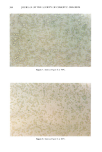
LIPO-AMINO ACID CIIOLESTERYL DERIVATIVES 359 Petrolatum Control Model A Model B Figure 7. Visual appearance of damaged skin treated with Models A and B (day 7). A and B recovered from "well-defined erythema" to "barely perceptible erythema" within three days. Models A and B induced a significant increase in water-holding capacity in damaged skin compared with petrolatum (day 3 p 0.05). No significant differences were observed between models A and B with respect to recovery of water- holding capacity or TEWL (Figures 8, 9). A significant decrease in TEWL was observed for models A and B when compared with the no-treatment condition. DISCUSSION EFFECT OF CHOLESTERYL DERIVATIVES ON DAMAGED SKIN Damaged skin shows a marked decrease in water-holding capacity in the stratum cor- neum accompanied by considerable and selective loss of intercellular lipids such as ceramide, cholesterol, cholesterol esters, and polar lipids. In contrast, a similar signifi- cant decrease in water-holding capacity could not be induced by a loss of lipids such as wax esters, squalene, or triglycerides (8). The present study evaluated the possibility of using cholesteryl derivatives to promote the recovery effect in damaged skin, and whether lipo-amino acid cholesteryl derivatives (AGCEs) could be used as a substitute for ceramide. The results showed that AGCEs are more effective than cholesteryl hydroxy stearate or petrolatum in promoting the recovery of water-holding capacity, as shown in Figures 2, 3, and 4. Occlusive agents such as petrolatum increase the water content in the stratum corneum simply by forming an occlusive film that traps beneath it the water already present in the skin (2). The ability
Purchased for the exclusive use of nofirst nolast (unknown)
From: SCC Media Library & Resource Center (library.scconline.org)