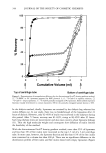
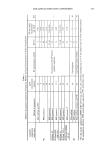
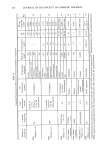
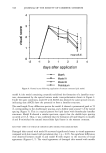
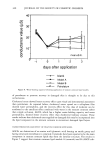
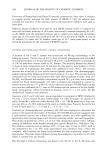
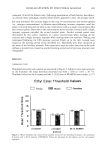
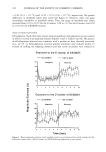
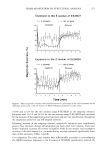
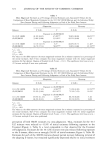
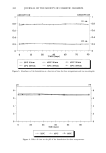
372 JOURNAL OF THE SOCIETY OF COSMETIC CHEMISTS Table I Mean Magnitude Estimates as a Percentage of Initial Estimates and Associated F-Values for the Comparison of Mean Magnitude Estimates for the 10:1 E:Z 3M2H Mixture and the Individual Ethyl Ester Isomers During and Following Adaptation to Each of the Ethyl Ester Isomers Adaptation Recovery Odorant X (S.E.) F X (S.E.) F Exposure to (E)-EE3M2H 10:1 E:Z 3M2H 41.9% (8.45) 47.28*** 59.8% (8.99) 20.05*** (E)-EE3M2H 33.8% (9.08) 53.18'** 85.2% (9.68) 2.32 Exposure to (Z)-EE3M2H 10:1 E:Z 3M2H 72.1% (12.15) 5.27 66.9% (9.77) 11.46' (Z)-EE3M2H 36.7% (7.13) 78.82*** 76.8% (3.88) 35.76*** *p .01. **p .005. ***p .001. The values in the table represent the mean magnitude estimate for an odorant expressed as a percentage of the initial estimates. Each F-test compares this mean magnitude estimate with the initial magnitude estimates for that odorant. Degrees of freedom for all F-tests = (1,11). The significance level was set at p .01 because multiple F-tests were performed. Table II Mean Magnitude Estimates as a Percentage of Initial Estimates and Associated F-Values for the Comparison of Mean Magnitude Estimates for the 10:1 Z:E 3M2H Mixture and the Individual Ethyl Ester Isomers During and Following Adaptation to Each of the Ethyl Ester Isomers Adaptation Recovery Odorant X (S.E.) F X (S.E.) F Exposure to (E)-EE3M2H 10:1 Z:E 3M2H 58.4% (7.35) 32.02*** 71.0% (6.56) 19.53'** (E)-EE3M2H 22.2% (3.66) 452.16'** 75.5% (7.65) 10.24' Exposure to (Z)-EE3M2H 10:1 Z:E 3M2H 67.0% (11.43) 8.33* 80.2% (8.68) 5.20 (Z)-EE3M2H 38.3% (9.42) 42.90*** 92.1% (9.65) 0.68 *p .01. **p .005. ***p .001. The values in the table represent the mean magnitude estimate for an odorant expressed as a percentage of the initial estimates. Each F-test compares this mean magnitude estimate with the initial magnitude estimates for that odorant. Degrees of freedom for all F-tests = (1,11). The significance level was set at p .01 because multiple F-tests were performed. perception of both 3M2H mixtures via cross-adaptation. Thus, estimates for the 10:1 E:Z mixture were reduced to 41.9% of initial estimates following exposure to the E-isomer (Figure 3, Table I), a level comparable to that observed for the E-isomer self-adaptation. Estimates for the 10:1 Z:E mixture were also reduced following exposure to the E-isomer, albeit not as strongly (58.4% of initial estimates Figure 4, Table II). Estimates for each of the 3M2H mixtures showed partial recovery following removal of the adapting E-isomer, but remained significantly depressed relative to initial estimates

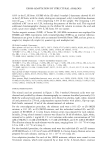
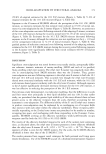
CROSS-ADAPTATION BY STRUCTURAL ANALOGS 373 (59.8% of original estimates for the 10:1 E:Z mixture [Figure 3, Table I] 71.0% of original estimates for the 10:1 Z:E mixture [Figure 4, Table II]). Exposure to the Z-isomer of EE3M2H affected the perception of the 10:1 Z:E 3M2H mixture, as intensity estimates for this mixture were reduced to 67.0% of initial esti- mates via cross-adaptation by the Z-isomer (Figure 4, Table II). However, no persistence of this cross-adaptation was noted following removal of the adapting Z-isomer estimates of the 10:1 Z:E mixture during the recovery period were 92.1% of the initial estimates (Figure 4, Table II). Estimates for the 10:1 E:Z 3M2H mixture decreased following exposure to the Z-isomer, although the reduction was not significant at thep .01 level set for comparisons (reduction to 72.1% of initial estimates Figure 3, Table I). This gradual pattern of reduction continued even following removal of the adapting odorant estimates for the 10:1 E:Z 3M2H mixture during the recovery period following exposure to the Z-isomer were significantly different from initial estimates (66.9% of baseline estimates Figure 3, Table I). DISCUSSION Significant cross-adaptation was noted between structurally similar, perceptually differ- ent odorants: isomeric mixtures of sweaty-smelling 3M2H and each of its purified, fruity-smelling ethyl ester isomers. The ethyl ester E-isomer was singularly more effec- tive in cross-adapting both 3M2H mixtures than was the Z-isomer. Thus, greater cross-adaptation was seen following exposure to the ethyl ester E-isomer in both the 10:1 E:Z and 10:1 Z:E acid mixtures. This occurred even though the ethyl ester E-isomer shared more structural similarity with the 10:1 E:Z acid mixtures, while the 10:1 Z:E acid mixture shared greater similarity with the ethyl ester Z-isomer. Although exposure to the Z-isomer significantly decreased intensity estimates for the 10:1 Z:E mixture, it was less effective in reducing the perception of the 10:1 E:Z mixture. Our previous study demonstrated, via molecular modeling, that the differences in acids and their esters were principally in their lipid solubility and size (10). In that earlier study, we postulated that the greater lipid solubility of the esters allowed them to have greater access to the olfactory receptors than the acids, therefore accounting for the asymmetric cross-adaptation. The differential ability of the E- and Z-ethyl ester isomers to produce cross-adaptation may be explained by an overlapping set of receptor fields that intersect with each other within the olfactory epithelium. Those receptors prefer- entially responding to the Z-ethyl ester isomer are postulated to be smaller in number, occupying less space, and overlapping with those responding to the E-isomer. Conse- quently, EE3M2H arriving at the olfactory epithelium would preferentially occupy receptors used by both the 10:1 Z:E or 10:1 E:Z-3M2H. The results of the olfactory threshold measures for each of the isomers were surprising since, as discussed above, the ethyl ester Z-isomer possesses a lower olfactory threshold than the ethyl ester E-isomer (Z vs E, 3.051 x 10⁻⁶% vs 4.11 x 10⁻⁵%). This is the opposite of what is seen for the 3M2H isomers. For the acids, the E-3M2H olfactory threshold is lower than that of the Z-3M2H (17,18). The results presented here suggest novel strategies for both personal and living space (room) deodorancy. Use of the EE3M2H as part of a deodorant/antiperspirant fragrance
Purchased for the exclusive use of nofirst nolast (unknown)
From: SCC Media Library & Resource Center (library.scconline.org)