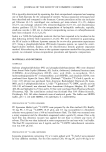
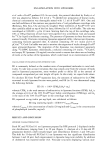
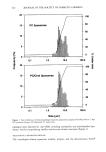
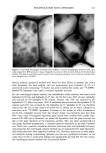
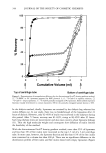
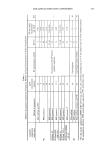
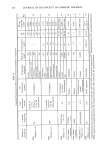
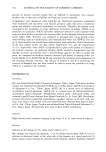
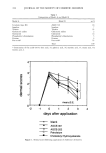
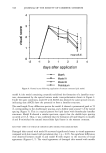
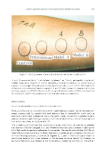
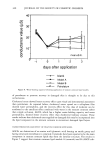
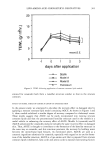
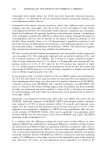
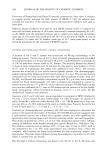
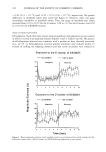
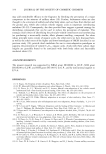
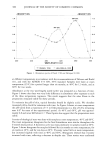
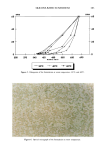
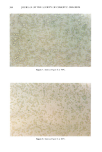
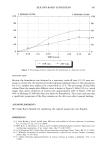
370 JOURNAL OF THE SOCIETY OF COSMETIC CHEMISTS + 0.50 (4.11 x 10⁻⁵%) and 11.95 + 0.55 (2.36 x 10⁻⁵%), respectively. No gender differences in threshold values were noted (see Figure 2). However, there was great intersubject variability in threshold values. Thus, the range of threshold step values extended from 6.25 to 16.25 for the E-isomer, 1.00 to 12.5 for the Z-isomer, and 6.50 to 16.50 for the EE3M2H mixture. TESTS OF CROSS-ADAPTATION Self-adaptation. Each ethyl ester isomer showed significant self-adaptation in each session in which it served as an adapting odorant (Figures 3 and 4, Tables I and II). The pattern of self-adaptation observed was consistent with a pattern we have observed previously (e.g., see ref. 3). Self-adaptation occurred quickly (estimates were reduced within 15 seconds of sniffing the adapting odorant) and was severe (estimates were reduced to Exposure to the E-Isomer of EE3M2H -a- (E)-EE3M2H -+- 10E:1Z3M2H 125 100, 125 IO0 0 0 Adaptation Recovery I I .... I,, T' T"-,'-.!-' I I .,,I,,,I,,.I,,,I,,.I,..I. I1{ I I.II 1,l. I I I 1 2 3 4 5 $ 7 8 9 10 Exposure to the Z-lsomer of EE3M2H -a- (Z)*EE3M2H -+- 10E:1Z3M2H Adaptation Recovery , ,J I,11 0 0 1 2 3 4 S 6 7 8 g 10 i I Time (min) Figure 3. Mean magnitude estimates (with standard errors) as a percentage of the initial estimates for the individual isomers and a 10E:lZ mixture of 3M2H following adaptation to each isomer.

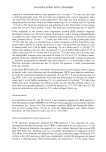
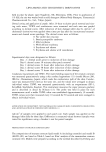
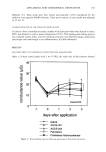
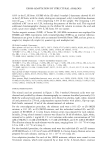
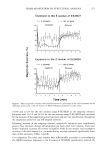
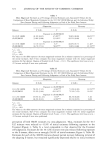
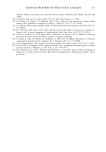
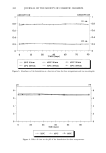
CROSS-ADAPTATION BY STRUCTURAL ANALOGS 371 Exposure to the E-isomer of EE3M21- -.•- E-EE3M2H - '- 10Z 1E 3M2H Adaptabort Recovery A 125 100 Exposure to the Z-isomer of EE3M2H -.•- Z-EE3M2H --- 10Z:1E 3M2H Adaptation Recovery I I., I, "l / i- ,I I I .t"ll--oT"l 'l i!l'i-i-iii', ,,,!./-K,•I, I ' I ' Time (min) Figure 4. Mean magnitude estimates (with standard errors) as a percentage of the initial estimates for the individual isomers and a 10Z:lE mixture of 3M2H following adaptation to each isomer. 33.8% and 22.2% for the two sessions using E-EE3M2H as the adapting odorant). Estimates were 36.7% and 38.3% for the two sessions using Z-EE3M2H and continued for the duration of the adaptation period (estimates did not vary significantly throughout the adaptation period for any self-adapted odorant). Following removal of the adapting odorant, magnitude estimates were significantly greater than estimates during self-adaptation for both ethyl ester isomers. Each ester isomer displayed a pattern of recovery to baseline levels in one session, and incomplete recovery in the other session (i.e., estimates during recovery remained significantly lower than initial estimates Tables I and II). Cross-adaptation. The ethyl ester isomers were differentially successful in cross-adapting the 3M2H mixtures. Exposure to the E-isomer of EE3M2H significantly reduced the
Purchased for the exclusive use of nofirst nolast (unknown)
From: SCC Media Library & Resource Center (library.scconline.org)