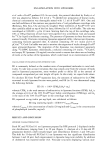
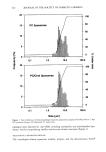
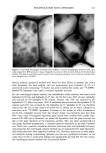
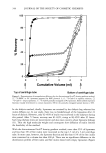
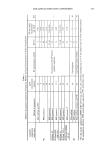
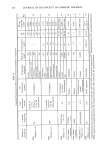
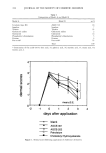
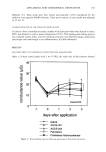
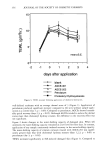
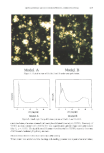
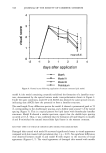
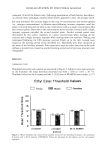
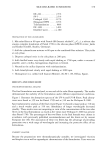
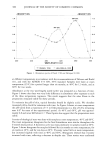
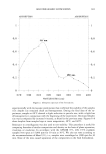
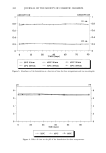
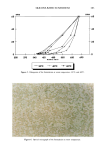
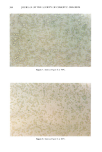
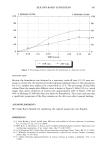
LIPO-AMINO ACID CHOLESTERYL DERIVATIVES 361 2O 10 mean+S.E. i i i i -1 0 1 2 3 days after application = blank -- Model A o Model B []-- Petrolatum Figure 9. TEWL following application of stratum corneum lipid models. stituted for ceramide) both form a lameliar structure similar tO that in the stratum corneum. EFFECT OF MODEL STRATUM CORNEUM LIPIDS ON DAMAGED SKIN In the present study, we attempted tO elucidate the recovery effect in damaged skin by applying a stratum corneum lipid model containing AGCE. As shown in Figures 1 and 6, these models exhibited a similar degree of recovery compared to cholesteryl esters. These results suggest that AGCE can be easily incorporated into existing stratum corneum lipids and that the preconstituted lameliar structure used in the models is a useful vehicle in enhancing the recovery effect of AGCE. Models A (ceramide) and B (AGCE substituted for ceramide) produced virtually the same recovery effect in damaged skin. Thus, AGCE is thought to contribute to the formation of the lameliar structure in the same way as ceramide, and this structure promotes the recovery by holding water between the intercellular lipid bilayers. As mentioned above, AGCEs are used as a cosmetic ingredient substitute for ceramide, especially with regard to its use for forma- tion of the lameliar structure. AGCE is a lipo-amino acid that is prepared from stratum corneum lipids (cholesterol, fatty acid) and amino acids (a natural moisturizing factor).

362 JOURNAL OF THE SOCIETY OF COSMETIC CHEMISTS The properties of AGCEs are produced through the combined effects of the function- alities possessed by lipo-glutamic acid and cholesterol. It can be assumed that AGCEs play an essential role in the maintenance of water-holding capacity in the stratum corneum. Topics for further study include the interactions of AGCE and other lipid components in the stratum corneum, which will be discussed elsewhere, and the pos- sibility of using AGCE as a substitute for ceramides. REFERENCES (lO) (]2) (13) (]4) (15) (]6) (17) (1) I. H. Blank, Factors which influence the water content of the stratum corneum,J. Invest. DermatoL, 18, 433-440 (1952). (2) H. Tagami, M. Ohi, K. Iwatsuki, Y. Kanamaru, M. Yamada, and B. Ichijo, Evaluation of the skin surface hydration in vivo by electrical measurement, J. Invest. Dermatol., 75,500-507 (1980). (3) G. Imokawa and M. Hattori, A possible function of structural lipids in the water holding properties of the stratum corneum, J. Invest. Dermatol., 84, 282-284 (1985). (4) M. Takenouchi, H. Suzuki, Y. Okaya, M. Ohyama, T. Kaneko, and H. Tagami, Hydration charac- teristics of the stratum corneum derived from scaly skin, J. Jpn. Cosmet. Sci. Soc., 9, 182-189 (1985). (5) G. Imokawa, S. Akasaki, and M. Hattori, Selective recovery of deranged water holding properties by stratum corneum lipids,J. Invest. Dermatol., 87, 758-761 (1986). (6) W. Abraham, P. W. Wertz, and P.M. Elias, Fusion patterns of liposomes from stratum corneum lipids,J. Invest. Dermatol., 90, 259-262 (1988). (7) S. Akasaki, Y. Minematsu, N. Yoshizuka, and G. Imokawa, The role of intercellular lipids in the water holding properties of the stratum corneum--Recovery effect on experimentally induced dry skin,Jpn. J. Dermatol., 98, 41-51 (1988). (8) G. Imokawa and Naonobu Yoshizuka, Skin lipid film and its role in skin conditions, FragranceJ., 64, 84-89, (1984). (9) S. Freeman and H. Maibach, Study of irritant contact dermatitis produced by repeat patch test with sodium lauryl sulfate and assessed by visual methods, transepidermal water loss, and laser doppler velocimetry, J. Am. Acad. Dermatol., 19, 496-502 (1988). P.J. Frosch and A.M. Kligman, The soap chamber test, J. Am. Acad. Dermatol., 1, 35-41 (1979). G. Imokawa and S. Akasaki, Water-retaining function in the stratum comeurn and its recovery properties by synthetic pseudoceramides,J. Soc. Cosmet. Chem., 40, 273-285 (1989). J. Pinnagoda, R. A. Tupker, T. Agner, and J. Serup, Guidelines for transepidermal water loss (TEWL) measurement, Contact Dermatitis, 22, 164-178 (1990). G. E. Nilsson, Measurement of water exchange through skin, Med. Biol. Eng. Cornput., 15, 209-218 (1977). K. P. Wilhelm, C. Surber, and H. Maibach, Quantification of sodium lauryl sulfate irritant dermatitis in man, Arch. Dermatol. Res., 281,293-295 (1989). K. P. Wilhelm and H. I. Maibach, Skin color reflectance measurement for objective quantification of erythema in human beings, J. Am. Acad. Dermatol., 21, 1306-1308 (1989). L. C. Froebe, F. A. Simon, H. O. L. Rhein, J. Mattai, R. H. Caganand, and S. E. Friberg, Prevention of stratum corneum lipid phase transitions in vivo, by glycerol,J. Soc. Cosmet. Chem., 41, 51-65 (1990). S. E. Friberg and D. W. Osborne, Small angle x-ray diffraction patterns of stratum corneum and a model structure for its lipids, J. Di•p. Sci. Technol., 6, 485-495 (1985).
Purchased for the exclusive use of nofirst nolast (unknown)
From: SCC Media Library & Resource Center (library.scconline.org)