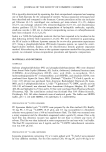
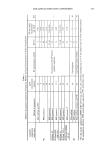
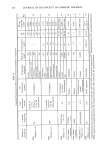
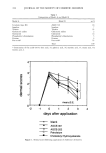
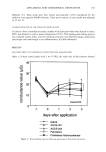
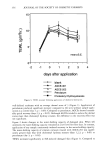
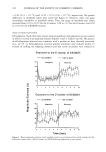
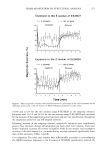
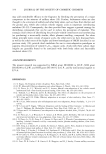
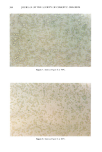
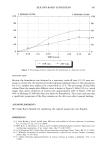
384 JOURNAL OF THE SOCIETY OF COSMETIC CHEMISTS Figure 7. Same as Figure 6 at 40øC. Figure 8. Same as Figure 6 at 60øC.

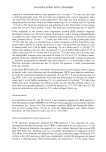
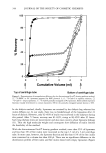
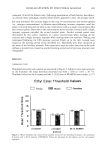
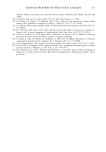
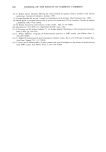
SILICONE-BASED SUNSCREENS 385 % RELEASED FILTER % RELEASED FILTER 100 100 80- 60- 40- 20- 0.25 0.5 0.75 1 1.25 2.75 24 TIME (hours) ß 310 rim. • 359 nm. Figure 9. Percentage of filters released by the formulation as a function of time. WASH-OFF TESTS Because the formulation was designed as a sunscreen, wash-off tests (13,14) were nec- essary to ensure that the silicones provided adequate substantiveness to the preparation. For 24 h, samples were subjected to a water flow at 25øC. The percentage of solar filter released from the sample after different times is shown in Figure 9. After 24 h (i.e., much longer than under conditions of normal use), approximately 40% of Parsol 1789 and 60% of Heliopan E-1000 had been lost from the formulation. This result indicates that a significant proportion of the filter remains on the skin even after repeated bathing. ACKNOWLEDGMENTS We thank Karen Shashok for translating the original manuscript into English. REFERENCES (1) J. Smid-Korbar, J. Kristl, and M. Stare, Efficiency and usability of silicone, surfactants in emulsions, Int. J. Cosmet. Sci., 12, 135-139 (1990). (2) M-•A. Ruiz, A. Hernlndez, A. Parera, and V. Gallardo, Dimethylsiloxane polymers: Vaporization rate test/freezing temperatures,J. Soc. Cosmet. Chem., 46, 175-180 (1995). (3) A.J. Disapio and M. S. Starch, New silicones emulsifier technology, Cosmet. Toilerr., 96, 55-57 (1981). (4) C. Willemin, Param•tres de solubilit& Caract•risation et selection des silicones, Parf•ms, Cosmetiq•es, Arames, 102, 75-78 (1992). (5) C. Cabeza, Derivados organomodificados de silicona, Noticias de cosmdtica y perfamer/a, 173, 17-24 (1990).
Purchased for the exclusive use of nofirst nolast (unknown)
From: SCC Media Library & Resource Center (library.scconline.org)