90 JOURNAL OF COSMETIC SCIENCE REFERENCES (1) M. I. Morasso, A.M. Thielemann, C. Pinto, M. Figueroa, and A. Arancibia, In vitro and in viva study of the substantivity of p-aminobenzoic acid and two of its esters,J. Sac. Cosmet. Chem., 36, 355 (1985). (2) R.M. Sayre, P.P. Agin, D.L. Desrochers, and E. Marlowe, Sunscreen testing methods: In vitro predictions of effectiveness, J. Sac. Cosmet. Chem., 31, 133 (1980). (3) F. Greiter, P. Bilek, S. Doskoczil, J. Washuttl, and F. Wurst, Methods for water resistance testing of sun protection products, Int. J. Cosmet. Sci., 1, 147 (1979). (4) R. M. Sayre, E. Marlowe, P. PohAgin, G. J. LeVee, and W. Rosenberg, Performance of six sunscreen formulations on human skin, Arch. Dermatal., 115, 46 (1979). (5) Sunscreen drug products for over-the-counter human use tentative final monograph, Federal Register, 58, 28194-28302 (1993). (6) G. M. Lazar, A. Baillet, A. E. Fructus, J. Arnaud-Battandier, D. Ferrier, and J. P. Marty, Evaluation of in vitro percutaneous absorption of UV filters used in sunscreen formulations, Drug Cosmet. Ind., 158, 5O (1996). (7) H. M. Fares and J. L. Zatz, Dual-probe method for assessing skin barrier integrity: Effect of storage conditions on permeability of micro-Yucatan pig skin, J. Soc. Cosmet. Chem., 48, 175 (1997). (8) G.P. Kushla, Studies of lidocaine permeation through hairless mouse skin from propylene glycol- water mixtures. M.S. Thesis, Rutgers University, New Brunswick NJ. (1986). (9) K. Kaidbey, "Substantivity and Water Resistance of Sunscreens," in Sunscreens, Development, Evaluation, and Regulatory Aspects, N.J. Lowe and N. Shaath, Eds. (Marcel Dekker, New York, 1990), pp. 405-410. (10) P. Treffel and B. Gabard, Skin penetration and sun protection factors of ultra-violet filters from two vehicles, Pharm. Res. 13, 770 (1996).

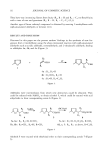
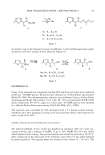
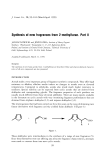
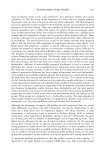
j. Cosmet. Sci., 50, 91-98 (March/April 1999) Synthesis of new fragrances from 2-methylfuran. Part I JANUSZ NOWICKI and J(SZEF G6RA, Institute of Heavy Organic Synthesis, "Blachownia," Energetyk6w 9, 47-225 Kqdzierzyn-Kogle, Poland, and Institute of General Food Chemistry, Technical University of L6dz, Stefanowskiego 4/10, 90-924 oeddz, Poland. Synopsis The synthesis of new 2-methylfuran derivatives are described. Odor and physicochemical characteristics of all new compounds are also presented. INTRODUCTION 2-Methylfuran 1 is one of the furan intermediates manufactured on a large scale. It is the main byproduct in the process of hydrogenation of furfuryl aidehyde to furfuryl alcohol. Being low-priced and readily available in the market worldwide, 2-methylfu- ran is an attractive intermediate in light organic synthesis. A very interesting trend is the application of 2-methylfuran to the synthesis of fra- grances. There are several reports on this subject. 2-Methylfuran is known to readily undergo on electrophilic type of condensation. Condensation with acetaldehyde in cer- tain weight ratios leads to the formation of 1,1-(5-methylfurfuryl)-ethane 2 (Figure 1), which has a citrus-flower fragrance (1). 271 U + + CH3CHO • Figure 1. In the Friedel-Crafts reaction with acid anhydrides, acylfuranes 3 are obtained (Figure 2): i R3 O O••2 3 1 O R• Figure 2. 91
Purchased for the exclusive use of nofirst nolast (unknown)
From: SCC Media Library & Resource Center (library.scconline.org)