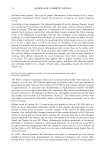
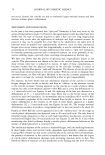
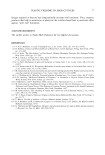
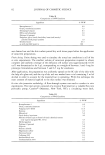
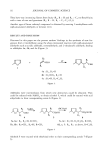
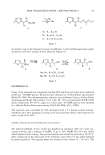
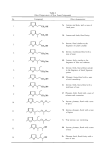
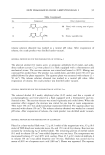
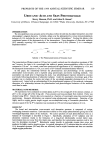
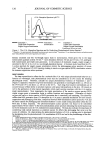
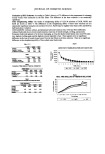
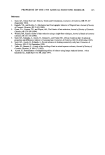
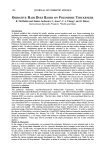
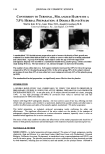
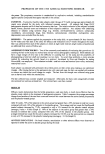
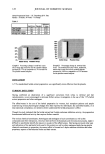
PLASTIC YIELDING IN HAIR CUTICLES 73 3b Figure 3. Macroscopic long longitudinal cracks found in hair fibers as follows: (3a) after the application of 20 cycles, 30 turns/inch per cycle at 10% RH (3b) typical crack found at the tip section of a hair fiber undergoing "split end." The hair was from a person in the panel of 100 individuals. 3c: Pattern of cuticle wear shown by a hair fiber after being subjected to 120,000 combing strokes with a combing wheel. 3d: Micrograph of a hair fiber after the application of 20 torsion cycles with 15 turns/inch/cycle at 10% RH. These observations indicate that the lack of cuticles in the torsioned fibers is not due to cuticle wearing. Rather, the cuticular material is still there and the apparent absence of cuticles is due to the prospect that they have lost their structure and boundaries due to extreme torsional forces. In Figure 1 b, for example, a portion of nondamaged cuticle can be seen extending continuously into a zone of damage and losing its structure. Surface damage with such characteristics is also commonly observed in polymers and is known as "crazing." Crazing is a form of plastic deformation, almost unique to polymers, and appears as a "whitening" of the material when subjected to intense and repetitive

74 JOURNAL OF COSMETIC SCIENCE localized shear stresses. This type of plastic deformation is also known to be a stress- dissipative mechanism, which retards the occurrence of fracture in brittle polymers (9,10). According to these arguments, the observed patterns of cuticle damage (Figures la and 2a), consisting of microvoids, microcracks, and thin, long, vertical cracks, constitute a form of crazing. They may appear as a consequence of a localized plastic deformation process. Such a process results from torsional shear stresses produced by fiber twisting, either in the laboratory or naturally when the hair undergoes severe tangling during combing. It is well known from the basics of mechanics that when an object of cylin- drical shape is subjected to torsion, the maximum shear strain always occurs at its surface (13). If such a shear strain is within the elastic or viscoelastic limit, the deformation process is reversible and no damage occurs in the material. However, if the shear strain increases beyond this limit, plastic deformation starts to take place at the surface until the whole material cracks (10). These principles may explain why at low twisting levels the cuticles deform viscoelastically without any damage, and why at high degrees of twisting they deform plastically by craze formation when their viscoelastic limit is exceeded. The same arguments may explain why at higher torsional strain levels the microcracks and microvoids on the cuticles coalesce and form a thin fracture channel that develops further into a longer vertical crack, propagating toward the cortex (see Figure 3a). EFFECTS OF HAIR TORSION ON THE CUTICLES AT INTERMEDIATE AND HIGH RELATIVE HUMIDITIES The fibers' torsional viscoelastic strain limit increased substantially with moisture. For instance, at 10% and 30% RH the maximum viscoelastic strain level was attained at approximately eight turns per inch, while at 65% RH the limit almost tripled, resulting in approximately 25 turns per inch. Furthermore, at high moisture content the fibers were seen to recover faster than when dry, indicating that during moisturization they become more elastic. No damage was observed on the highly moisturized cuticles when the number of turns/inch/cycle was between 19 and 25. This observation contrasts with that made at low relative humidities, where cuticular damage was already seen at this level of torsion. Higher levels of torsion (30-35 turns/inch/cycle) applied to hair at 65% RH lead to a form of cuticle deformation somewhat similar to that already observed under dry con- ditions at lower levels of torsion. A closer analysis of the cuticles by SEM revealed, however, that the helicoidal damaged patterns of hair torsion fatigued at 60% RH were absent of microvoids and microcracks. Instead, the cuticular material in the damaged regions appeared very smooth, and no traces of boundaries or endocuticular layers were found (see Figures 4a and 4b). Plastic deformation without microcrack or microvoid formation in polymers is known as "shear band formation." It is known to occur above the glass transition temperature when the polymer is more ductile (14,15). Fracture of the hair fiber at 65% RH was found to occur only at deformation levels higher than 40 turns/inch/cycle. At 100% relative humidity the hair fibers were able to withstand an even greater number of turns per inch, approximately 45, without any damage to the cuticles. Also, the hair fibers' behavior was seen to be predominantly elastic. Levels of twisting higher
Purchased for the exclusive use of nofirst nolast (unknown)
From: SCC Media Library & Resource Center (library.scconline.org)