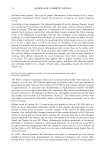
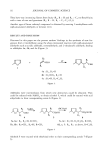
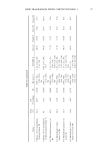
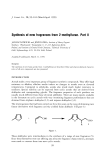
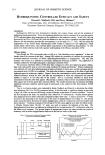
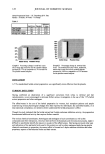
92 JOURNAL OF COSMETIC SCIENCE They have very interesting flavors from fruity (R2, R = H and R• C2) to floral-fruity with a note of rose and geranium (R2, R -- H, R• = C•-C3) (2,3). Another type of furan carbonyl compound is obtained by reacting 2-methylfuran with ot,•-unsaturated aldehydes or ketones (4,5). RESULTS AND DISCUSSION Discussed in this paper are the present authors' findings in the synthesis of new fra- grances from 2-methylfuran using the above-mentioned reaction with o•,[3-unsaturated aldehydes such as acrylic aidehyde, crotonaldehyde, and 2-ethylacrylic aidehyde, leading to aldehydes 4a, 4b, and 4c (Figure 3): •CHO H+ • + RI •- •CHO 1 R• 4a: R1, R2=H 4b: Ri=CH3, R2=H 4c: R•=H, R2=C2H 5 Figure 3. Aldehydes were intermediates from which new derivatives could be obtained. They could be reduced with NaBH 4 to obtain alcohol 5, which could be reacted with acid anhydrides to their corresponding esters 6 (Figure 4): • NaBH4• - CHO R1 4 5a, 6a: R•, R2=H, R=CH• 5b, 6b: R•=CH•, R2=H , R=CH• R2 "'-6 "["' 'CH2OH R• R• 5 6 5c, 6c: R•=H, R2=C2H5, R=CH 3 6d, e, f: R•, R 2- as above, R=C2H 5 Figure 4. Alcohols 5 were reacted with ethylvinyl ether to their corresponding acetals 7 (Figure 5):

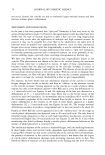
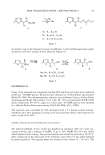
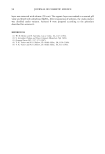
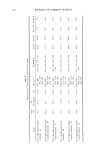
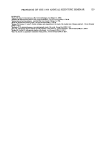
NEW FRAGRANCES FROM 2-METHYLFURAN: I 93 •CH2OH R1 5 7a: R•, R2=H 7b ' R•=CH 3, R2=H 7c: R•=H, R2=C2H 5 ••R1R20Tø• 7 Figure 5. As another step in the Grignard reaction of aldehydes 4 with methylmagnesium iodide, alcohols 8, and their acetates 9 were obtained (Figure 6): O AcONa R1 4 8 9 8a, 9a: R•=CH 3, R•=H 8b, 9b ß R•-H, R•=C•H 5 EXPERIMENTAL Figure 6. Purity of the obtained new compounds reached 98% and their structures were confirmed by IR and •H-NMR spectra. IR spectra were obtained in a Perkin-Elmer spectrometer Model SP-1000: Gas chromatographic analyses were performed using a Perkin-Elmer chromatograph Model 900 (column 1.8 m, LAC 2R, 15% on chromosorb WAW 60/80 mesh, temperature 80-195øC, argon as a carrier gas). •H-NMR spectra were obtained in a Hitachi-Perkin-Elmer spectrometer R24A (80 MHz, CC14, TMS). The reactions were controlled by TLC developed with a 9:1 hexane-acetone mixture. Aldehydes 4a-c were prepared according to the procedure described in the literature (5), with a yield of 45-66%. GENERAL PROCEDURE FOR PREPARATION OF ALCOHOLS 5 The selected aldehyde 4 (0.47 mole) was dissolved in methanol (200 cm 3) with con- tinuous stirring, and a solution of NaBH 4 (4 g) in 10% NaOH (80 cm 3) was slowly added dropwise with cooling. The reaction medium was stirred for one hour at 40-50øC. After evaporation of the major part of the methanol, water (50 cm 3) was added followed by phase separation. The aqueous phase was extracted with toluene (2 x 50 cm3). The
Purchased for the exclusive use of nofirst nolast (unknown)
From: SCC Media Library & Resource Center (library.scconline.org)