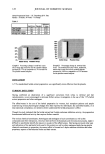
PLASTIC YIELDING IN HAIR CUTICLES 75 4a 2kx 4b .. . 8tc • 2. 6k x • 664 Figure 4. Helicoidal patterns of cuticle damage produced after the application of 20 torsion cycles, 35 turns/inch per cycle at 65% RH. (a) x0.42k (b) x2.6k. than 50 turns/inch resulted in cuticle and cortex fracture, with no cuticle shear bands or craze formation. For example, Figures 5a and 5b display hair that has been fractured at 100% RH by applying 20 cycles with 50 turns per inch per cycle. These micrographs demonstrate that the boundaries and structure of the cracked cuticles are still well defined after such deformations. This implies that at large torsional strains and at high relative humidities, plastic deformation of the cuticles by crazing and shear bands does kv 3• 5b Figure 5. Macroscopic long longitudinal cracks produced after the application of 20 torsion cycles, 50 turns/inch per cycle at 100% RH. (a) x0.54k (b) x0.45k.

76 JOURNAL OF COSMETIC SCIENCE not occur. Instead, the cuticles are able to withstand larger torsional strains and they fracture without plastic deformation. DISCUSSION AND CONCLUSIONS In the past it has been proposed that "split end" formation in hair may occur by the action of longitudinal stresses (5). However, the experimental results described here have shown that the type of fracture required to split a hair into two long longitudinal sections only occurs after the application of multiple and high torsional stresses. In practice it may not be possible for a hair fiber to be subjected to the same level of torsional stress as applied here experimentally. However, since no other mechanical fatigue stress except torsion splits hair longitudinally, it may be concluded that it is the accumulation of irreversible torsional deformations that leads to "split end" formation. In everyday grooming practices such a cumulative process can occur gradually at suc- cessive combing stages, especially those involving entanglements at the hair tips. We have also shown that the process of splitting hair longitudinally begins at the cuticles. This phenomenon was shown to be due to the cuticles bearing the maximum shear stresses when hair is subjected to torsion. In light of these considerations, it becomes evident that the physical integrity of the cuticular envelope is crucial in protecting the hair fiber against "split end" formation. The absence of cuticles will place the maximum torsional stresses at the cortex surface. With no cuticles to dissipate these torsional stresses, the fiber will split. Moisture in the cuticles is another parameter that was seen to increase the torsional threshold for a fiber to split longitudinally. For instance, we have shown that the mechanical response of the cuticles to torsion fatigue changes from brittle to ductile, and then to "rubbery" as the moisture content in the cuticles increases. Crazing appeared on the cuticles as a result of plastic defor- mation, but only at low moisture content (=10% RH) and at a very low deformation (12 + 3 turns/inch/cycle) (see Figures la and lb). Splitting of the hair was observed at a deformation of 27 + 3 turns/inch/cycle, most likely due to the brittle nature of the cuticles at such low humidities. At intermediate relative humidities (65% to 85% RH) the viscoelastic properties of the cuticles changed from brittle to ductile. As a result, plastic deformation in the cuticles, in the form of shear bands, appeared at a higher deformation (32 + 3 turns/inch/cycle) (see Figures 4a and 4b). The average torsional deformation necessary to produce a longitudinal split in hair was found to be about 40. Finally, at 100% RH the cuticles appeared to be in the "rubbery state." At this stage no cuticle plastic deformation was observed, even at 40 turns/inch/cycle. The only form of torsional energy dissipation in hair at such high humidities was fracture, occurring at torsions levels higher than 50 turns/inch/cycle (see Figures 5a and 5b). It is also worth mentioning that brittle polymers display a similar plastic deformation behavior as the amount of added plasticizer is increased (14). The mechanical response of the cuticles to torsional fatigue, with the resulting formation of shear bands, crazes, and vertical cracks, dependent upon humidity, indicates a plas- ticizing effect of water not only in the cortex but also in the cuticles (8,16). Furthermore, the presence of moisture in the cuticles is beneficial since it was shown that the degree of cuticle plastic deformation decreases with increasing moisture levels in hair. The beneficial effects of moisture are also manifested in the finding that the level of torsion
Purchased for the exclusive use of nofirst nolast (unknown)
From: SCC Media Library & Resource Center (library.scconline.org)