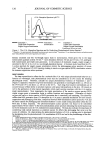
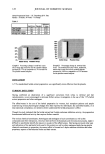
PREPRINTS OF THE 1999 ANNUAL SCIENTIFIC SEMINAR 119 UROCANIC ACID AND SKIN PHOTODAMAGE Kerry Hanson, Ph.D. and John D. Simon* University of Illinois, Urbana-Champaign, IL 61820, *Duke University, Durham, NC 27708 INTRODUCTION: The role epidermal trans-urocanic acid (t-UA) plays within the skin has elucidated researchers since the chromophore's original discovery. Currently, debate over the photoprotective versus immunomodulatory behavior of t-UA excludes the use of urocanic acid in cosmetic formulations. I Fueling this debate is the complicated nature of the photoreactivity of the chromophore. Upon absorption of ultraviolet radiation (UV) naturally occurring t-UA isomerizes to cis-urocanic acid (c-UA) (Scheme 1) in a wavelength- dependent manner. 2 __ / COOH __ HN •.N :"' N.-:. • NH Scheme 1. The Photoisomerization of Urocanic Acid The isomerization efficiency peaks at 310 nm, but is greatly reduced near the absorption maximum of 280 nm 2 however, the latter is at a wavelength that induces a greater immunomodulatory effect in the skin compared to 3 l0 nm? As a result, some have questioned the significance of UV absorption by t-UA, and the subsequent isomerization to c-UA, as a source of UV-induced immunomodulatory behavior. In this paper, the relationship between the photoreactivity and photobiology of the epidermal chromophore trans-urocanic acid is explored using spectroscopic and kinetic modeling methods. One assumption was made prior to beginning this study: Any photobiological response initiated by urocanic acid results following absorption of ultraviolet radiation. Under this assumption, the primary goal of this program was to elucidate the nature and origin of the wavelength-dependent photoreactivity of trans- urocanic acid. Armed with an understanding of the photochemical response of the molecule, subsequent discussion of a relationship between the photochemical and photobiological behaviors of the molecule could then be made. MATERIALS AND METHODS: All experiments were conducted in solution phase at pH 5.6, the average pH of the stratum corneum, or pH 7.2, the average pH of the living cell. Trans-urocanic acid was purchased from Aldrich. Purity was checked using HPLC. Kinetic data were acquired as a function of wavelength using time-resolved laser spectroscopy. Energetic information was acquired using photoacoustic spectroscopy. Detection of the highly reactive oxygen species singlet oxygen was accomplished using a Germanium photodiode. The emission signal of the 3•. •-IA transition was monitored at 1270 nm following irradiation of t-UA. RESULTS: n The broad and structureless trans-urocanic acid absorption spectrum is composed of unique, overlapping electronic transitions. Each transition exhibits its own unique photochemistry giving rise to the wavelength-dependent nature of the molecule. The action spectrum of each photochemical event as a function of wavelength is described in Figure 1. Specifically, absorption of UV radiation near the absorption maximum results in the formation of a long-lived electronically excited triplet state. Isomerization does not occur from this triplet state, and therefore the isomerization quantum yield is low near the absorption maximum? Bimolecular energy transfer to molecular oxygen does occur and produces the highly reactive singlet oxygen. In contrast, absorption of UV radiation near the red-tail of the t-UA absorption spectrum (310 nm) does not efficiently lead to triplet formation and does not sensitize singlet oxygen production.

120 JOURNAL OF COSMETIC SCIENCE Transition 3 t-UA Absorption Spectrum pH 7.2 ß I I I 1 240 280 320 360 Wavelen•h (nm• Transition 2 -- Triplet State Generation Singlet Oxygen Sensitization Isomerization Transition 1 Triplet State Generation Singlet Oxygen Sensitzation Transitions are not to scale Figure 1. The t-UA Absorption Spectrum and Its Underlying Photochemical Action Spectra.* * Transition 1 • is experimentally determined by photoacoustic spectroscopy, Transittons 1-2 are based upon kinetic and photoacousttc data 4 and published isomerization quantum yieM values. • Instead, excitation near this wavelength region leads to isomerization, which gives rise to the large isomerization quantum yield at 310 nm. 2'4 Upon absorption between 310 nm and 351 nm, t-UA undergoes both isomerization and triplet state generation. In the presence of molecular oxygen, singlet oxygen is sensitized in the UV-A by t-UA in a wavelength-dependent manner. A literature study found that the UV- A action spectrum for singlet oxygen sensitization mimics the photosagging action spectrum of mouse skin, 4-5 and the proposed UV-B/C transition leading to reactive oxygen species (ROS) sensitization mimics the immune suppression action spectrum. 3 DISCUSSION: The data reported herein reflect that for a molecule like t-UA with unique photochemical behavior as a function of wavelength, each photochemical event must be considered as its own source for initiating physiological events. Therefore, consider the unique photochemical behavior of Transitions 1 and 3 (Figure 1) separately. Reactive long-lived intermediates are generated at wavelengths below ca. 270 nm in the UV-B and UV-C and above ca. 320 nm in the UV-A. Such long-lived reactive intermediates are of concern because of their ability to sensitize reactions with natural chromophores in the skin. Of concern as well is the application of other topical ingredients which could sensitize reactions with the t-UA reactive triplet intermediate(s). Most importantly, the triplet sensitization of the reactive oxygen species (ROS) singlet oxygen poses a tremendous threat to cellular functions and components. Generation of singlet oxygen can lead to a chain reaction of ROS generation that is essentially self-sustaining. This discovery reflects that ROS generation from UV absorption by t-UA poses a potential mechanism for both immune suppression and photoaging of the skin comparison between ROS-sensitization action spectra by t-UA and the action spectra for photoaging and immunomodulation is easily made raising speculation about the role ROS play in these responses. The photoisomerization action spectrum was found to be red-shifted approximately 40 nm relative 4 to the immunomodulation action spectrum indicating that isomerization may not be the dominant source oft-UA-mediated immunomodulation. The data also indicate the importance of considering weak optical transitions as potential sources for effects like photoaging that occur over the course of a lifetime. By characterizing the photochemical behavior of t-UA, a starting point is developed for deciphering how the photochemical t-UA-sensitization of ROS can lead to the photodamage of the skin. References: I Cosmetic Ingredtent Review Panel. FinatReport on the Safety A.* •essment ofUA. d. Am. Col/. Toxtc. 14. 386 (1995) 2 Mon-ison. H. Bernasconi. C. Pandey. G A P/avelength Effect •m UA t•)•Z Photoisomerizatitnt. Photochem. Photobiol. 40. 549 (I 984) 3 DeFabo. EC.Noonan. F P MechanismoflmmuneSnppre.•.•ionbyUVIrraditi•ntinvivo J. Erp. Med 155.84(1983) 4 Hanson. K M. Simon. J D The UV-.4 Photoreactivity oftra..t.*-Uroca, ic .4cid and the Photoaging of the SMn. Proc. Natl..4ca• Sci.. 95. 10576 (1998). Hanson. K M. Simon. J D The Origin of the P/avetength-Depemlent Photoreactivity oftrans-Urocanic .4cid Photochem. Photobiol. 67. 538 (1998). Hanson. K M. Simon. J D /'he Photochemtcat Iaomerization Kinetics of Urocaoic .4cid aml Their Effects ulnm the In Vitro aml In Viw• Photoi*'omeri:ation .4ctiot Spectra. Photochem Photobiol.. 66. 819 (1997). Hanson. K M. Li. B. Simon. J D ,4 Spectroscopic Sludy oflhe Epidermal Chromophore tra,.*-Urocanic ,4cid J. ,4m. Chem. Soc.. 119. 2715 (1997). Li. B. Hanson. K M. Simon. J D /'he Primary Processes of the Electronic I•cited State of t-Urocansc ,4cid J. Phy.*. Chem . I01. 969 (1997). Hanson. K M. Simon. J D Photochemistry of Urocanic ,4cid: Evidence that U,4 ShouM Be Used with Caution in Cosmetic Formulatio, c J. Stsc. Cos. Chem. 4•. 151 (May/June 1997) 5 BiaseL D L. Harmon. D P. On-. T V P/avelength Depetnlence of Hi.*'tological. Phy.*ical. and Via'ible Changes in Chrtmically UV-Irradiated Hairle.• Mouse Skin. Photochem. PhotobioL SO. 763 (1989)
Purchased for the exclusive use of nofirst nolast (unknown)
From: SCC Media Library & Resource Center (library.scconline.org)