98 JOURNAL OF COSMETIC SCIENCE layer was extracted with toluene (50 ccm). The organic layer was washed to a neutral pH value and dried with anhydrous MgSO 4. After evaporation of solvents, the crude product was distilled under vacuum. Acetates 9 were prepared according to the procedure described for acetates 6. REFERENCES (1) W. H. Brown and H. Sawitzky, Can. J. Chem., 34, 1147 (1956). (2) S. Arctander, Perfume and Flavor Chemicals (Montclair, NJ, 1969). (3) German Patent DE 3 527 975 (1987). (4) Y. K. Yuriev and N. S. Zefirov, Zh. Obshch. Khim., 30, 1150 (1960). (5) Y. K. Yuriev and N. S. Zefirov, Zh. Obshch. Khim., 33, 411 (1963).

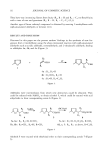
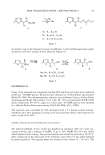
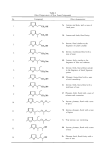
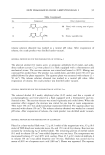
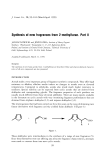
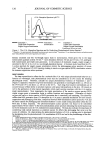
j. Cosmet. Sci., 50, 99-104 (March/April 1999) Synthesis of new fragrances from 2-methylfuran. Part II JANUSZ NOWICKI and J6ZEF G6RA, Institute of Heavy Organic Synthesis, "Blachownid," Energetykgw 9, 47-225 Kqdzierzyn-Kooele, Poland, and Institute of General Food Chemistry, Technical University of Lgdoe, Stefanowskiego 4/10, 90-924 Lgdoe, Poland. Accepted for publication March 31, 1999. Synopsis The synthesis of new furan acetals from 2-methylfuran are described. Odor and physicochemical character- istics of all new compounds are also presented. INTRODUCTION Acetals make a very important group of fragrance synthetic compounds. They offer high resistance to alkalies alkaline media induce no changes in acetals even at elevated temperatures. Compared to aldehydes, acetals also reveal much higher resistance to oxidizers. Special stability can be expected from cyclic acetals that are derived from aldehydes and corresponding glycols. The fragrance properties of such products are usually much different from those of initial aldehydes. There are many reports available in the literature on cyclic acetals with very interesting fragrance performances that are obtained from aliphatic aldehydes (1,2) and terpene aldehydes (3,4). The investigations that had been carried out for a few years on the ways of obtaining new furane derivatives with fragrance activity yielded furan aidehyde 1 (Figure 1): R R 1 Figure 1. These aldehydes were intermediates in the synthesis of a range of new fragrances (5). Since they themselves were not offering any attractive fragrance characteristics, attempts were made to convert them into new cyclic acetals. 99
Purchased for the exclusive use of nofirst nolast (unknown)
From: SCC Media Library & Resource Center (library.scconline.org)