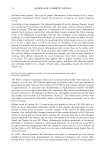
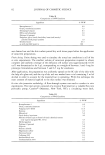
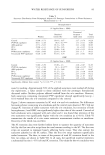
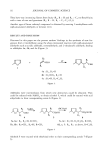
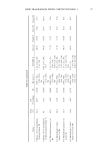
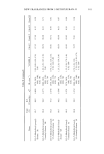
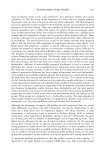
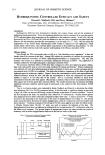
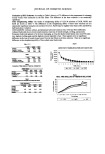
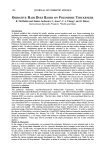
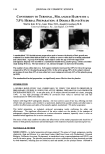
PREPRINTS OF THE 1999 ANNUAL SCIENTIFIC SEMINAR 117 FORMULATING FOR THE UNIQUE ATTRIBUTES OF MATURE SKIN Zoe Diana Draelos, M.D. Dermatology Consulting Services, High Point, NC 27262 Introduction The skin undergoes constant change, adapting to environmental stresses, the cumulative effects of ultraviolet (UV) radiation, and hormonal fluctuations. These changes become more pronounced with maturity, creating formulation challenges in this age group. This paper discusses the unique attributes of mature skin in hopes of aiding in the formulation of efficacious products for this expanding population segment. Data 1. Artatomic and Physiologic The pertinent data collected regarding age related cutaneous differences in physiology and functioning is presented in tabular form. The data is also compared for various races. EVALUATED CAucASIA• ' HISPANIC SKIN" ASIAN BLACK SKIN'" MATURE SKII• PARAMETER SKIN' SKIN' SC THICKNESS 7.2 MICRONS 6.S MICRONS EPIDERMIS BECOMES MORE COMPACT WITH AGE SC LAYERS 17 22 NO CHANGE TEWL FOLLOWING HIGHER THAN " HIGHER THAN LOWER IN HEALTHY SLS EXPOSURE TM WHITE FOLLOWING WHITE FOLLOWING AGED SKIN 2% SLS PREOCCLUDED SKIN 0.5% SLS TEWL FOLLOWING HIGHER THAN HIGHER THAN NO CHANGE TAPE STRIPPING WHITE WHITE CORTICOSTEROID HIGHER PERMEATIOI • LOWER PERMEATIDI NO CHANGE PENETRATION •' THAN BLACK THAN WHITE VESSEL REACTIVITY HIGHEST SAME AS WHITE LESS NO AGE-RELATE D SKIN DIFFERENCE STINGING GRI•,•TEST POSSIBLY LESS POSSIBLY LESS SUSCEPTIBILITY , ,, MELANOGENESIS DECREASED EXFOLIATION DECREASED ABILITY ABILITY TO HEAL DECREASED AND WITHSTAND TRAUMA RESPONSE TO"' 'ERYTHEMA ERYTHEMA HYPER- POSSIBLY' LESS IRRITATION AND HYPER- PIGMENTATION PIGMENTATION •WEAT GLAND-• FENNER APOCRINE- MOR E APOCRINE- NO CHANGE ECCRINE GLANDS ECCRINE GLANDS CERAMIDE LEVELS v' INTERMEDIATE INTERMEDI•TE"HIGH HIGHEST ' ' LOWEST DECR•ASE'D wITH AGE

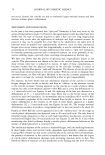
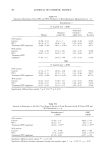
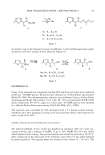
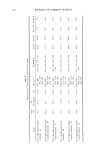
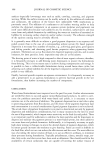
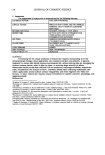
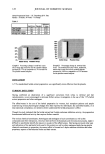
118 JOURNAL OF COSMETIC SCIENCE 2. Appearance The appearance of mature skin is characterized by the following features. CUTANEOUS FEATURE AGED SKIN APPEARANCE SURFACE TEXTURE RETAINED SKIN SCALE BROWN TONES RED TONES YELLOW TONES TISSUE REBOUND SKIN THICKNESS SUBCUTANEOUS FAT IRREGULAR WITH COARSE AND FINE WRINKLES, NUMEROUS CRUSTY GROWTHS (SEBORRHEIC KERATOSES) EXCESSIVE,, ES ,PECIALL,Y ' ,OVE, R JOJNTS , MOTTLED WITH DIFFUSE DYSPIGMENTATION (POIKILODERMA) AND LOCALIZED DYSPIGMENTATION (LENTIGO,S) NUMEROUS FINE BROKEN BLOOD VESSELS TELANGIECTASIAS) SALLOWHESS DUE TO CLUMPED ELASTIC TISSUE (SOLAR ELASTOSIS) SLOWED MORE TRANSPARENT DECREASED Summary Formulating for the unique attributes of mature skin requires incorporating all of the aforementioned changes, where appropriate, into cosmetics and skin care products. In general, cleansers for mature skin should remove environmental dirt, without altering skin pH, damaging the stratum corneum barrier, which is slow to repair, or removing large amounts of sebum. Moisturizers should provide both UVB and UVA sun protection, encourage exfoliation, smooth skin scale, and plasticize the stratum corneum. Cosmetics should mask underlying undesireable skin colors, apply easily around surface contour irregularities, and resist migration into folds and furrows. In short, mature skin requires unique formulations for specific anatomic, physiologic, and appearance needs. References 'Stephens TJ, Oresajo C: Ethnic sensitive skin. Cosmet Toilet 109:75-80, 1994 "Berardesca E, Maibach HI: Sodium-lauD'l-sulphate-induced cutaneous irritation. Contact Dermatitis 19:136- 140,1988 '"Berardesca E, Maibach H: Racial differences in skin pathophysiology. J Am Acad Dermatol 34:667-672, 1996 'vStephens TJ, Oresajo G: Ethnic sensitive skin. Cosmet Toilet 109:75-80, 1994 Vltarvell JD, Maibach HI: Percutaneous absorption and inflammation in aged skin: a review. J Am Acad Dermatol 31:1015-1021,1994 '•Berardesca E, Maibach HI: Racial differences in sodium lauryl sulphate induced cutaneous irritation: black and white. Contact Dermatitis 18:65-70, 1988 v"Stoughton RB: Bioassay methods for measuring percutaneous absorption. In: Montagna W, Stoughton RB, Van Scott EJ (eds). Pharmacology of the skin. New York: Appleton-Century-Crofts, 1969, pp 542-544 '•"Sugino K, Imosawa G, Maibach HI: Ethnic difference of stratum comeurn lipid in relation to stratum comeurn function. J Invest Dermatol 100:597, 1993
Purchased for the exclusive use of nofirst nolast (unknown)
From: SCC Media Library & Resource Center (library.scconline.org)