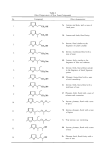
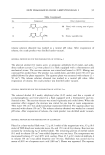
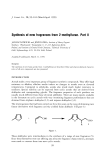
j. Cosmet. Sci., 50, 91-98 (March/April 1999) Synthesis of new fragrances from 2-methylfuran. Part I JANUSZ NOWICKI and J(SZEF G6RA, Institute of Heavy Organic Synthesis, "Blachownia," Energetyk6w 9, 47-225 Kqdzierzyn-Kogle, Poland, and Institute of General Food Chemistry, Technical University of L6dz, Stefanowskiego 4/10, 90-924 oeddz, Poland. Synopsis The synthesis of new 2-methylfuran derivatives are described. Odor and physicochemical characteristics of all new compounds are also presented. INTRODUCTION 2-Methylfuran 1 is one of the furan intermediates manufactured on a large scale. It is the main byproduct in the process of hydrogenation of furfuryl aidehyde to furfuryl alcohol. Being low-priced and readily available in the market worldwide, 2-methylfu- ran is an attractive intermediate in light organic synthesis. A very interesting trend is the application of 2-methylfuran to the synthesis of fra- grances. There are several reports on this subject. 2-Methylfuran is known to readily undergo on electrophilic type of condensation. Condensation with acetaldehyde in cer- tain weight ratios leads to the formation of 1,1-(5-methylfurfuryl)-ethane 2 (Figure 1), which has a citrus-flower fragrance (1). 271 U + + CH3CHO • Figure 1. In the Friedel-Crafts reaction with acid anhydrides, acylfuranes 3 are obtained (Figure 2): i R3 O O••2 3 1 O R• Figure 2. 91

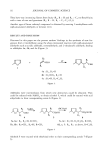
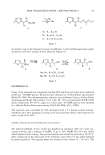
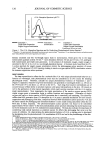
92 JOURNAL OF COSMETIC SCIENCE They have very interesting flavors from fruity (R2, R = H and R• C2) to floral-fruity with a note of rose and geranium (R2, R -- H, R• = C•-C3) (2,3). Another type of furan carbonyl compound is obtained by reacting 2-methylfuran with ot,•-unsaturated aldehydes or ketones (4,5). RESULTS AND DISCUSSION Discussed in this paper are the present authors' findings in the synthesis of new fra- grances from 2-methylfuran using the above-mentioned reaction with o•,[3-unsaturated aldehydes such as acrylic aidehyde, crotonaldehyde, and 2-ethylacrylic aidehyde, leading to aldehydes 4a, 4b, and 4c (Figure 3): •CHO H+ • + RI •- •CHO 1 R• 4a: R1, R2=H 4b: Ri=CH3, R2=H 4c: R•=H, R2=C2H 5 Figure 3. Aldehydes were intermediates from which new derivatives could be obtained. They could be reduced with NaBH 4 to obtain alcohol 5, which could be reacted with acid anhydrides to their corresponding esters 6 (Figure 4): • NaBH4• - CHO R1 4 5a, 6a: R•, R2=H, R=CH• 5b, 6b: R•=CH•, R2=H , R=CH• R2 "'-6 "["' 'CH2OH R• R• 5 6 5c, 6c: R•=H, R2=C2H5, R=CH 3 6d, e, f: R•, R 2- as above, R=C2H 5 Figure 4. Alcohols 5 were reacted with ethylvinyl ether to their corresponding acetals 7 (Figure 5):
Purchased for the exclusive use of nofirst nolast (unknown)
From: SCC Media Library & Resource Center (library.scconline.org)