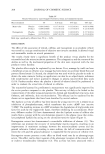
212 JOURNAL OF COSMETIC SCIENCE glands are holocrine (self-destructing), and the secreted sebum forms when the fully mature, lipid-rich cells die and disintegrate, discharging their contents to the skin surface via the follicular canal (1). Sebum is often thought to play a role in the patho- genesis of acne. This role has, however, not been clearly established (2). Some authors have suggested that the physical properties of sebum may be important in the patho- genesis of acne (3). However, studies done on the physical properties of sebum have been scarce and incon- clusive. Butcher and Coonin (4) studied some of the physical properties of sebum acquired from the forehead of a large number of subjects (presumably normal), and Burton (5) studied the properties of sebum obtained from the scalp of ten acne patients and seven normal patients. These properties have been summarized in Table I. Another study that investigated forehead sebum ascribed a melting point at 33ø-35øC (6). These studies suggest that sebum collected from different sources or body sites have different viscosities and melting points. One of the reasons for these differences could be that scalp sebum is not involved in acne whereas forehead sebum is. The physical properties of sebum, its melting point and viscosities in particular, are important, as they would mediate the blockage of the sebaceous follicle. To evaluate this theory, we have examined the physical properties of the sebum components and their mixtures using differential scanning calorimetry (DSC). There are, however, physical limitations to collecting large amounts of sample from the skin surface, and it is not easy to get "pure" sebum since it is contaminated with varying amounts of skin surface lipids. Furthermore, sebum varies quantitatively from person to person, contributing to the variability of the data. Hence we decided to carry out our experiments on a model sebum based on a composition given in the literature. We have evaluated a different sebum model and the effect of its components on its melting temperatures. SEBUM COMPOSITION The lipids from the skin surface are derived mainly from two sources, the sebaceous glands and the epidermis (7). The surface lipid from the gland-rich areas naturally contain a higher proportion of sebaceous lipid, whereas from gland-deficient areas such as arms and legs there is a greater proportion of epidermally derived lipid. Skin lipids from the face are derived in large part from sebum. The main components of sebum are triglycerides, wax esters, squalene, cholesterol esters, and cholesterol (7). The composi- Table I Physical Properties of Sebum Property Forehead sebum (ref. 4) Scalp sebum (ref. 5) Specific gravity Surface tension Viscosity Freezing point 0.91 g/cm 3 24.9 dyne/cm from 26.5 to 31øC 0.55 poise at 38øC 1.00 poise at 26.5øC Viscosity discontinuous at 30øC due to the separation of a precipitate in the sebum Sample started to freeze at 30øC and then solidified at 15ø-17øC 0.90 g/cm 3 for three normal samples 22.9 dyne/cm for six normal samples at 30øC 0.32 poise at 35øC 0.82 poise at 25øC 15o_17oc

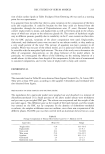
DSC STUDIES OF SEBUM MODELS 213 tion of skin surface lipids in Table II adapted from Downing (8) was used as a starting point for our experiments. It is apparent from the table that there is great variation in the composition of the fatty acids and triglycerides. It could be because the free fatty acids are formed from the triglycerides through the action of Propionibacteriz/m aches (P. aches). Bacterial lipases convert triglycerides to mono- and diglycerides as well as free fatty acids in the sebum, many of which are unique to the sebaceous glands (9). The extent of hydrolysis might vary in different persons, possibly due to variability in the P. aches content on their skin. For the DSC analysis, variations of the above composition were used. Diglycerides, cholesterol, and cholesterol esters were not used in our sebum models, as they made up a very small percent of the total. The percent of squalene was kept constant in all samples. Water was not part of the sebum model, as it is polar and would probably not be miscible with the non-polar lipid mixture. The aim of the study was to determine the effect of component characteristics on the phase behavior of the model sebum. In particular, we investigated the effects of the following on the melting behavior of a model sebum: (a) the carbon chain length of the components, (b) the ratio of unsaturated to saturated components, and (c) the ratio of triglyceride to fatty acid content. EXPERIMENTAL MATERIALS The materials listed in Table III were obtained fkom Sigma Chemical Co., St. Louis, MO. They were at least 99% pure, according to the supplier. Chloroform and methanol were also obtained from Sigma. PREPARATION OF LIPID SAMPLES AND DSC PROCEDURE The ingredients for a particular model were weighed out and dissolved in a mixture of chloroform:methanol (3:1). Small portions of the above model sebum were withdrawn and put onto a pre-weighed DSC pan. The solvent was evaporated and the weight of the pan taken again. The difference gave us the weight of the lipid mixture, and this weight was entered on the DSC run by computer. In the absence of chloroform-methanol co-solvent, the samples withdrawn were not uniform, since there was a separation of the different phases. The DSC pan was then covered with an aluminum lid and run at a scan Table II Average Composition of Human Skin Surface Lipid for 17 Subjects (ref. 8) Lipid class Mean (%) Range Triglycerides 41.0 19.5-49.4 Diglycerides 2.2 2.3-4.3 Fatty acids 16.4 7.9-39.0 Wax esters 25.0 22.6-29.5 Squalene 12.0 10.1-13.9 Cholesterol 1.4 1.2-2.3 Cholesterol esters 2.1 1.5-2.6
Purchased for the exclusive use of nofirst nolast (unknown)
From: SCC Media Library & Resource Center (library.scconline.org)