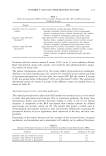
j. Cosmet. sci., 54, 133-142 (March/April 2003) Inhibitory effects of Iamulus mori extracts on melanogenesis KANG TAE LEE, KWANG SIK LEE, JI HEAN JEONG, BYOUNG KEE JO, MOON YOUNG HEO, and HYUN PYO KIM, Corearia Cosmetics Co., 204-1 JeongchonRi, Senggeoeup, Cheonansi, 330-830 (K.T.L., K.S.L., j.H.j., B.K.J.), and College of Pharmacy, Kangwon National University, 200-701 (M. Y.H., H.P.K.), Korea Accepted for publication December 18, 2002. Synopsis To develop an active agent for skin whitening, the inhibitory effects of 285 plant extracts on tyrosinase activity were examined, and one plant extract having tyrosinase inhibition activity was chosen. Ramulus mori (young twigs of Moru• alba L.) extracts showed inhibition activity in tyrosinase and melanin synthesis in B-16 melanoma cells. To clarify the mechanism of its inhibition on melanogenesis, the effect of R. mori extracts on tyrosinase activity, synthesis, and gene expression was evaluated. R. mori extracts showed tyrosinase inhibition activity by competitive method, and there was no suppression of tyrosinase synthesis and gene expression. Further, to evaluate the inhibitory activity of R. mori in vivo, its effect on melanin production in UV-induced brown guinea pigs was examined, where a decrease of melanin production in the guinea pig model was observed. Also, R. mori extracts showed no toxicity in animal tests such as the acute toxicity test, the skin irritation test, the eye irritation test, the skin sensitization test, and the acute oral toxicity test, and no toxicity in the human skin irritation test. A single compound from R. mori extracts was purified using various column chromatography and recrys- tallization, and its chemical structure was identifed using mass chromatography, IR spectroscopy, and NMR analysis. The chemical structure was that of 2,3',4,5'-tetrahydroxystilbene(2-oxyresveratrol) and showed inhibition activity on tyrosinase (IC5o = 0.23 pg/ml). Also, R. mori extracts inhibited tyrosinase activity in a competitive manner (Ki = 1.5 x 10 6 M) when L-tyrosine was used as a substrate. INTRODUCTION It has been observed that the increase of melanin synthesis or uneven distribution can cause local pigmentation in the skin. Pigmentary disorders are caused by various factors, including UV radiation, inflammation, estrogens, and genetic disorders. Recently, the harmfulness of ultraviolet rays has increased due to the destruction of the ozone layer. Excessive exposure to UV radiation may cause post-inflammatory pigmentation (1). In East Asia, most women want to avoid uneven skin pigmentation. To satisfy this desire many cosmetic companies have been developing melanogenesis inhibitors and discov- 133

134 JOURNAL OF COSMETIC SCIENCE ering skin-whitening cosmetic preparations. In cosmetic preparations, inhibitors such as kojic acid, arbutin, ascorbic acid, and licorice extracts have been used as whitening ingredients (2). Plant extracts having an inhibitory effect on melanogenesis may be a good choice for cosmetic purposes because of their relatively few side effects. Therefore, we screened 285 plant extracts for their inhibitory activity on tyrosinase (3). Among the plant extracts, R. mori extracts showed potent inhibition activity on tyrosinase and melanin synthesis but did not inhibit tyrosinase synthesis and gene expression by zymography and RT- PCR, respectively. R. mori extracts showed inhibition of pigmentation and no toxicity in animal tests. Rlorus a/ba L. and other plants of the same genus have been used as antiphlogistics, diuretics, and expectorants in Chinese herbal medicine. R. mori (young twigs of Rlorus alba L.) is harvested in the early spring and used in folk remedies in Korea. Although the constituents of Horus alba L., such as flavonoids, coumarines, and stilbenes (4), have been studied by many investigators and isolated, few reports on the usage of cosmetic whitening ingredients have been published. In this study, we purified and identified an active compound from the R. mori extract, 2,3',4,5'-tetrahydroxystilbene(2-oxyresveratrol). A naturally occurring compound par- ticularly found in Horus alba, it showed inhibition activity on tyrosinase (IC5o = 0.23 •g/ml). Also, it inhibited tyrosinase activity in a competitive manner (Ki = 1.5 x 10 -6 M) when L-tyrosine was used as a substrate. MATERIALS AND METHODS PREPARATION OF PLANT EXTRACTS We prepared the R. mori extracts for anti-melanogenic ingredients. R. mori was extracted by a mixture of ethyl alcohol and water (EtOH:H20 = 70:30) and dried to powder. This powder was dissolved in 1,3 butylene glycol and used for this study. TYROSINASE INHIBITION For the assay, the test reaction mixture was prepared by adding 0.5 ml of R. mori extracts, to which 250 units of mushroom tyrosinase (Sigma, Saint Louis, MO) had been added, to 0.5 ml of L-tyrosine (0.1 mg/ml) or 0.5 ml of 50 mM sodium phosphate buffer (pH 6.8). After incubation for ten minutes at 37øC, we measured tyrosinase activity by absorbency at 475 nm. We determined the effect of the test sample on tyrosinase inhibition by IC5o, the concentration at which half the original tyrosinase activity is inhibited. We calculated the percent inhibition of tyrosinase activity as follows: % inhibition = [(A - B)/A] x 100 where A = absorbency at 475 nm without the test sample, and B -- absorbency at 475 nm with the test sample.
Purchased for the exclusive use of nofirst nolast (unknown)
From: SCC Media Library & Resource Center (library.scconline.org)