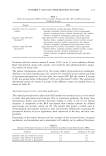
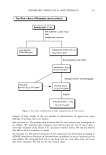
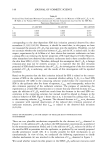
PENETRATION OF MIXED MICELLES INTO THE EPIDERMIS 155 analysis presented above, and lends greater validity tO the idea put forward by us recently (28) that steric factors can play a key role in determining whether the miceliar surfactant can penetrate into the skin. Concerns that the penetration of SDS into the SC may alter the characteristic pore size in the SC are mitigated by the work of Peck et aL (9). These authors found that the average pore size of the SC measured by hindered transport was unaffected by exposing the epidermis to SDS solutions for 18 hours. Instead, they concluded that the increased permeability of the skin resulted from an increase in the effective porosity/tortuosity of the SC. Nevertheless, we believe that additional research should be conducted to better understand the effect of surfactant penetration into the skin on the aqueous pathways of the SC. POSSIBLE ELECTROSTATIC EFFECTS ON SDS SKIN PENETRATION Interestingly, the oL m = i micelies have an equal, or slightly lower value, of the regres- sion coefficient, b (0.032 + 0.014), than the one reported in our recent paper (0.043 + 0.006) (28), while the SDS monomers penetrate into the epidermis much more readily according to the results reported in this paper (a = 4.1 + 1.0 here versus a = 0.14 + 0.04 in reference (28)). The main difference in the conditions corresponding to the two sets of experiments is the presence of 0.1 M NaC1 in the systems examined in this paper, compared to the no-added-salt case considered in the previous paper (28). It is known that the skin carries a net negative charge (9), and that the addition of salt screens this negative charge. Screening the negative charge would make it easier for negatively charged SDS monomers to approach the skin surface, which could explain the observed increase in the value of a. However, the same argument should apply to the O• m = 1 micelies, which are also negatively charged. Nevertheless, the SDS micelies do not show a significant change in their contribution to SDS penetration upon the addition of salt. In fact, the pure SDS micelies appear to be somewhat less able to contribute to Cs•i, in the presence of salt (b = 0.0032) than in the absence of salt (b -- 0.0043 in reference (28)). It is important to keep in mind, however, that the addition of salt may lead to some micelie growth (32,46). As a result, applying our model of micelie penetration, the larger micelies in the presence of salt may be less able to penetrate into the skin, thus counteracting the effect of any decrease in the electrostatic repulsions between the skin and the SDS micelies. The discussion above about potential electrostatic effects affecting surfactant penetration into the skin indicates that steric hindrance may not be the only factor determining whether a micelie can penetrate into the aqueous pores of the skin. Iontophoresis experiments with charged permeants have shown that the aqueous pores in the SC are charged, and that positively charged permeants traverse the skin more easily than negatively charged permeants (9,44). However, it is also known that the size of the permeant relative to that of the aqueous pore affects the penetration of the permeant into the skin (9,43). If the permeant is larger than the aqueous pore size, then electrostatic effects should be irrelevant, since the steric hindrance would prevent any access into the pore. However, when the permeant is physically small enough to access the skin aqueous pores, then the electrostatic interactions between the permeant and the pores, as well as the steric interactions between the permeant and the pore wall, will play a role in the transport of the permeant across the skin (9,12,43,45,47). In our experiments, all the micelies are negatively charged due to the presence of SDS,

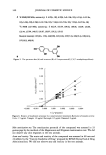
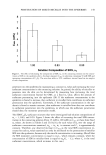
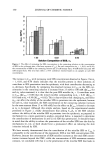
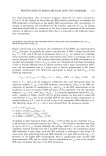
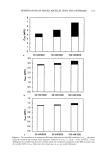
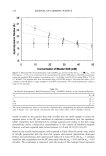
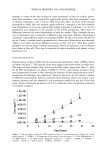
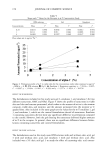
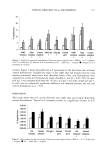
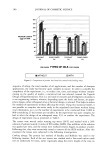
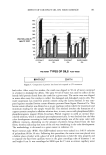
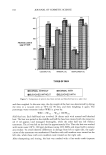
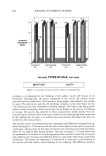
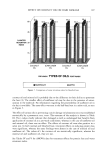
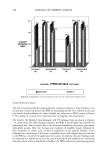
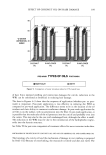
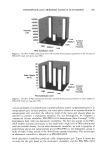
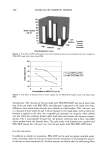
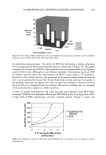
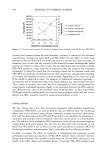
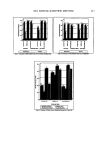
156 JOURNAL OF COSMETIC SCIENCE but the surface charge density of the SDS/C•2E 6 mixed micelies decreases as o• m de- creases. This reduction in surface charge density should make it easier for the less negatively charged mixed micelies to access the negatively charged skin pores. However, the addition of C12E6 also causes the micelies to grow and sterically hinders their access to the skin pores, thereby counteracting this surface charge reduction effect. Future work aimed at studying the effect of electrostatics on permeant penetration into the epidermis should examine the penetration of fixed-size charged species at different ionic strengths. CONCLUSIONS It is well known that mixing surfactants can lead to a reduction in the skin irritation potential of a surfactant system (6,24,26). Based on the premise that the irritating surfactant must penetrate into the skin to induce skin irritation, we tested whether mixing the irritating surfactant SDS with C12E6 affected the amount of SDS penetrating into the epidermis (Cski•). We found that increasing the concentration of C12E6 in the contacting solution, while maintaining a fixed concentration of SDS, led to a decrease in Cski• ,. Provided that the skin irritation induced by SDS is related to C,.•i ,, these findings are consistent with the expectation of reducing skin irritation by mixing surfactants. In our recent paper (28), we found that both monomeric and miceliar SDS are able to penetrate into the epidermis. An important consideration in the case of SDS/C•2E 6 surfactant mixtures was whether the reduction in the amount of SDS penetrating into the epidermis was due to the reduced SDS monomer concentration and/or due to a reduction in the skin penetration ability of miceliar SDS. A regression analysis, based on our experimental results, demonstrated that only pure SDS micelies (O•n• = 1) contrib- uted to C,/•i,, at a level comparable to the contribution of the SDS monomers, particularly at the highest surfactant concentrations examined (see Figure 3a). For the SDS/C•2E 6 surfactant mixtures, corresponding to mixed micelies having compositions of o• m = 0.83 and 0.50, the monomeric SDS contributed significantly more to skin penetration than the miceliar SDS, which essentially did not contribute to C,/•i , (see Figures 3b and 3c). Consequently, mixing SDS with C•2E 6 reduced Cs•i, both by reducing the concentration of monomeric SDS and by almost entirely preventing miceliar SDS from penetrating into the epidermis. Using DLS measurements, we demonstrated that the average hydrodynamic radii of the SDS/C•2E 6 mixed micelies increased as the solution composition of SDS decreased. This corresponded to the observed decreased ability of the SDS/C•2E 6 mixed micelies to penetrate into the SC. Comparing the hydrodynamic radii of the SDS/C•2E 6 mixed micelies examined (24 • for gm = 0.83 and 27 • for gm = 0.50) with the hydrodynamic radii of the PEO-bound SDS micelies in our previous paper (25 •, in reference (28)), the steric hindrance model for the prevention of micelie penetration into the skin remains consistent with our experimental findings in this paper, with SDS in the larger mixed micelies not contributing to From our results, one can understand how the monomer penetration model was derived from mixed-surfactant skin irritation data. Mixing surfactants often leads to growth in micelie size (30,31). When the mixed micelies cannot penetrate into the skin, then the surfactant penetration mechanism reduces to the monomer penetration model. In that case, since the CMC is comparable to the surfactant monomer concentration, there
Purchased for the exclusive use of nofirst nolast (unknown)
From: SCC Media Library & Resource Center (library.scconline.org)