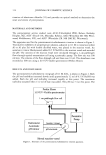
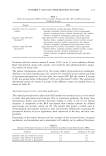
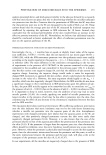
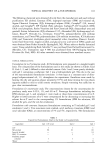
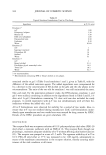
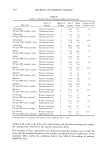
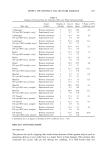
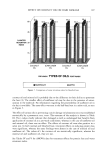
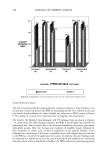
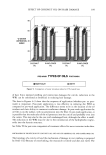
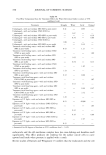
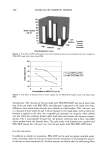
196 JOURNAL OF COSMETIC SCIENCE Procedure. The aqueous and silicone phases were blended in separate containers until they were homogeneous. The aqueous phase was then added to the silicone phase while mixing with the same Lightnin mixer and stirrer configuration described for the water- uptake test. The mixer speed was set at 1376 rpm, and after all the water phase was added, mixing was continued for ten minutes. Anhydrous Roll-On Antiperspirant Ingredient Weight (%) DCP (12.5% in cyclopentasiloxane) Bentone gel VS 5* REZAL 36G powder** Cyclopentasiloxane Variable Variable 22.0 q.s. to 100% * A blend of Quaternium-18 Hectorite, cyclomethicone, and SD alcohol 40 (supplied by Elementis Specialties). ** Aluminum-zirconium tetrachlorohydrex-GLY powder (supplied by Reheis, Incorporated). ANHYDROUS ANTIPERSPIRANT FORMULAS AND PROCEDURE Procedure. All of the ingredients were weighed into a glass beaker and mixed using a kitchen hand-held mixer (Braun Handblender, model MR 360) for approximately one minute. Anhydrous Soft Solid Antiperspirant Ingredient Weight (%) Elastomer (DCP or PEG-DCP) Variable AZG-370* 25.0 Cyclopentasiloxane q.s. to 100% * Aluminum-zirconium tetrachlorohydrex-GLY powder (supplied by Summit Research). Procedure. All of the ingredients were weighed into a glass beaker and mixed using the same laboratory mixer and stirrer configuration described for the water-uptake test. The mixer was stopped periodically so that the sides of the beaker could be scraped down to ensure that the formula was uniformly mixed. MULTIPLE EMULSION FORMULA AND PROCEDURE Ingredient Weight (%) Part A PEG-DCP (12% in cyclopentasiloxane) 5.7 Cyclopentasiloxane 12.4 Tocopherol acetate 1.0 Part B Deionized water 45.8 Magnesium sulfate 2.1 P.art C Laureth-7 3.0 Part D Deionized water 28.7 Magnesium sulfate 1.3

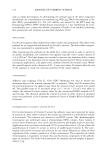
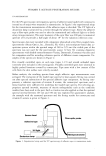
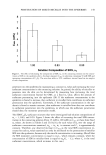
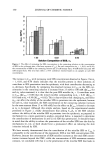
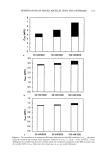
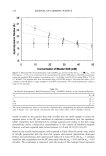
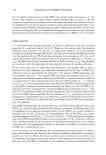
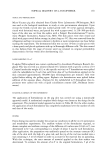
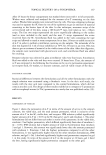
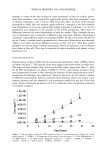
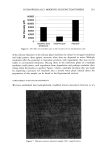
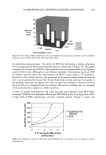
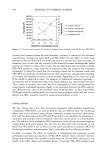
HYDROPHILICALLY MODIFIED SILICONE ELASTOMERS 197 Procedure. The ingredients in Part A and Part B were mixed in separate containers until uniform. Part B was then added to Part A while mixing with the same Lightnin mixer and stirrer configuration described for the water-uptake test. The mixer speed was set at 1376 rpm, and after all of Part B was added, mixing was continued for ten minutes. Next, Part C was mixed into the emulsion formed by Parts A and B, and this mixture was then dispersed into Part D while mixing with the same mixer, but at a lower speed (500 rpm) SYNERESIS TEST To determine syneresis for an anhydrous antiperspirant soft solid formula, 30 g of the formula is weighed into a 50-ml polypropylene (disposable) centrifuge tube (Fisher- brand, cat. # 05-539-9). The sample is then spun at 3000 rpm for 30 minutes using a bench top centrifuge (International Equipment Company, model HN-SII). After cen- trifuging, the tube with the sample is placed on an electronic balance and tared. The supernatant fluid is carefully pipetted from the top of the sample and the amount of fluid removed is weighed by difference. Syneresis is reported as a percentage of the original sample weight (i.e., [weight of removed fiuid]/[sample weight] x 100). VISCOSTY MEASUREMENTS Viscosity measurements were made using a Brookfield Model RVDVII+ equipped with a Helipath stand. Various combinations of "T" spindles and speeds were used according to the type of formula tested: PEG-DCP dispersions: Spindle #93 @ 2.5 rpm Antiperspirant gel viscosity: Spindle #93 @ 2.5 rpm Antiperspirant roll-on formula viscosity: Spindle #91 @ 50 rpm (Helipath off) Antiperspirant soft solid formula viscosity: Spindle #93 @ 2.5 rpm RESULTS AND DISCUSSION SYNTHESIS AND EVALUATION OF PEG-DCP VARIANTS In order to evaluate the effects of various composition and process variables on the properties of PEG-DCP, a two-level factorial experimental design was performed. The variables (factors) studied were the level of PEG substitution, the length of the PEG chain, and a process variable that was thought to have the largest effect on the crosslink density. This process variable is referred to as the "crosslink density process parameter." In a designed experiment, a series of runs are made in which the variables under study are systematically changed in order to determine their effects on the properties of interest. For this study, we evaluated the viscosity of the PEG-DCP samples and their emulsification abilities as measured by the water-uptake test. The water-uptake test provides a measure of the emulsification effectiveness. It is used to determine the maximum amount of water that can be incorporated into a w/s emulsion where the dispersion of PEG-DCP in cyclopentasiloxane is used as the continuous phase. The viscosity results for the PEG-DCP samples from the experimental design runs are
Purchased for the exclusive use of nofirst nolast (unknown)
From: SCC Media Library & Resource Center (library.scconline.org)