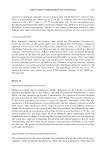
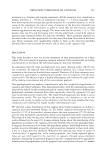
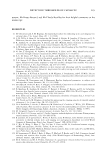
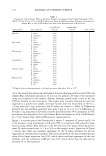
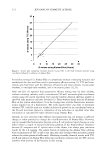
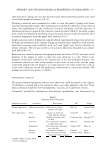
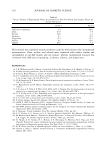
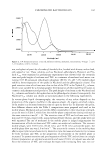
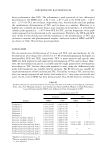
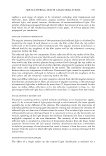
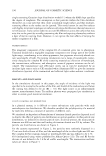
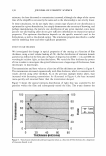
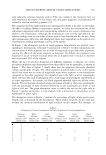
1vHE-SC1\TTERING MONTE CARLO SIMULATIONC 1.00& 2 ..----------� 1. � 1.00E+Q" � :s -a· '? 1.cm 1.00E- 1 .OOE- 1.00E-10 1.0(JE- 199 -5micron :Figure 5. Spatial intensity distribution of light reflected (left) and transmitted (right) from a film of titanium dim:ide dispersed in oil. Only the thic ·ness of the film varies. horizontal distance from the incident light source. l•or a non-turbid, perfectly clear medium, there will be no spatial spreading of the light beam as it passes th.rough the film, and so the intensity at all points of the graph under these conditions would be zero, except at the origin. The reflected intensity is the intensity of light that i' scattered back by the partides and exits the top surface of the film, whereas the transmitted intensity is the intensity of the light passing through the bottom of the fi Im. Cimulations indicated that as the thickness of the film increased, the overall intensity of the reflected light increased, regardless of the horizontal distance from the source. This is not surprising, considering that less light is transmitted thmu 7 h, i.e., more light is reflected from, a thicker film. In addition, the size of the "ring" of ligh spreaclir g our fror the ·ource was larger for the thicker film, which i again n t surprising given rha. rhe light lu s more opportunities to scatter and spread in a thicker film. i ulat:ion sho,v cl that for the transmir eel intensity, ch spatia intensity profile ·was v ·ry similar to chat or the refl i::ed imensity at 100+ microns a ay from che source horizont lly). However, che behavior closer to die source ,:vas very different: the inten- sity of transmitted light near the origin (light source) was much higher for the thinner films, suggesting that much of the light passed through without being significantly deflected, and th horizontal s1 read feJl off sharply. The thicker films exhibited less intensity near the origin, and the intensity of light dropped off more sJowly further from the source. Because less Ii -.hr is trnnsmitted through a thicker film, one might eXJ)ect that for a thicker 1Jm, the intensity o · the transmitted light would be lower tner alJ di:tances from the light source these simulations slmw drnt this is not trne. Instead, thc.: shape of the intensity j)rofile as a function of discance from the .light source was affected as the film thickne s was varied. EFFECT OI SURFACE ROUGHNESS ·'Cl.re investigated the effects of film surface roughness on the optical properties of the film. In order to highlight the effect of the rough surface, we simulated a formulation ,vith a relativdy I.ow concentration of TiO2 (1 % by volume toral) suspended in silicone oil. This particle loading was simulated as a panide mixture with the f1 t distribution of particles introduced above: 0.2% volume loading each of five particle sizes r nging from 0.2 to 1.0 microns, with an average diameter of 600 nm. We varied the RMS slope of the film by powers of two to investigate the optical behavior o- rer a wide range of film

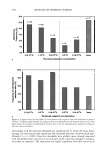
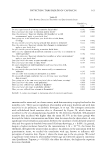
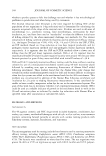
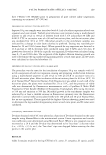
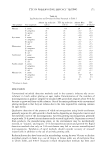
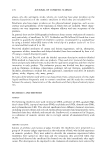
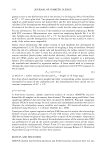
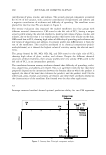
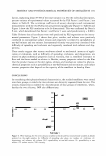
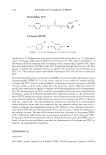
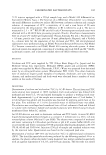
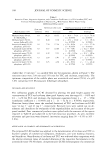
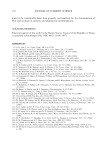
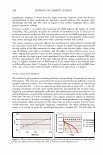
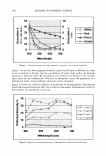
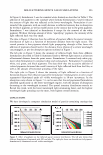
200 JOURNAL OF COSMETIC SCIENCE roughnesses, keeping in mind that the single-scattering Gaussian slope distribution approximation is most applicable for relatively smooth surfaces. The incident light ,vavelength was 600 nm. We show in Figure 6 how surface roughness affects some optical properties of films. In Figure 6 (left) it is ,evident that increasing the RMS slop:'. of the surface of a film containing TiO 2 particles increased the amount of transmirted ha.ze. ff there are no scattering particles within the film, the haze goes to zero as the RMS slope goes to zero. However, in this case, the turbid film itsel( contributed to the majority of the overall haze hence the high haze vaJue even with a perfectly smooth film surface. The surface roughness especially affected the distribucion of light reflected directly off the top surface of the film. This is exhibited in Figure 6 (right). The light bouncing off the top surface of the film maimains the same color as the incident light- :vhite in the case of ambient room light or sunliglu-and this effect is ,.,hat primarily gives rise co looks ranging from glossy to matte m flat (imagine a bright white spot on a glossy red apple, and how the spot sprea ls with roughness). For a film surface with an RMS slope of 0.02, appro'"imately 14% of the light reflected off the surface is deflected by more than 2.5 degrees, whereas ,vith an RMS slope of 0.16, almost 45 % of the reflected light is deflected by more than 2.5 cl grees. For a perfectly smooth surface with an RMS slope of 0, none of the surface-refle ·t d light is deflected by more than 2.5 degrees. FOJlMIJI.ATION WITH PIGMENTS Vf.T e modeled ight pigment-containing mixtures corresponding to hypothetica] coating formulations. The mixtures contained several tyJ)es of particles having different sizes and com pl· x refractive indices. An oil-in-water emul.sion base was modeJed by considering the oil drop.lets (RI = 1.4) to be spherical particles dispersed in water (RI = L33). By running simulations over the entire visible spectrnm, incrementing the incident wave- length by a set amount, absorption, reflection, and transmission curves were derived. lor each formulation, we performed simulations over seven wavelengths in the visible region (400 nm-700 nm) in 50-nm increments. The complex refractive indices of materials vary as a function of incident wavelength, and so the input parameters were changed for each simufotion. Some matefr- ls have RI values that are nearly constant over the entire visible spectrum, with negligibJe imaginary components, bur when simulating pig- ment , it is crucial to input th: wavelength-dependem complex Ris. The RI values of '911] 00.1 89..9 89.7 0 O.Ot 008 �sope 0.16 Anwe Figure 6. Effect of surface roughness on transmitted haze (left) and angular distribution of light reflected off the top surface of the film (right) for a film of titanium lioxide dispersed in oil.
Purchased for the exclusive use of nofirst nolast (unknown)
From: SCC Media Library & Resource Center (library.scconline.org)