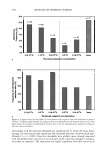
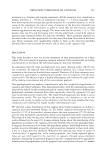
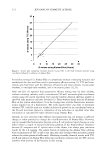
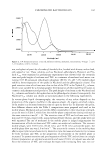
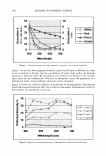
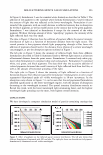
MIE-SCA TTERING MONTE CARLO SIMULATIONS 203 In Figure 8, formulation 2 was the standard white formula as described in Table I. The addition of red pigment to the standard white formula (formulations 2 and 6) reduced the amount of light that was reflected at the lower wavelengths. Formulation 8 con- tained all the pigments, with an overall decrease in reflected intensity due to absorption by the black pigment, as well as modifications to the contour due to the green pigment. Formulation 7 was identical to formulation 8 except for the removal of the white pigment. Without the large amount of white "opacifying" pigment, the intensity of the light reflected back was very small. The data in Figure 9 illustrate how the addition of pigment affects the spatial intensity distribution of light as a function of horizontal distance from the light source. The central premise is that pigments absorb light propagating through a film hence the addition of pigments should restrict the distance that a photon of a certain wavelength can propagate, as per the absorption spectra outlined in Figure 7. The left plot in Figure 9 shows the intensity of reflected light from three different formulations described in Table I illuminated under a 400-nm light source as a function of horizontal distance from the point source. Formulation 2 contained only white pig- ment while formulation 6 contained white and red pigment. Formulation 8 contained white, red, green, and black pigments. The data show that the successive addition of colored pigments decreased the overall intensity of light reflected back from the film, as well as the amount of horizontal spreading of the light. The right plot in Figure 9 shows the intensity of light reflected as a function of horizontal distance from the point source for formulation 3 (red pigments in oil-in-water suspension) illuminated under all visible wavelengths in 50-nm increments. In the absorption curve shown in Figure 7 it can be seen that the red pigmented formulation absorbed significantly in the lower wavelength regime, with the amount of absorption decreasing as the wavelength increased. The spatial intensity distribution exactly re- flected this trend, with the lower wavelength light attenuating faster, and the highest wavelength light spreading out the most, with highest overall intensity. CONCLUSIONS We have developed a computer simulation model of particle-containing coatings that 1.IIE-112 1.IIE-04 1.IIE-lli -Fonn2 --Fonn6 FormB 1.IIE-111 a: 1.IIE-'11 Distance ttom source .-ncmns) Distance 1i'DmSOta"ce (Miaons) Figure 9. Effect of pigments on the reflected spatial intensity distribution. The left plot shows three different formulations illuminated with 400-nm light. The right plot shows one formulation (red pigment, formulation 6) illuminated over all visible wavelengths.

204 JOURNAL OF COSMETIC SCIENCE tracks the trajectories of photons as they undergo multiple scattering events through the film. The effects of manipulating mixtures of particles with different complex Ris and sizes, as well as the effects of increasing the thickness of the film and changing the surface roughness, are predicted by this program. Optical models such as the one described can not only aid in the formulation of existing materials, but can also be used to probe potential new materials that are suitable for use in coating applications. In summary, we have demonstrated the capability of this tool in rigorously modeling, i.e., quantifying under certain constraints, the optical properties of formulations using input parameters that are relevant to the chemist. ACKNOWLEDGMENTS The authors wish to thank Dr. John Graf of GE Global Research for very helpful discussions on key aspects of the described simulation program. REFERENCES (1) P. Kubeika and F. Munk, Ein Beitrag zur Optik der Farbanstriche, Zeits. F. techn. Physik, 12, 593-601 (1931). (2) S. Chandrasekhar, Radiative Transfer (Dover, New York, 1960), p. 196. (3) S. E. Orchard, Reflection and transmission of light by diffusion suspensions,]. Opt. Soc. Amer., 59, 1584-1597 (1969). (4) H. W. Jensen, S. R. Marschner, M. Levoy, and P. Hanrahan, "A Practical Model for Subsurface Light Transport," in Proceedings of the 28th Annual Conference on Computer Graphics and Interactive Techniques (2001), pp. 511-518. (5) L. Henyey and J. Greenstein, Diffuse radiation in the galaxy, Astrophys. ]., 93, 70-83 (1941). (6) G. Mie, Ann. Physik, 25, 377 (1908). (7) H. C. van de Hulst, Light Scattering by Small Particles (Wiley, New York, 1957), Chapters 9 and 10. (8) C. F. Bohren and D.R.Huffman, Absorption and Scattering of Light by Small Particles (Wiley, New York, 1983), as modified by B. T. Drane. (9) S. A. Prahl, M. Keijzer, S. L. Jacques, and A. J. Welch, A Monte Carlo model of light propagation in tissue, in SPIE Proceedings of Dosimetry of Laser Radiation in Medicine and Biology, G. J. Muller and D. H. Sliney, Eds., Volume IS 5, pp. 102-111 (1989). (10) S. A. Prahl, Light Transport in Tissue, PhD thesis, University of Texas at Austin, 1988. (11) J. A. Ogilvy, Theory of Wave Scattering from Random Rough Surfaces (Adam Hilger, Bristol, UK, 1991). (12) Almaz Optics (www.almazoptics.com). (13) J. J. Joshi, D. B. Vaidya, and H. S. Shah, Color Res. Appl., 26, 3 (2001). (14) H. Chang and T. T. Charalampopoulos, Determination of the wavelength dependence of refractive indices of flame soot, Proceedings of the Royal Society of London, Series A - Mathematical and Physical Sciences, 430, 577-591 (1880).
Purchased for the exclusive use of nofirst nolast (unknown)
From: SCC Media Library & Resource Center (library.scconline.org)