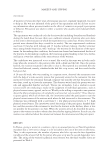
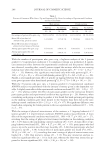
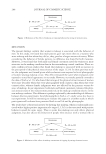
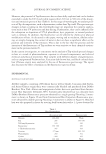
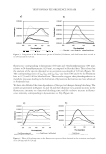
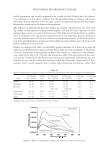
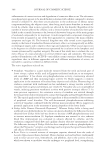
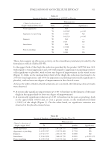
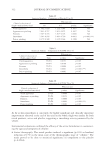
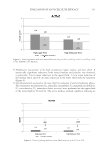
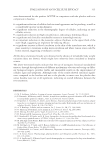
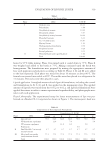
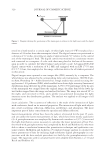
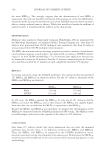
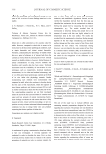
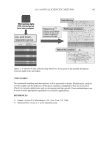
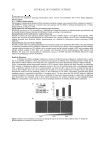
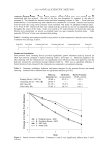
JOURNAL OF COSMETIC SCIENCE 298 FLUORESCENCE ANALYSIS OF PHOTO AND THERMAL DEGRADATION OF HAIR Figure 5 presents emission spectra of intact and photo-exposed Piedmont hair, which were obtained at an excitation wavelength of 290 nm. A decrease in the intensity of the peaks at 350 nm (43%), 420 nm (27%), and 465 nm (23%) as a result of 24-hour irra- diation in a weatherometer is evident, suggesting photodecomposition of Trp and the kynurenines. It should be noted that a decrease in the Trp emission is signifi cantly larger than the corresponding reductions in the intensity of the peaks at 420 and 465 nm, which may be related to the phenomenon that kynurenines are fi rst formed as a result of Trp photo-oxidation reactions before undergoing subsequent photodecomposition. Further examination of fl uorescence spectra obtained at an excitation wavelength of 350 nm con- fi rms the decomposition of kynurenines by showing reductions of peak intensities at 420 nm (12%) and 465 nm (17%). Similar trends were observed in the spectra of Piedmont hair subjected to thermal treatment with hot irons at 160°C (15,19). A decrease in the intensity of peaks corresponding to both Trp and kynurenine emissions was observed. In the case of thermally treated hair (160°C for 30 minutes), an increase in the ratio of I465/ I420 (from 1.12 for intact hair to 1.37 for thermally treated hair, as calculated from the spectra obtained at an excitation wavelength of 290 nm) was noted, which may refl ect predominant formation of kynurenine, which could in turn be responsible for the yellow coloration of thermally treated Piedmont hair. The results of the fl uorescence analysis of photodegradation of various types of hair as a result of irradiation for 72 hours are collected in Table II. White and Piedmont hair showed the largest loss of Trp fl uorescence (in the range of 56.7% to 64.8%), while the corresponding decreases for highly pigmented dark brown and Asian hair were signifi - cantly smaller (47.7% to 42.9%). For kynurenines, the fl uorescence decreases were smaller especially for highly pigmented Chinese and dark brown hair. It should also be men- tioned that for dark brown and black Chinese hair the analysis of the spectra resulting from excitation at 350 nm actually shows an increase in the intensity of the peaks as- cribed to kynurenines (for dark brown hair, an increase of 11% and 14% at 420 and 465 nm, respectively). This result may suggest that the melanin, present in dark-colored hair, offers selective photoprotection to kynurenines by decreasing the extent of their photode- composition. It should also be added that the dark brown hair employed in this work was Figure 5. Comparison of the fl uorescence spectra of Piedmont hair, untreated and irradiated for 24 hours.

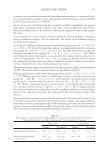
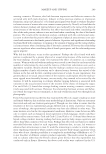
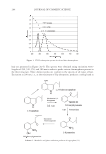
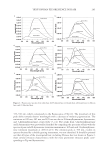
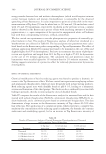
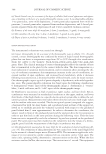
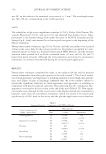
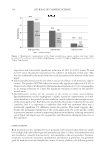
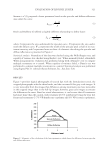
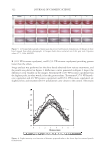
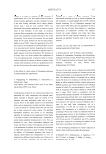
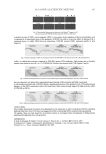
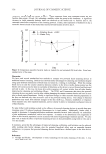
TRYPTOPHAN FLUORESCENCE IN HAIR 299 highly pigmented and visually appeared to be as dark as black Chinese hair. An alterna- tive explanation of this effect could be that the photobleaching of melanin, which also takes place during exposure of hair to light, results in higher absorption and thus higher fl uorescence emission by the keratin chromophores. The behavior of light brown hair was similar. In contrast, bleached hair lost very little Trp, while its fl uorophores at longer wavelengths (420 and 465 nm) experienced more damage than was the case with other hair types. The behavior of bleached hair is complex since it undergoes very signifi cant transformations in the bleaching process, leading to not only melanin removal, but also oxidation of the keratin protein. A detailed explana- tion of the photodegradation mechanism of bleached hair is beyond the scope of this paper and will be addressed in future work. Finally, we analyzed the effect of externally applied melanin (as a leave-in or rinse-off solution) on the fl uorescence spectra of hair. The results, presented in Figure 6, show that a leave-in deposition of lipomelanin on white hair results in a reduction of hair fl uores- cence both in the Trp (330–350 nm) and kynurenine (400–500 nm) regions of the emis- sion spectra. Furthermore, the fl uorescence spectrum of pigmented, light brown hair was found to be very similar to that obtained from white hair externally coated with 2% lipo- melanin. Such a result suggests that a simple light-absorption mechanism, rather than Table II Results of Fluorescence Analysis of Intact and Photoirradiated Hair with Various Degrees of Pigmentation Hair I (350) (cps) Exc. 290 nm % Trp loss I (420) (cps) Exc. 350 nm I (465) (cps) Exc. 350 nm % 420 nm loss % 465 nm loss White 2.4·106 56.7 1.6·107 1.5·107 21.5 26.9 Piedmont 1.6·106 64.8 1.4·107 1.4·107 25.5 30.3 Bleached 1.1·106 30.2 1.9·107 (431 nm) 1.9·107 (460 nm) 32.6 32.2 Light brown 0.8·106 38.8 8.5·106 8.7·106 9.1 5.7 Dark brown 0.7·106 47.7 1.1·106 0.8·106 3.0 4.0 Asian 0.6·106 42.9 1.7·106 1.3·106 13.3 17.9 Irradiation was carried out in a weatherometer for 72 hours. Figure 6. Effect of lipomelanin coating on the fl uorescence spectra of white hair.
Purchased for the exclusive use of nofirst nolast (unknown)
From: SCC Media Library & Resource Center (library.scconline.org)