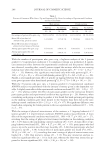
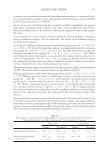
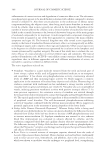
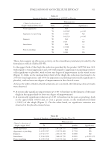
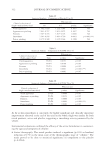
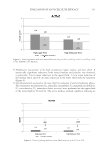
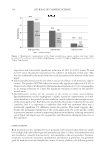
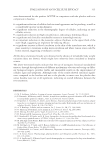
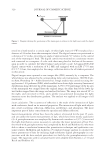
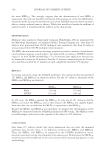
JOURNAL OF COSMETIC SCIENCE 300 energy transfer between hair and melanin chromophores (which would require intimate contact between melanin and protein chromophores), is responsible for the observed quenching of hair fl uorescence. It is also important to point out a blue shift in the maxi- mum emission of Trp from 350 nm for white hair, to 342 nm and 336 nm for hair coated with 1% and 2% lipomelanin, respectively. As shown in the previous section, a similar shift is observed in the fl uorescence spectra of hair with increasing amounts of melanin pigmentation, i.e., upon comparison of the spectra for unpigmented white or Piedmont hair with those corresponding to brown- or black-colored hair. We also carried out experiments to test the photoprotective properties of externally ap- plied melanin to hair. The results of fl uorescence analysis of white hair irradiated in a weatherometer are collected in Table III. The loss and protection parameters were calcu- lated based on the fl uorescence peaks corresponding to Trp and kynurenine. The effect of melanin application followed by rinsing was found to be minimal in the case of Trp and slightly higher for UV-A chromophores. For leave-in treatments the extent of photopro- tection was signifi cant and ranged from 24% for Trp to as high as 55.8% for kynurenine in the case of 1% melanin application. The calculated loss and protection values for kynurenines were actually higher for 1% melanin than for 2% melanin treatment. This fi nding suggests saturation of a protective effect for relatively photoresistant kynurenine chromophores. EFFECT OF CHEMICAL TREATMENTS Chemical modifi cation of hair by reducing agents was found to produce a dramatic in- crease in the Trp fl uorescence of hair. We have carried out experiments employing sodium and ammonium thioglycolates, which are most frequently used in hair waving products. Both reducing agents react with disulfi de bonds at pH 8–9.5, leading to a symmetric scission and formation of two thiol groups. The thiols can be re-oxidized by reaction with hydrogen peroxide, thereby reconstituting the cleaved disulfi de bonds. Table IV compares the results of the fl uorescence analysis for untreated hair and for hair treated with sodium thioglycolate (NaTGA), ammonium thioglycolate (NH4TGA), so- dium hydroxide, and a commercial perm based on ammonium thioglycolate. The data demonstrate a large increase in the fl uorescence intensity of Trp—about 40–50% after hair reduction. The application of a commercial perm, which represents a complete for- mulation (the concentration of the reducing agent is unknown the formula also contains surfactants and emulsifying agents), led to an increase in Trp fl uorescence intensity of Table III Results of Fluorescence Analysis of Trp and Kynurenine Photodegradation of Untreated and Lipomelanin-Treated White Hair Treatment % Trp loss/ protection % 420 nm loss/ protection % 465 nm loss/ protection Untreated 56.7/0 21.5/0 26.9/0 1% Melanin rinse-off 56.0/1.2 20.6/4.2 25.7/4.5 1% Melanin leave-in 43.1/24 12.0/44.7 11.9/55.8 2% Melanin leave-in 35.3/37.7 16.4/23.7 14.6/45.7

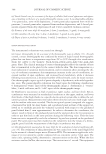
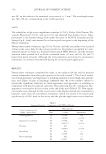
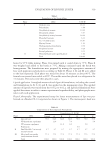
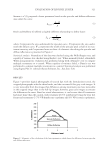
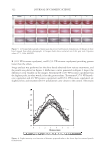
TRYPTOPHAN FLUORESCENCE IN HAIR 301 nearly 100%. The results presented in Table IV also include the analysis of hair that was fi rst reduced and subsequently re-oxidized with hydrogen peroxide. The data suggest a decrease in the fl uorescence intensity of Trp after treatment with hydrogen peroxide, as compared to reduced hair, to levels about 20% higher than the initial values obtained for untreated hair. Based on these data, one can conclude that the reduction–re-oxidation cycle does not reconstitute the original structure of untreated hair, at least as probed by Trp fl uorescence. In contrast to thioglycolates, which act as active reducing agents at pH 9, the use of 3% sodium hydroxide leads to a decrease in the intensity of Trp fl uorescence from 5.6 ± 0.3 ⋅105 cps to 2.4 ± 0.2 ⋅105 cps. The treatment of hair with high concentration alkalis such as 3% NaOH is employed in the process of relaxing curly, African hair. The chemistry of this process includes the reaction of HO− with disulfi des and subsequent formation of thiolate groups. Further transformations result in the formation of lanthionine groups and lysino- alanine residues. Disulfi de bond cleavage is signifi cant and was reported to be as high as 72% (20). In relaxed hair, disulfi des are replaced with lanthionine groups, which main- tain the stiffness and rigidity of the keratin matrix. A possible interpretation of these observations is suggested by reviewing the literature of protein model systems. One of them is a protein referred to as fusarium solani pisi cutinase, which is an enzyme with a single L-Trp, which is located close to a disulfi de bridge (21). It is also involved in a hydrogen bond with an alanine residue (22). According to Martinho et al. (23), there are both static and dynamic quenching mechanisms of the fl uores- cence of this Trp residue. Disruption of the Ala-Trp hydrogen bond, which occurs during melting of the protein, releases Trp from the viscinity of a cystine residue and results in a fourfold increase in Trp fl uorescence intensity. In addition, UV light, with wavelengths corresponding to the maximum of Trp absorption, breaks down the disulfi de bridge, re- sulting in a ten-fold increase in Trp fl uorescence quantum yield. The cleavage of the disulfi de bond increases the internal backbone mobility of the neighboring residues and releases the Trp residue from the viscinity of the cystine residue (24). Reduction of disul- fi des in the process of hair waving with thioglycolates has a similar effect. It also has a plasticizing effect on the amorphous matrix in cortical cells and increases the mobility of protein chains. Re-oxidation of cysteine residues into disulfi des, as a result of treatment with hydrogen peroxide, reconstitutes the network of disulfi de bridges and, consequently, brings about the reduction of Trp emission intensity. It should also be added that other Table IV Effect of Chemical Treatments on Trp Fluorescence of Dark Brown Hair Hair treatment Intensity of Trp fl uorescence at 336 nm × 105 (cps) Untreated Treated 6% NaTGA, pH 9.0 (15 min) 5.1 ± 0.2 7.8 ± 0.3 6% NaTGA (15 min)/2% H2O2 (5 min) 5.4 ± 0.2 6.4 ± 0.2 6% NH4TGA, pH 9.0 (15 min) 5.1 ± 0.2 8.4 ± 0.3 6% NH4TGA (15 min)/2% H2O2 (5 min) 5.3 ± 0.2 6.4 ± 0.3 3% NaOH (15 min) 5.6 ± 0.3 2.4 ± 0.2 Commercial perm (NH4TGA) (15 min) 5.2 ± 0.2 10.1 ± 0.5 Perm and neutralizer (15 min and 5 min) 5.2 ± 0.2 6.9 ± 0.2 The spectral analysis was carried out on dry hair at ambient conditions (40%–50% RH).
Purchased for the exclusive use of nofirst nolast (unknown)
From: SCC Media Library & Resource Center (library.scconline.org)