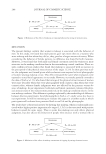
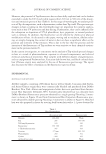
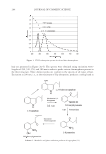
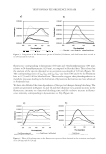
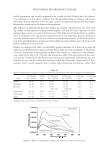
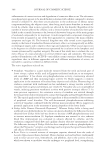
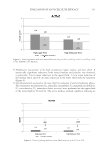
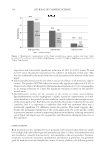
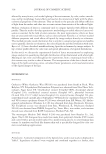
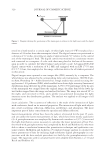
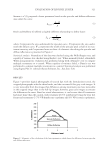
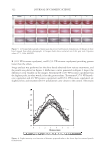
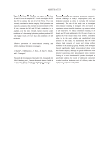
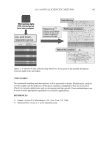
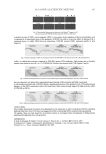
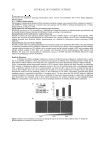
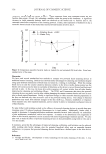
JOURNAL OF COSMETIC SCIENCE 322 B (11% VP/eicosene copolymer), and E (5% VP/eicosene copolymer) providing greater luster than the others. Image analysis was performed on the shine bands obtained from various treatments, and the results are plotted in Figure 4. Refl ectance curves generated in Figure 4 depict the differences seen visually on the images. Treatment B (11% VP/eicosene copolymer) has the highest peak in other words, it has the greatest shine. Treatments C (7% VP/hexade- cene copolymer and 4% VP/eicosene copolymer) and E (5% VP/eicosene copolymer) are slightly lower, and treatment D (5% polybutene) came closest to the control. The results Figure 3. (a) Cropped photographs of mannequin lips treated with lipstick formulations. (b) Images of shine band cropped from above photographs. (c) Images shown were converted into 8-bit gray scale. Exposure values: f/7.1, 1/80s, 800 ISO. Figure 4. Light intensity as a function of distance perpendicular to the lower lips for various lipstick formulations.

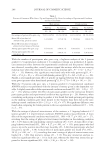
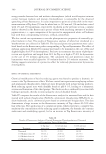
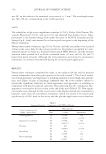
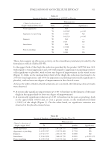
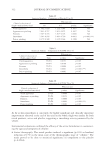
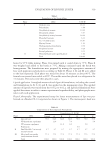
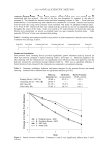
EVALUATION OF LIPSTICK LUSTER 323 Table III Luster Parameters of Evaluated Lipstick Formulations Control A B C D E F Mean ± SD Mean ± SD Mean ± SD Mean ± SD Mean ± SD Mean ± SD Mean ± SD Specular 1038.70 60.34 1081.78 14.86 1153.39* 48.32 1074.52 14.65 1028.80 31.03 1131.93* 23.95 1102.88 8.15 Diffuse 856.44 101.88 835.55 19.23 844.75 37.17 852.62 14.50 846.58 20.07 851.09 46.38 841.94 4.09 Peak 197.54 9.83 214.07 3.67 242.25* 2.19 217.01 1.41 197.89 7.02 230.63* 8.11 213.96 5.44 Max width 3.37 0.45 3.52 0.16 3.05 0.24 2.92 0.25 3.23 0.31 3.29 0.41 3.69 0.11 L Stamm 0.18 0.05 0.23 0.02 0.27* 0.01 0.21 0.01 0.18 0.02 0.25 0.03 0.24 0.01 LR-R 0.36 0.03 0.37 0.02 0.45* 0.03 0.43 0.03 0.38 0.04 0.39 0.01 0.36 0.01 *Treatments statistically signifi cant from the control at p 0.05. seem to be in agreement with the visual differences depicted among treatments, but a more rigorous analysis was needed. Luster parameters for the various formulations evaluated were calculated using equations 1 and 2, and the results are displayed in Table III. The results shown represent average and standard deviation values obtained from four separate measurements for each treat- ment. The results for the peak height were 197.54, 242.25, 214.07, 217.01, 197.89, 230.63, and 213.96 for the control and formulations A, B, C, D, E, and F, respectively. The two treatments that had the highest peaks and were statistically different from the control were treatments B (11% VP/eicosene copolymer) and E (5% VP/eicosene copoly- mer). The rest of the treatments, although visually different, were not statistically differ- ent from the control. Both luster parameters were calculated: LStamm and LR-R. The values for LStamm were 0.18, 0.27, 0.23, 0.21, 0.18, 0.25, and 0.24 for the control and formula- tions A, B, C, D, E, and F, respectively. The values for LR-R were 0.36, 0.45, 0.37, 0.43, 0.38, 0.39, and 0.36 for the control and formulations A, B, C, D, E, and F, respectively. The only treatment that was statistically different from the control in both luster param- eters was treatment B (11% VP/eicosene copolymer). DISCUSSION It appears from the results obtained thus far that the addition of VP/eicosene copolymer to lipstick formulations increases their shine. The incremental increase in shine is concen- tration-dependent, as the lipstick containing 11% has more shine than the one contain- ing 5% only. The addition of polybutene to lipstick has a very small contribution to shine compared to the control. On the other hand, the addition of VP/hexadecene copolymer contributed to the overall shine but was not as effective as the addition of VP/eicosene copolymer. The abilities of the two polymers, VP/hexadecene and VP/eicosene, to impart shine in lipstick formulations in two different capacities led us to pay more attention to their chemical structures. They are both derived from VP and long-chain alpha olefi ns how- ever, they do not have the same alkyl chain length, degree of alkylation, or molecular
Purchased for the exclusive use of nofirst nolast (unknown)
From: SCC Media Library & Resource Center (library.scconline.org)