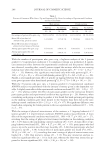
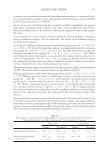
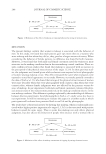
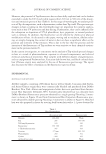
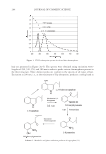
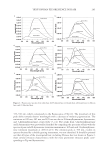
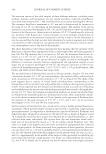
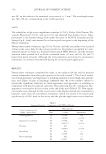
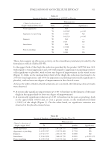
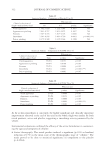
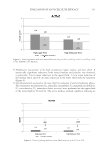
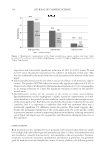
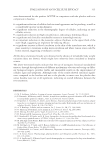
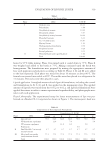
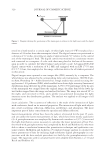
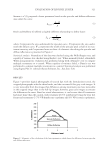
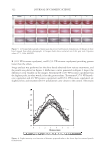
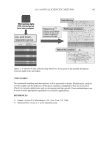
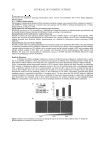
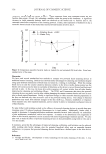
JOURNAL OF COSMETIC SCIENCE 324 weight. These polymers are often used as pigment dispersants and fi lm formers. If the addition of a polymer helps create a better pigment dispersion, the formulation will have better shine since shine is more visible in darker shades than in lighter ones. Our insight to identify their mode of action led us to calculate RGB values for all formulations used, to evaluate if pigment dispersion was a factor. These data are displayed in Table IV and plotted in Figure 5. RGB values of lips treated with different lipstick formulations were obtained by image histogram analysis. Averages and standard deviations of the RGB values displayed were obtained from four separate treatments for each formulation. Total RGB values for the control and formulations A, B, C, D and E were 275.0, 221.6, 209.1, 196.1, 213.2, and 222.4, respectively. Only two formulations were statistically different from the control: formulations B (11% VP/eicosene) and C (7% VP/hexadecene copoly- mer and 4% VP/eicosene copolymer). CONCLUSIONS Based on the results obtained in this study, we can conclude that both of the tested VP-containing polymers are good pigment dispersants and will contribute to visually detected shine from lipsticks. The method presented in this paper could help researchers screen formulations for their optical properties. Table IV RGB Values of Evaluated Lipstick Formulations Control A B C D E F Mean ± SD Mean ± SD Mean ± SD Mean ± SD Mean ± SD Mean ± SD Mean ± SD Red 136.4 3.0 117.9 6.20 112.2* 2.3 106.89* 0.7 114.7 3.6 120.9 1.9 119.0 2.2 Green 61.2 3.5 45.7 5.54 42.2 3.2 39.09* 0.4 41.1* 3.4 47.8 2.2 44.6 1.0 Blue 77.3 1.9 58.1* 5.49 54.8* 2.4 50.15* 1.2 57.1* 3.4 62.3 0.7 58.80* 1.4 Total 275.0 8.3 221.6 17.07 209.1* 7.8 196.13* 2.1 213.2 10.3 231.0 4.6 222.4 4.6 *Treatments statistically signifi cant from the control at p 0.05. Figure 5. A comparison of different treatments based on the total RGB values of lipsticks. *Treatments statistically signifi cant from the control at p 0.05.

EVALUATION OF LIPSTICK LUSTER 325 REFERENCES (1) J. B. Wilkinson and R. J. Moore, Harry’s Cosmeticology (Chemical Publishing, Co., New York, 1982), 7th ed. (2) R. Korichi, R. Provost, C. Heusele, and S. Schnebert, Quantitative assessment of properties of make up by video imaging: Application to lipsticks, Skin Res. Technol., 6(4), 222–229 (2000). (3) J. S. Ryu, S. G. Park, T. J. Kwak, M. Y. Chang, M. E. Park, K. H. Choi, K. H. Sung, H. J. Shin, C. K. Lee, Y. S. Kang, M. S. Yoon, M. J. Rang, and S. J. Kim, Improving lip wrinkles: Lipstick related image analysis, Skin Res. Technol., 11, 157–164 (2005). (4) K. Keis, K. R. Ramaprasad, and Y. K. Kamath, Effect of hair color on luster, J. Cosmet. Sci., 55, 423–436 (2004). (5) R. F. Stamm, M. L. Garcia, and J. J. Fuchs, The optical properties of human hair. I. Fundamental con- siderations and goniophotometric curves, J. Soc. Cosmet. Chem., 28, 571–599 (1977). (6) C. Reich and C. R. Robbins, Light scattering and shine measurements of human hair: A sensitive probe of hair surface, J. Soc. Cosmet. Chem., 44, 221–234 (1993). (7) R. McMullen and J. Jachowicz, Optical properties of hair: Effect of treatments on luster as quantifi ed by image analysis, J. Cosmet. Sci., 54, 335–351 (2003).
Purchased for the exclusive use of nofirst nolast (unknown)
From: SCC Media Library & Resource Center (library.scconline.org)