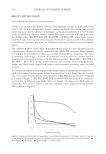
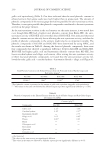
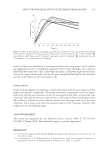
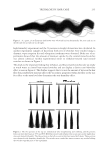
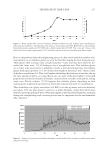
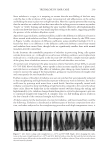
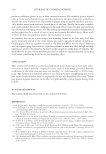
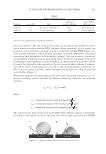
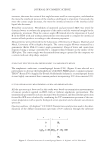
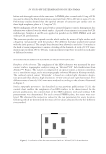
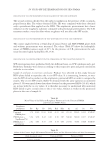
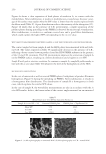
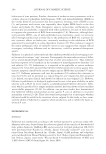
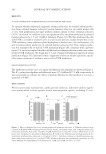
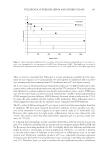
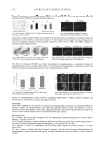
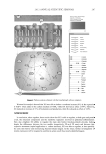
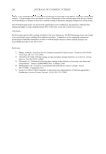
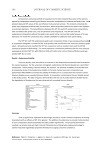
JOURNAL OF COSMETIC SCIENCE 234 MATERIALS AND METHODS Trehalose was purchased from Sigma Aldrich. Dark brown European hair with a waviness number of 6 was used in the experiments (Figure 1). In a typical experiment, hair was washed with base wash (12/1.6 of sodium laureth ether sulfate / cocoamidopropyl betaine) and when dry either soaked in or dosed with a solution of trehalose. Control switches were treated with an equal amount of water. Hair switches were straightened using GHD straighteners (Leeds, UK, BD20 0ES). Each switch was clamped to a stand, and with one hand a comb was slowly run through the switch while the iron held by the other hand followed the comb straightening the switch. After four passes of the iron, each switch was further combed fi ve times. In one set of experiments at high humidity, the treated switches were placed in a humidity chamber, the conditions were set to 30°C and 80% RH for three hours, and pictures were captured at regular intervals. From the pictures and in-house software the “volume” of the switches was measured from the projected area of the switch silhouette. In another set of experiments switches were styled in a climatic room whose environmental conditions (temperature and humidity) could be altered and pictures obtained. Adsorption isotherms were studied using a dynamic vapor sorption (DVS) kit by Surface Measurement Systems (SMS, UK, HA0 4PE). Powder x-ray studies were contracted out to Intertek, UK. Trehalose glass was made from a solution of trehalose dihydrate using a Buchi spray dryer (Buchi UK Ltd., Oldham, OL9 9QL). RESULTS AND DISCUSSION HUMIDITY CHAMBER EXPERIMENTS Dark brown EU wavy #6 switches (as shown in Figure 1), treated with 2% trehalose solution and straightened using hot irons in the laboratory at conditions of 23°C and 40% RH, showed that straight style could be sustained at high humidity (80% RH and 30°C) even after three hours (Figure 2). While control switches fl uffed up to an area of ~14000 mm2, from a starting point of ~5000 mm2, trehalose- and heat-treated switches attained a fi nal area of only ~7000 mm2. This striking longevity benefi t could only be obtained with trehalose and heat, i.e., switches straightened with hot irons without trehalose treatment did not show any anti-humidity benefi t and those not straightened with hot irons but were trehalose-treated did show some but not the pronounced anti-humidity benefi t seen here. ADSORPTION ISOTHERMS AND POWDER X-RAY STUDIES As increase in moisture content in hair fi bers at high humidity and consequent plasticiza- tion of the hair is implicated in the loss of hair style, the fi rst experimental check that was performed was to ascertain the amount of water taken up in the control and trehalose- treated (and ironed) switches. Two types of experiments were performed. In one a large batch of control and trehalose-heated switches was carefully weighed before and after the

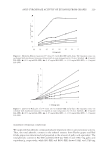
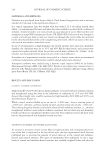
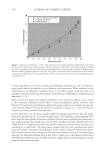
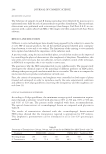
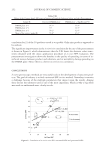
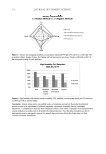
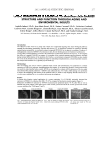
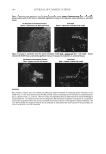
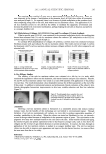
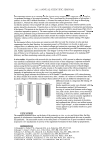
TREHALOSE IN HAIR CARE 235 Figure 1. A 2-gram, 25-cm European dark brown wavy #6 switch laid out horizontally. The root ends are on the left and the tip ends are on the right. high-humidity experiment and the % increase in weight of moisture was calculated. In another experiment samples of hair from both sets of switches were studied using a dynamic vapor sorption kit and adsorption isotherms were obtained. Both sets of ex- periments showed that the amount of moisture uptake by the control ironed switches was almost identical (within experimental error) to trehalose-treated (and ironed) switches as shown in Figure 3. This leads to the important fi nding that trehalose- and heat-treated switches take up nearly as much water as control heat-treated switches and yet display a distinct anti-humidity effect as seen in Figure 2. This further suggests that it is not the amount of water in the hair fi ber but possibly how moisture affects the viscoelastic properties within the fi ber or the sur- face effect at the array level that determines the anti-humidity effect. Figure 2. The two pictures at the top are immediately after straightening and combing, and the pictures below are after three hours at 30°C and 80% RH. Hair treated with trehalose (the two pictures on the right) show clear anti-humidity benefi ts. The two pictures on the left are control switches treated with water. These pictures were obtained in the humidity chamber kit. The switches were combed fi ve times to remove any residue holding the switches together prior to the experiment.
Purchased for the exclusive use of nofirst nolast (unknown)
From: SCC Media Library & Resource Center (library.scconline.org)