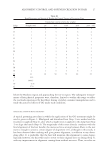
JOURNAL OF COSMETIC SCIENCE 22 for several hours before use. All samples were individually tagged with small pieces of electrical insulation tape and numbered with waterproof marker pen before being treated by placing the samples of each set (untreated control, control treatment, GG treatment N = 10 per set) in a shallow glass dish and covering with 20 ml of the relevant solution. After treatment for 30 min at 40°C, the samples were rinsed with deionized water for 30 s and air dried at 20°C/20% RH for at least 36 h. Before the perception evaluation, the tress was treated by immersion in an excess of the GG treatment for 30 min at 40°C, rinsed with deionized water for 30 s, and then air dried at 20°C/20% RH for at least 36 h. SOFTNESS PERCEPTION EVALUATIONS Fifteen experienced researchers were chosen as panelists for evaluating the softness of six tresses containing samples of the virgin straight and naturally curly Japanese hair. Mean curl radii of both types of hair were estimated by measurements on 100 randomly drawn fi bers from each initial tress. Curl radius was measured by placing the hair on a template of accurately drawn concentric circles of known radii. The straight hair showed a mean curl radius of 56.6 ± 22.0 mm, whereas for the curly hair the mean radius was 21.7 ± 17.9 mm, a statisti- cally meaningful difference at the 99% confi dence level (as determined by the Student’s t-test). For the perception test, the curly hair content of each tress was 0%, 2%, 5%, 10%, and 20%, by weight. A second tress containing 20% curly hair, by weight, was prepared and treated with an excess of the GG treatment as described earlier. Each tress weighed 5 g. The panelists were blindfolded and were asked to handle each tress and arrange in order in terms of softness. The order provided by each panelist was recorded and converted into a six-point scale, according to the frequency with which each tress was positioned. Each panelist was individually interviewed and asked to describe how they felt softness when touching their hair. Their comments were recorded, and then frequently occurring key points were extracted. EVALUATION OF THE STRESS REQUIRED TO STRAIGHTEN UNRULY HAIR The maximum load required to straighten an unruly tress during typical fi nger combing and teasing motions, such as would be performed by consumers when assessing the state Table I Treatment Compositions Ingredient Composition/wt (%) Control formulation GG formulation Lactic acid 4 4 Benzyl alcohol 1 1 GG 0 2 Deionized water Balance Balance pH To 3.7 To 3.7

ALIGNMENT CONTROL AND SOFTNESS CREATION IN HAIR 23 of their hair, was estimated. Several small unruly tresses, consisting of 150 hair fi bers each, collected from the virgin curly tress of a Japanese female, were attached to a force meter and the maximum loads achieved during fi nger combing and bunching of the tresses were measured these loads corresponded to the points where the tresses were just straightened and aligned. The maximum loads achieved were then converted to approxi- mate values of load per fi ber. STRESS RELAXATION MEASUREMENTS Stress relaxation measurements were carried out on a KES-G1-SH tensile tester (Kato Tech Co. Ltd., Kyoto, Japan) in the stress relaxation mode. Damaged curly hair samples of 60 mm in length were taken from the tip part and set individually in the removable clips of the instrument to give a test length of 50 mm. The test apparatus consisted of a 1000-ml glass beaker lined with two overlapping 150-mm-diameter fi lter papers (Whatman International Ltd., Maidstone, England). These papers were thoroughly wetted with deionized water dispensed from a squeezy bottle 30 min before the ex- periment was started. Deionized water (200 ml) was then maintained in the beaker at all times to ensure that the fi lter papers remained damp and to maintain a relative hu- midity of above 95% within the beaker. A two-piece lid was fabricated from thin plas- tic sheet so as to form a tight fi t around the arms of the tensile tester when in place. The beaker was raised around the sample area and the lid was carefully placed so as to form a tight fi t around the arms of the tensile tester, but without touching the moving sample arm. This arrangement kept the mounted fi ber centered in the beaker. The relative humidity conditions within the beaker apparatus were monitored with a Testo 635 handheld digital temperature and humidity probe (Testo AG, Lenzkirch, Germany). After an equilibration time of 5 min, a slight strain (typically 5% of the fi nal extended load) was applied to remove the crimp and straighten the sample. This equilibration time was also observed after the fi bers were treated with the relevant solutions. A strain of 0.5% was then applied to the sample at a rate of 0.01 mm s−1, and the stress relaxation was measured over a 20-min period. Data were collected via a personal computer and exported as a comma separated values (.csv) fi le that could be opened by any common spreadsheet and graphing software. Due to the small extensions used in these experiments, it was possible to test each sample before and after treatment, thereby lowering uncertainty and minimizing the sample numbers. It also negated the need to measure the fi ber diameters because the same fi ber could be followed throughout. It was assumed that the swelling of the fi ber due to the treatment was negligible. ASSESSMENT OF INITIAL MODULUS To obtain the initial modulus of hair in the low strain regions, stress versus strain mea- surements were carried out on a KES-G1-SH tensile tester (Kato Tech. Ltd., Kyoto, Japan) in the stress–strain mode. Measurements were performed on 50-mm-long hair under 20% relative humidity conditions, using a strain of 0.25% and a strain rate of 0.01 mm s−1.
Purchased for the exclusive use of nofirst nolast (unknown)
From: SCC Media Library & Resource Center (library.scconline.org)