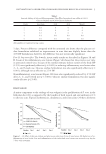
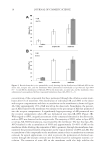
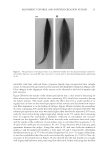
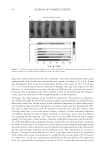
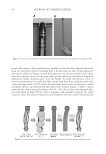
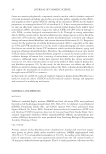
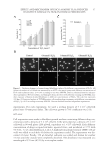
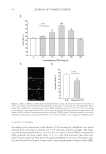
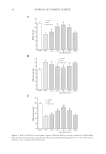
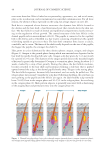
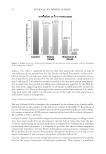
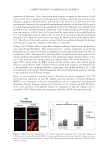
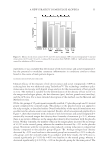
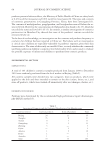
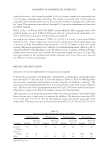
JOURNAL OF COSMETIC SCIENCE 26 shape was indeed adjusted by the GG treatment. Curl radii measurements were again implemented, this time for the treated hair, and a mean curl radius of 33.3 ± 23.8 mm was determined. This value was intermediate between the values of 56.6 ± 22.0 and 21.7 ± 17.9 mm measured for the curl radii of straight and curly hair, respectively. The difference in curl radius between the curly hair and GG-treated curly hair was found to be statistically meaningful at the 99% confi dence level (as determined by the Student’s t-test), again an indication of the straightening effect of the treatment. To deepen the understanding of the mechanism behind the improvement in alignment and softness brought about by GG treatment, physical measurements on individual hair fi bers were carried out. In this regard, it was considered important to connect the percep- tion of softness experienced by consumers to a realistic stress range for measurement. The fi rst step in doing this was to ask the panelists to describe how they felt softness when touching their hair, in an open answer format. Analysis of their responses identifi ed “smoothness during touching or fi nger combing” as dominant, with “ease of combing/ less snagging during combing” and “less bounce or stress when I hold or bend” judged equally in second place. These answers, therefore, highlighted alignment and the fl exibil- ity of the hair fi ber itself as important factors, respectively, and indicated that consumers are aware of such points. To estimate the load required to just straighten and align unruly and curly tresses, a force meter was used to monitor the loads experienced by such tresses during typical fi nger combing and bunching actions. This arrangement is shown in Figure 3. A range of values between 0.3 and 5 g per fi ber were recorded. In correlation with simple stress–strain measurements on single hair fi bers under high ( 95%) humid- ity con ditions, carried out in preliminary experiments (data not shown), this upper load limit of 5 g was found to correspond to strains of 0.5%, a value that was estimated to be Figure 2. (A) Tresses, made from straight tresses with additions of varying levels of unruly hair, used for softness evaluation, and (B) softness evaluation results for these tresses.

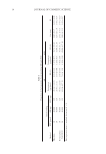
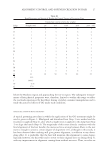
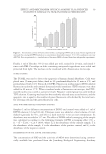
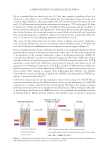
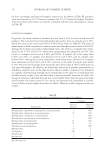
ALIGNMENT CONTROL AND SOFTNESS CREATION IN HAIR 27 below the Hookean region and approaching the toe-in region. The subsequent measure- ments of hair physical properties were, therefore, limited to within this range to refl ect the real loads experienced by hair fi bers during everyday consumer manipulation and to study the perceived effects of GG under such conditions. STRESS RELAXATION MEASUREMENTS A typical grooming procedure in which the application of the GG treatment might be used is given in Figure 4. Misaligned and disordered hair (Step 1) are washed and the treatment is applied (Step 2), after which a slight stress is applied to the damp hair (Step 3) to align the bunch (Step 4). The magnitude of this stress directly correlates with the fi nal alignment of the hair bundle the meniscus force arising between fi bers in the wet state is enough to attain a certain degree of alignment (11), although in this study, it has been observed that combing will give greater alignment, in addition to any detan- gling effect. It is preferable that the hair will maintain this alignment to some degree typically, however, the hair will tend to revert to their original state on drying (Step 5), with any improvement in alignment coming from residual water set. Thus, to realize an Table III Rank Responses and Statistical Results for Control Tresses in Perception Tests Judge Unruly hair content of tress (by weight) Straight (0%) 2% 5% 10% 20% 20% + GG A 1 2 5 4 6 3 B 1 2 3 5 6 4 C 1 2 3 4 6 5 D 2 1 3 5 6 4 E 1 2 3 5 6 4 F 1 4 2 6 5 3 G 1 3 4 5 6 2 H 1 2 3 6 5 4 I 1 3 4 5 6 2 J 2 1 3 5 6 4 K 1 2 5 4 6 3 L 1 3 2 6 4 5 M 2 1 3 6 4 5 N 2 1 5 4 6 3 Ri 21 30 50 75 84 55 52.5 S 3009.5 W 0.76 χ2 57.0 R
Purchased for the exclusive use of nofirst nolast (unknown)
From: SCC Media Library & Resource Center (library.scconline.org)